Party districts in Budapest: where to drink, dance and stay safe

Where is the nightlife district in Budapest?
The main nightlife hub is District VII (Erzsébetváros) in Pest, centred on Kazinczy utca and the Jewish Quarter. District VI (Terézváros) around Andrássy út has cocktail bars and the opera district. District V inner city has more upmarket bars. The Buda side is quieter but has riverside venues on Batthyány tér.
How Budapest’s nightlife geography works
Budapest splits into Buda (west bank) and Pest (east bank), joined by several bridges. Nightlife is almost entirely on the Pest side, concentrated in Districts V, VI, and VII. The Buda side has a few excellent venues but is much quieter after midnight.
Understanding which district you’re in helps you navigate: each district has a Roman numeral prefix, and Budapest addresses always include it (e.g., “VII. Kazinczy utca 14” means District VII).
| Main hub | District VII (Erzsébetváros), Kazinczy utca |
| Getting there | Metro M2 to Blaha Lujza tér, tram 4/6 |
| Avoid drinking on | Váci utca (District V), 2–3× standard prices |
| Main scam zone | Around Deák tér (konzumlány) |
| Best for locals | Ráday utca, Bartók Béla út, Margit körút |
District VII (Erzsébetváros): the ruin-bar capital
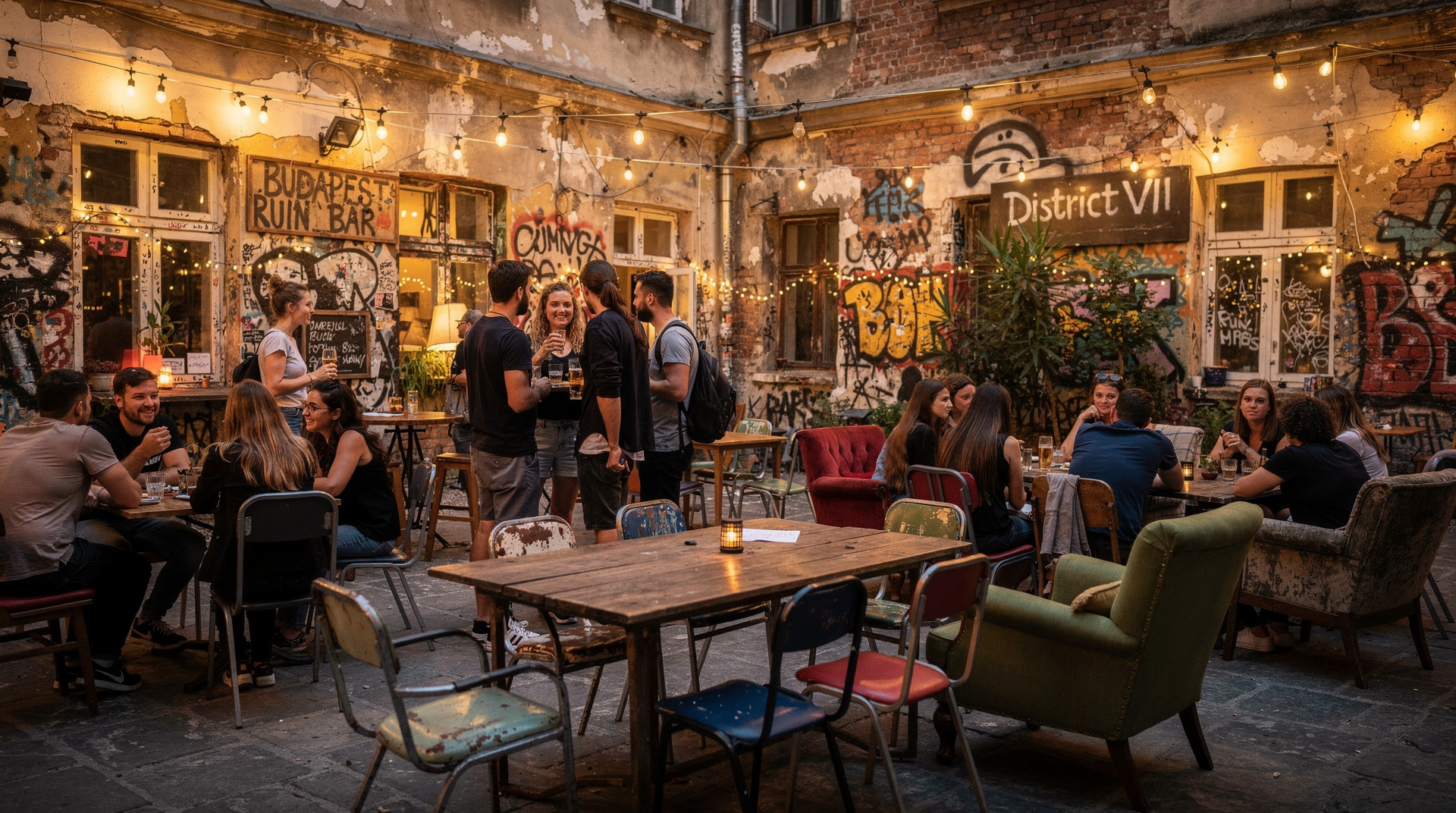
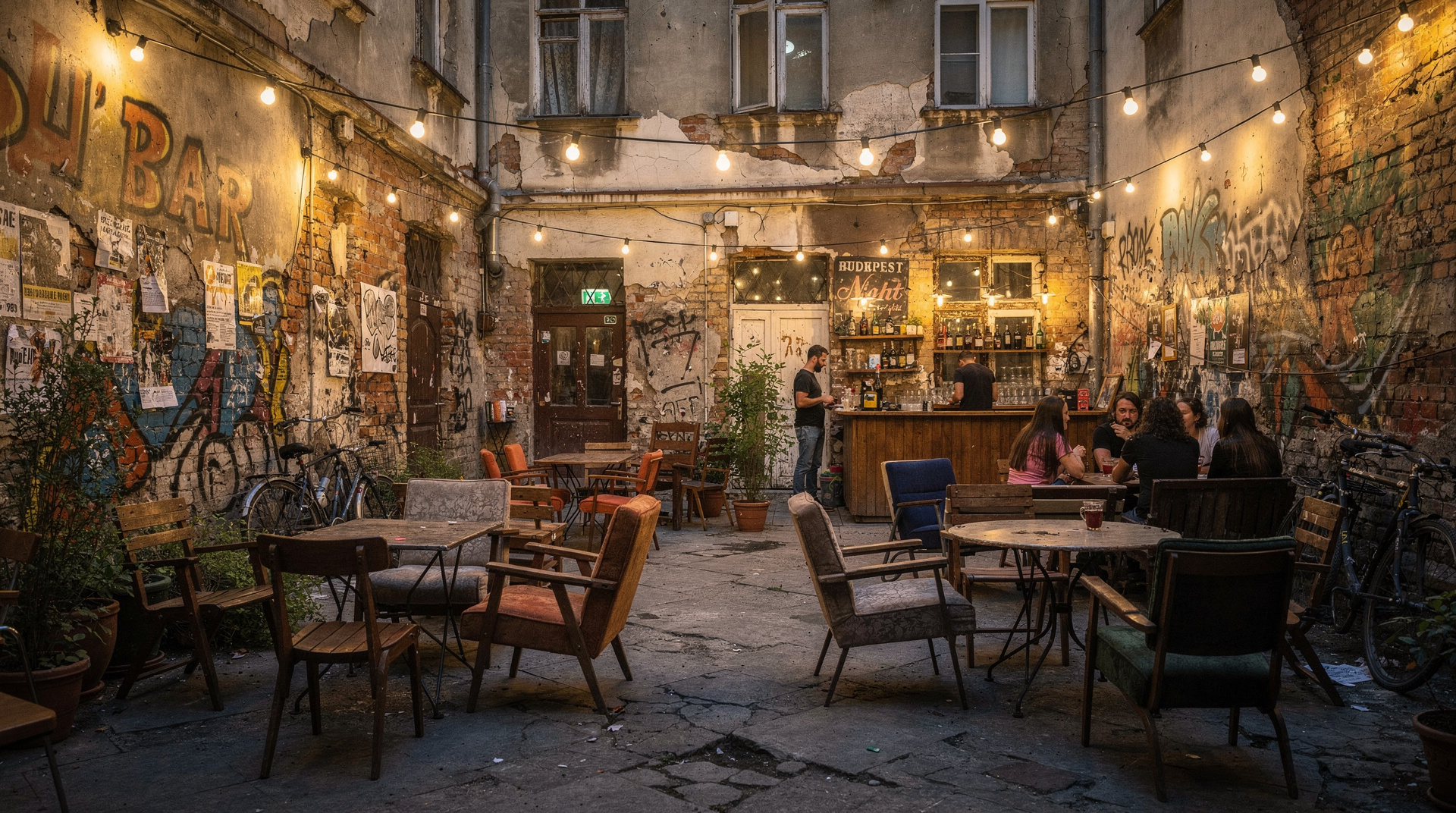
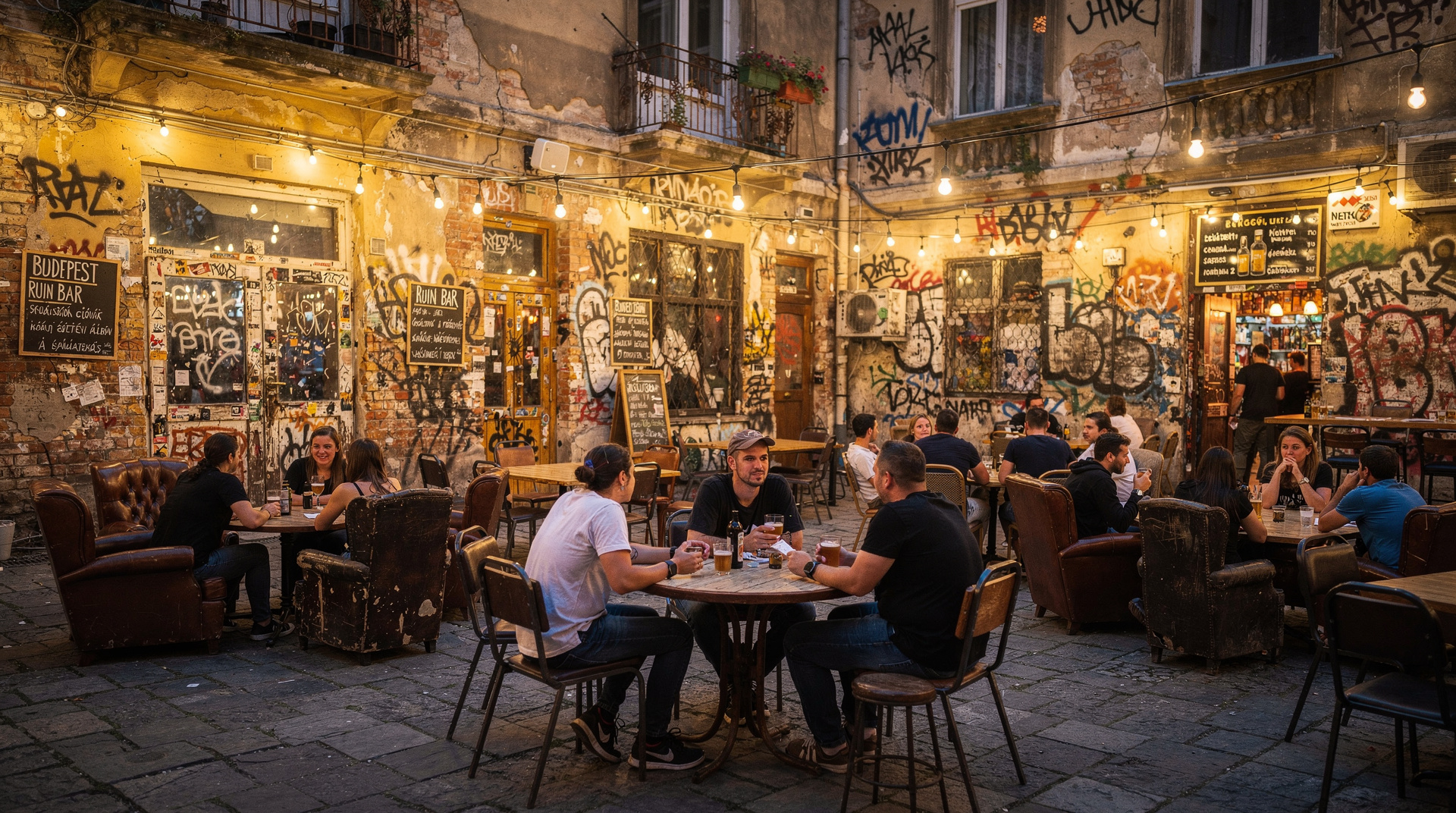
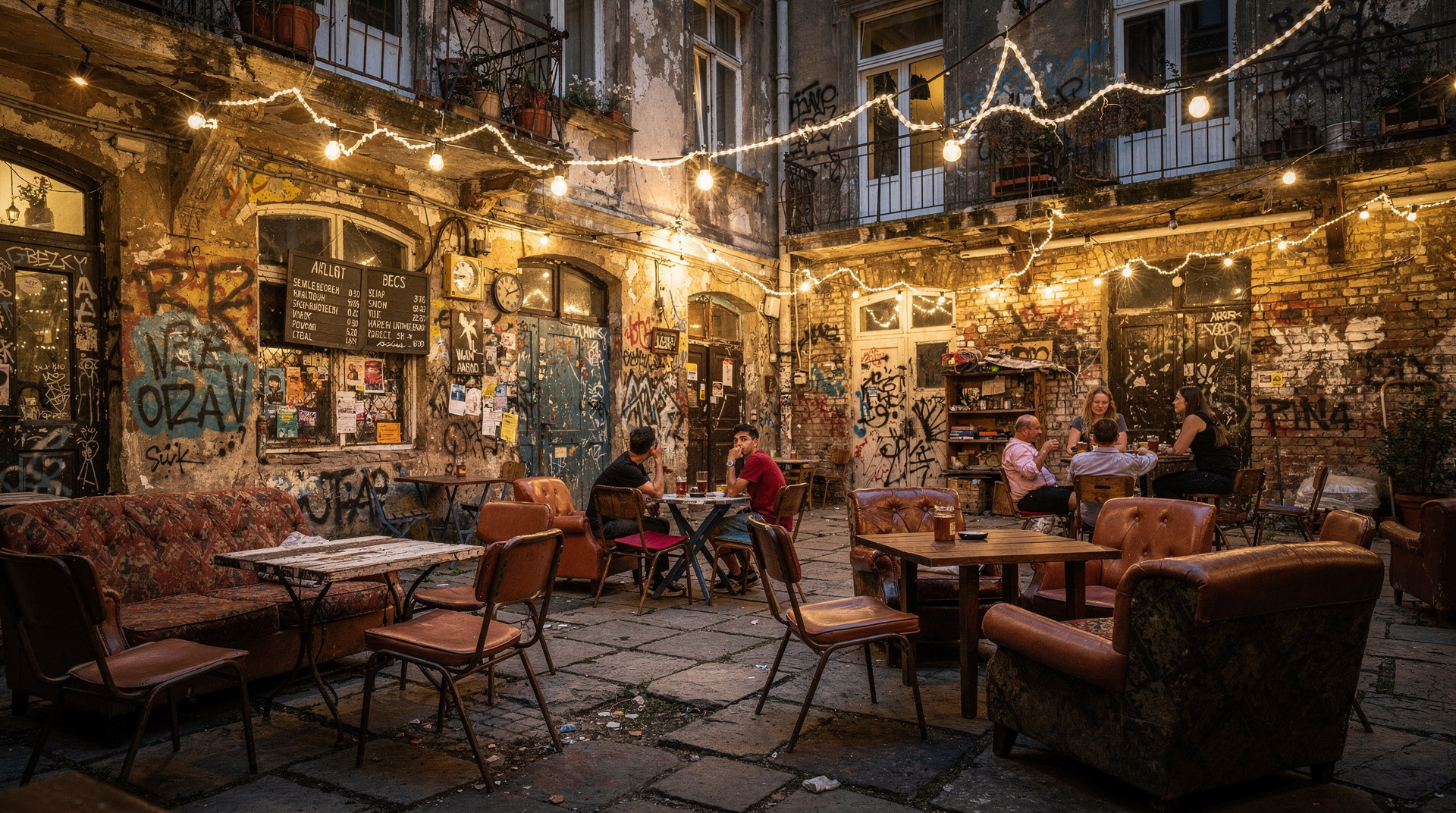
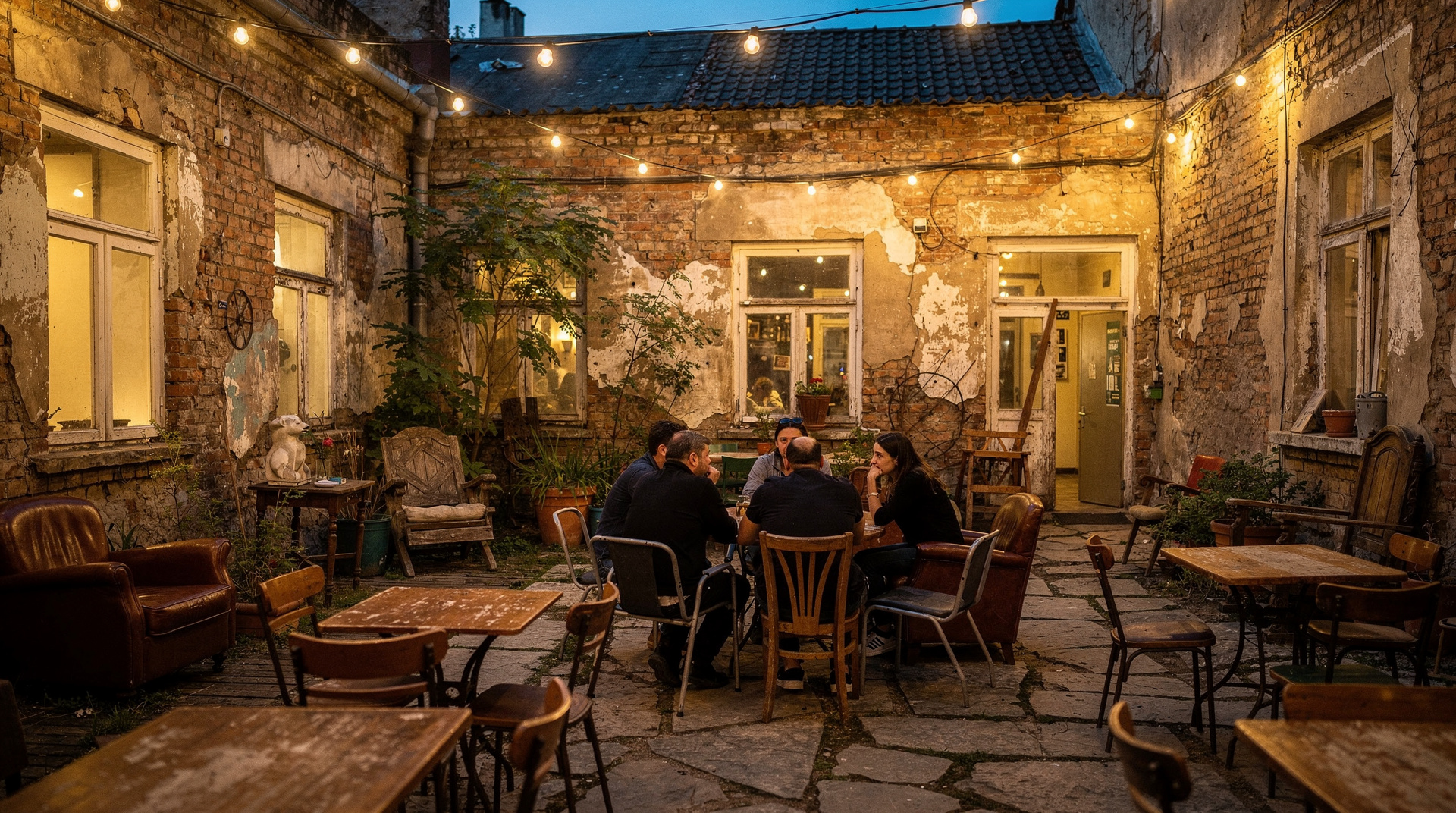
The undisputed centre of Budapest nightlife, District VII holds the highest density of bars, clubs, and ruin bars in the city. The core of the district overlaps with the historic Jewish Quarter — an area of former Habsburg-era apartment buildings, many of which were abandoned or derelict after World War II and the communist era, and which became the setting for the ruin-bar movement.
Key streets:
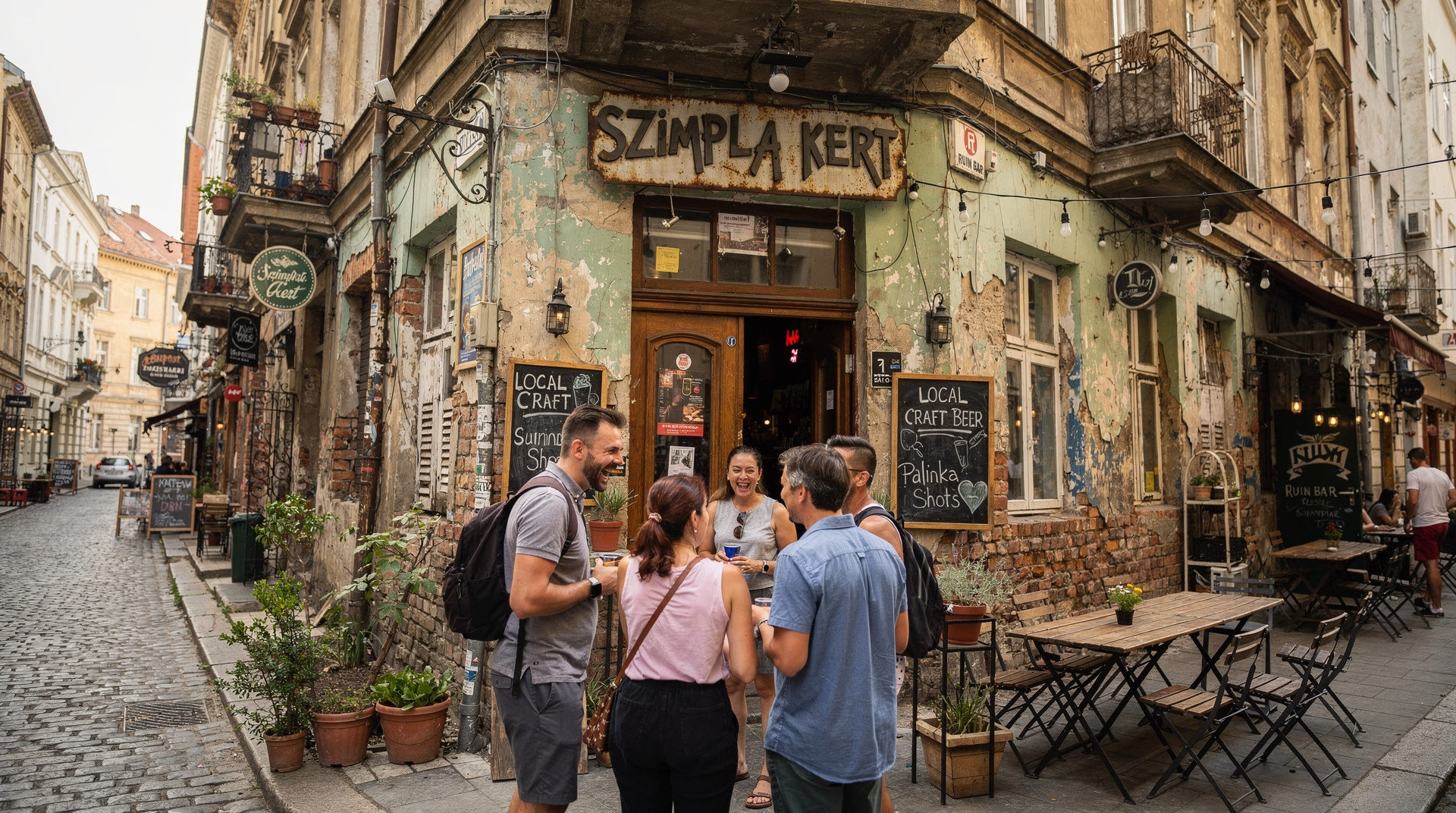
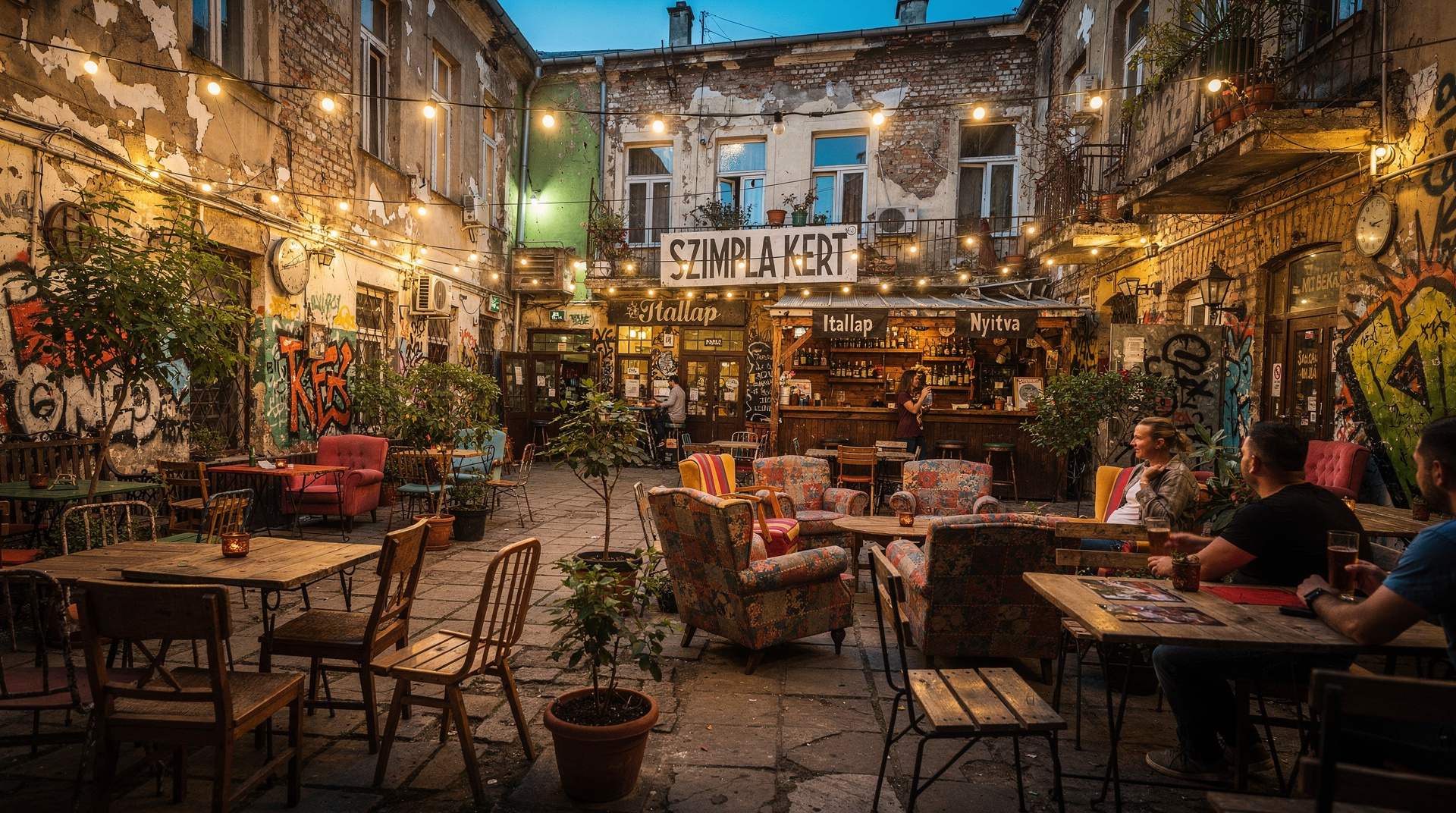
- Kazinczy utca: Home to Szimpla Kert (no. 14), Kőleves (no. 41), Ellátó Kert (no. 48)
- Akácfa utca: Instant–Fogas (no. 51), Mazel Tov (no. 47), several smaller bars
- Dob utca: Quieter alternative bars and restaurants; Macesz Bistro at no. 26
- Klauzál tér: The central square of the Jewish Quarter; outdoor café seating in summer
- Rumbach utca: Border of the tourist core; lower prices, more mixed clientele
Getting there: Metro M2 to Blaha Lujza tér; tram 4/6 to Wesselényi utca or Blaha Lujza tér.
A guided party-district bar hop with 2-hour unlimited drinks covers the main venues with a host managing logistics — useful for larger groups who don’t want to navigate independently.
District VI (Terézváros): cocktail bars and the opera district
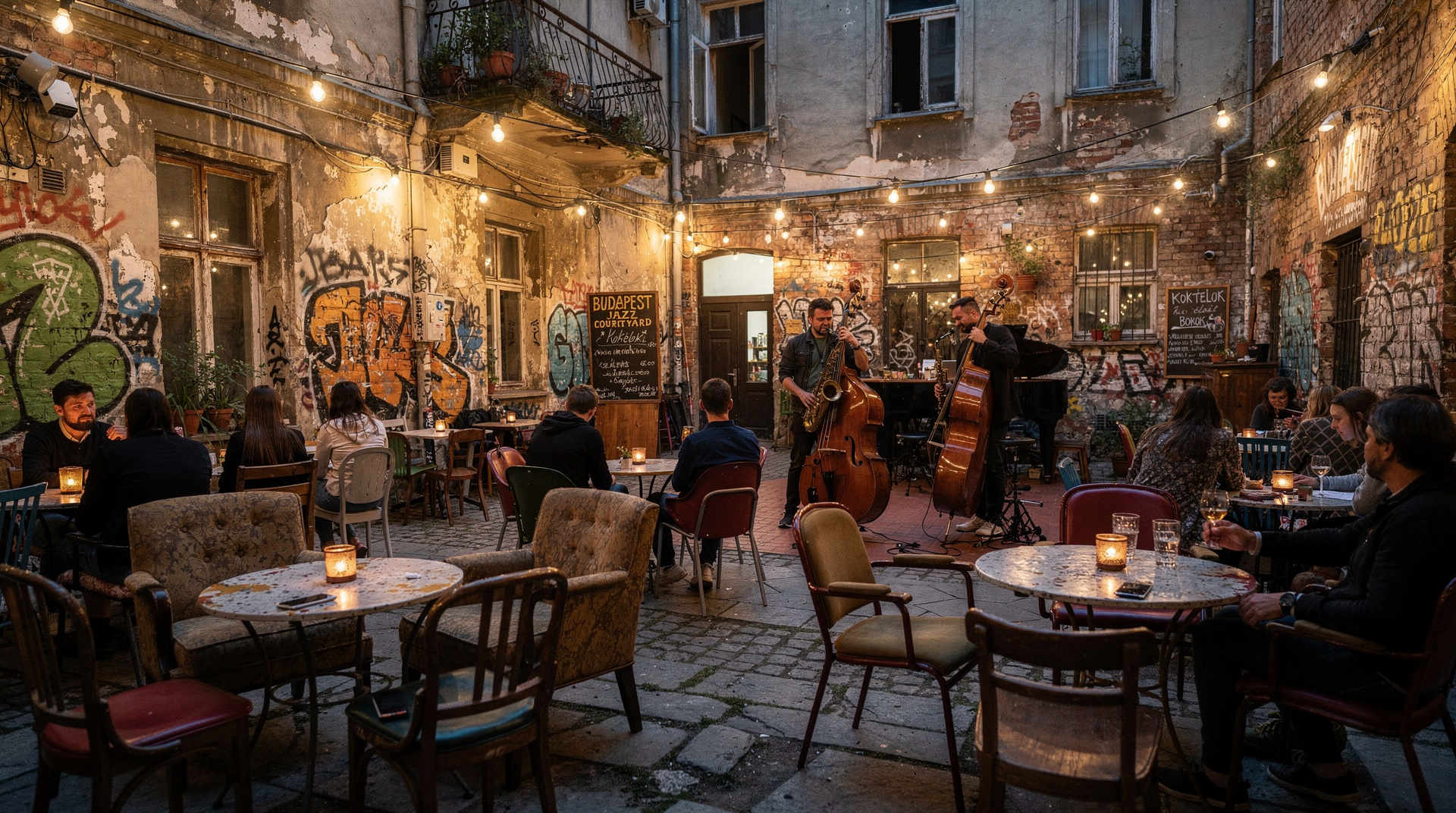
North of District VII, District VI runs along the UNESCO-listed Andrássy út boulevard. The nightlife here is more upmarket — cocktail bars, jazz venues, and the area around the Hungarian State Opera (Andrássy út 22).
Notable venues:
- Blue Fox (Hajós utca 22) — jazz bar near the opera; live music most evenings
- Anker’t (Paulay Ede utca 33) — large ruin-bar-style courtyard, calmer than Szimpla
- Csendes Vintage Bar (Ferenczy István utca 5) — intimate retro interior; strong cocktails
- Liszt Ferenc tér — open square lined with café-bars; packed in summer evenings; tourist-adjacent but local enough
Getting there: Metro M1 (yellow) along Andrássy út — Opera, Oktogon, and Vörösmarty utca stops.
District V (Belváros): inner-city Pest bars and the Váci utca warning
District V is the inner city — Parliament, St. Stephen’s Basilica, the Chain Bridge end of the riverfront. There are excellent bars here, but also the tourist-trap concentration around Váci utca.
Avoid: Bars and restaurants immediately on or adjacent to Váci utca. Beer at 3,000–4,000 HUF (€7.50–10) per glass, wine at 4,000+ HUF — the same drinks cost half the price in District VII. No local or longer-term visitor drinks on Váci utca in the evening.
Good in District V: The Basilica area (Október 6 utca; Divino Wine Bar at no. 20 is honest and excellent for Hungarian wine), Veres Pálné utca (a quieter bar street south of the city centre), and the riverside promenade for a casual evening beer with river views.
The Danube embankment: boat bars and riverside venues
Several floating bars and restaurant ships are moored along the Pest embankment (between Elizabeth Bridge and Chain Bridge). These range from party boats to calm riverside restaurant bars. The atmosphere is excellent on warm evenings — Parliament on the opposite bank is illuminated after sunset.
Party boat cruises depart from Vigadó tér (District V embankment) in the evenings. See the Budapest nightlife guide for details on sparties and boat parties. For sightseeing cruises paired with dining, see best Danube cruises Budapest.
The Buda side: quieter but worth knowing
Batthyány tér (District I): A small square on the Buda bank directly across from the Parliament. Several bars have outdoor seating with direct views of the illuminated Parliament — one of the best spots for a sunset drink in Budapest. Not a nightlife hub; closes early compared to Pest.
A38 Ship (District XI embankment, near Petőfi bridge): Moored on the Buda bank, A38 is a Ukrainian stone-carrying ship converted into a concert venue. It hosts the best live music in Budapest — indie, electronic, jazz, world music — and is where Hungarian musicians perform alongside international acts. See the live music and jazz guide for the full rundown.
Margit körút (District II): The street running parallel to the Danube on the Buda side has a mix of local pubs and café-bars, considerably less touristy than the Pest equivalents. Good for a quiet evening.
The konzumlány zone: where scams concentrate
The highest concentration of predatory bar scams operates around Deák tér and the streets immediately surrounding it — particularly towards Vörösmarty tér and along the Pest embankment. This is where “friendly women” approach male tourists to suggest a bar.
The scam is essentially absent in the ruin-bar district (Kazinczy utca, Akácfa utca area) — the neighbourhood has too many genuine local bars and too much nightlife competition for this tactic to work. The risk concentrates where tourists are navigating unfamiliar streets without a specific destination.
Rules: never follow a stranger to a bar, always check drink prices before ordering, walk away from any bar without a visible menu. Details in common scams in Budapest.
Where to stay if you’re prioritising nightlife
District VII itself is the obvious choice — you’re in the ruin-bar district and can walk home. Budget hostels and mid-range hotels are plentiful. District VI is also excellent — slightly calmer but walkable to everything. District V inner city puts you near the river and is 15 minutes’ walk from the bars.
Our where to stay in Budapest guide covers all districts with honest pros and cons by budget and travel type.
Getting home after a night out
Tram 4/6: Runs 24 hours along Rákóczi út and the Grand Boulevard — the most reliable late-night option. The stop nearest the ruin-bar district is Wesselényi utca or Blaha Lujza tér.
Bolt: Ride-hailing app; set it up before arriving in Budapest. A ride from the Jewish Quarter to most Pest hotels costs 2,000–3,500 HUF (€5–8.75). Do not hail street taxis in the nightlife zone — meters are often manipulated. See taxis and Bolt in Budapest.
Night buses: Budapest operates a network of night buses (éjszakai autóbusz, marked “É”) — BKK’s BudapestGO app has the full timetable.
For a Budapest 3-day itinerary that balances daytime sightseeing with evenings in the right districts, see our full itinerary guide.
The evolution of Budapest’s nightlife districts
The current geography of Budapest nightlife is not permanent. The ruin-bar district (District VII) emerged in the 2000s and was consolidated by 2010; the areas around it are shifting constantly. Understanding which direction the scene is moving helps visitors find venues that are currently interesting rather than already past their peak.
Where the scene is expanding: District VIII (Józsefváros), historically the roughest district in inner Pest, has been gentrifying steadily since 2015. The Corvin sétány area around the Corvin Mozi (cinema) has new bars and restaurants with a younger, more local crowd than the District VII ruin bars. The Palace Quarter (Palotanegyed) further east in District VIII is the next wave — currently emerging, not yet tourist-facing.
What’s become more established (and less edgy): The Kazinczy utca core — Szimpla Kert and its immediate neighbours — has stabilised into an international tourist institution. This is not a criticism of quality (the bars remain excellent) but an observation about character. Visitors who want the atmosphere the ruin bars had in 2008–2012 will find it in the peripheral parts of District VII and in District VIII rather than at the famous addresses.
The Buda side emerging: The Bartók Béla út corridor in District XI has developed significantly since 2018. New bars, independent cinemas, and creative-industry spaces have created a genuinely interesting alternative to the Pest nightlife core. Less convenient from most tourist accommodation (requires tram 47/49 from Deák tér), but more locally-feeling.
If you would rather explore the ruin-bar scene as part of an organised group instead of hunting for venues yourself, a ruin pub crawl with free VIP entry, 6 shots, games and photos is a close alternative.
A practical neighbourhood guide for first-time visitors
If you have one night: Start at Szimpla Kert (Kazinczy utca 14) between 20:00–22:00 for the introduction to the ruin-bar concept, then walk north to Instant–Fogas (Akácfa utca 51) for the club experience after midnight. This covers the essential Budapest nightlife experience in two stops. If you prefer not to plan the route yourself on a first night, a guided ruin-bar crawl through the district’s best-known venues takes care of the navigation and lets you focus on the atmosphere.
If you have two or three nights: Add Anker’t (Paulay Ede utca 33) for a calmer evening, the Batthyány tér riverside bars (Buda side) for a sunset Parliament view, and at least one boat party or sparty if you’ve pre-booked. See Budapest nightlife guide for the full framework.
If you’re specifically interested in the local scene: Use the guide to best bars for locals and target Ráday utca (District IX), Margit körút (District II), and the Bartók Béla út area (District XI).
Club comparison: what’s playing where
Budapest’s club scene has clearer genre specialisation than its ruin bars:
Electronic/house/techno: Instant–Fogas (multi-genre but strongest in electronic), Akvárium Klub (Erzsébet tér 12, District V — also hosts live music), and A38 Ship (Buda embankment). These venues host international DJs as well as Hungarian residents.
Hip-hop and R&B: Morrison’s 2 (Révay utca 25, District VI) is the most established hip-hop club in Budapest. Mixed with mainstream pop on weekends.
Alternative/indie: A38 Ship (live music focus), Dürer Kert (Ajtósi Dürer sor 19, District XIV — outdoor garden in summer), and various ruin-bar rooms on specific event nights.
Mainstream: Ötkert (Október 6 utca 1, District V), upmarket crowd, commercial music, higher entry prices (2,500–4,000 HUF on weekends). The closest thing to a “normal” European nightclub in an otherwise distinctive scene.
Entry policies and cover charges
Entry to the ruin bars (Szimpla Kert, Anker’t, Ellátó Kert) is free at all times — no cover charge, no guestlist, no dress code. Walk in, buy a drink, leave when you want.
Entry to club rooms within larger venues (Instant–Fogas after midnight, Corvintető) requires a cover charge: typically 1,500–2,500 HUF (€3.75–6.25) on weeknights, up to 3,000–4,000 HUF (€7.50–10) for major event nights.
For organised pub crawls that include VIP club entry (bypassing the queue and the cover charge), see the pub crawls Budapest guide.
Food in the nightlife district
The party district’s food scene has improved significantly in the past decade. What’s available for a pre-bar dinner or a mid-evening snack:
Pre-bar dinner: Kőleves (Kazinczy utca 41) and Macesz Bistro (Dob utca 26) are the best dinner options within the ruin-bar area. Borsodi’s at Gozsdu udvar is a casual option if you’re in a hurry.
Street food during the evening: Gozsdu udvar (the covered passage between Király utca and Dob utca) has food stalls open until midnight and beyond. The lángos stand at the south end of Kazinczy utca is usually open until 23:00 on weekends.
Post-midnight fuel: Döner kebab on Rákóczi út (multiple 24-hour shops), lángos stand near Blaha Lujza tér (until 03:00–04:00 on weekends). See late-night Budapest for the full picture.
For the food context beyond the nightlife district, see best restaurants in Budapest and street food in Budapest.
The party district accommodation question
Where you stay relative to the nightlife district significantly affects your experience. The trade-offs:
Staying in District VII (the ruin-bar district): Pros: Walk home from the bars; maximum immersion in the neighbourhood; hostels and budget hotels are plentiful and fairly priced (budget accommodation from 8,000 HUF / €20 per night in dorms, private rooms from 25,000–50,000 HUF / €62.50–125).
Cons: Noise on Friday and Saturday nights — the bars and street noise continue until 04:00–06:00. If you’re a light sleeper, you’ll need earplugs. Some streets (particularly Kazinczy utca at 02:00) are genuinely loud.
Staying in Districts V or VI: Pros: Quieter streets, more hotel options at various price points, close to parliament and inner-city sightseeing; still within 15–20 minutes’ walk of District VII.
Cons: The walk back after midnight is either on foot (safe but 20 minutes) or by Bolt (2,000–3,000 HUF / €5–7.50 each way).
Staying in Buda: Pros: Very quiet at night, good base for Buda sightseeing, Castle District accommodation is beautiful.
Cons: Crossing the river after midnight requires either the Bolt (more expensive — Buda rides cost more from the nightlife area) or tram 4/6 across the Margaret Bridge. The journey adds 20–30 minutes each way.
For accommodation guidance, see where to stay in Budapest.
The honest guide to Budapest nightlife: what it’s actually like
Budapest nightlife has developed a specific international reputation that doesn’t always match reality in both directions: some visitors arrive expecting something more extreme than they find; others arrive expecting something too tame.
It is not Amsterdam: The Hungarian government has been consistently conservative on drugs policy; drug use in nightlife venues exists but is not openly visible or tolerated in the way it is in some European cities. The nightlife is alcohol-driven.
It is not just cheap booze: The best Budapest nightlife experiences — a sparty at Széchenyi Baths, a DJ night at Instant–Fogas, a boat cruise on the Danube past the illuminated Parliament — have genuine value beyond low drink prices. The experience is memorable; the prices happen to also be reasonable.
The stag-do reputation is real but manageable: Budapest attracts thousands of stag groups annually. During summer weekends, the District VII ruin-bar district has a high proportion of stag-group participants. This creates a specific atmosphere that some visitors enjoy and others find overwhelming. Weeknight visits and shoulder-season visits have a very different crowd profile. The early hours (20:00–22:00) before the stag groups arrive are the most atmospheric for couples and independent travellers.
Safety is genuinely good: Budapest’s violent crime rate in the nightlife areas is very low by European standards. The main documented risks are financial (bar scams, taxi overcharging) rather than physical. A careful, informed visitor faces essentially no physical safety risk in the main nightlife zones.
For the complete safety picture, see is Budapest safe? and common scams in Budapest.
Combining party districts with daytime culture
Budapest’s nightlife districts overlap with some of the best daytime culture:
District VII (the ruin-bar district) sits within the Jewish Quarter, which has the Dohány Street Synagogue, the Jewish Quarter heritage district, and several excellent daytime cafés.
District VI (the opera district) has the Hungarian State Opera, the UNESCO-listed Andrássy út boulevard, and the district’s art nouveau architecture.
A day that starts with culture (morning synagogue visit, afternoon Andrássy út walk) and ends with nightlife (evening in the ruin bars, late at Instant–Fogas) is a very Budapest day — and more satisfying than treating the two as separate.
For the complete daily programme, see the Budapest 3-day itinerary and first time in Budapest.
Party districts by season
The nightlife map shifts with the seasons more than first-time visitors expect. In summer (June–August), outdoor seating dominates: ruin-bar courtyards, the Danube embankment boat bars, and rooftop spots all operate at full capacity, and District VII gets genuinely crowded by 22:00 on weekends. In shoulder season (April–May, September–October), the same venues are noticeably calmer, with outdoor seating still viable on mild evenings — this is arguably the best balance of atmosphere and comfort.
Winter (November–March) pushes activity indoors: ruin bars remain fully operational, but rooftop and boat-bar options thin out, and New Year’s Eve is the single busiest night of the entire calendar (see Budapest New Year’s Eve). Christmas market season (late November–December) adds a different, calmer evening crowd in District V around Vörösmarty tér that coexists with, rather than competes with, the District VII nightlife scene.
Districts compared at a glance
| District | Character | Noise level | Best for |
|---|---|---|---|
| VII (Erzsébetváros) | Ruin bars, dense nightlife | High until 04:00–06:00 | First-timers, maximum choice |
| VI (Terézváros) | Cocktail bars, opera district | Moderate | Upmarket evenings, jazz |
| V (Belváros) | Inner-city, riverside | Moderate, quieter after 01:00 | Sightseeing combined with drinks |
| VIII (Józsefváros, Corvin) | Gentrifying, local crowd | Moderate | Non-touristy alternative |
| II (Buda) | Riverside, Batthyány tér | Low | Sunset drinks, quiet evenings |
Frequently asked questions about Party districts in Budapest
Is it safe to walk between nightlife areas at night?
Yes. Budapest is safe to walk at night in the main nightlife zones — violent crime is very low. The main risks are pickpocketing at crowded bar entrances and the konzumlány bar scam near Deák tér. Stick to well-lit main streets (Rákóczi út, Andrássy út, Király utca). Avoid shortcuts through unlit courtyards if you're carrying valuables.What is the Váci utca trap and should I drink there?
Váci utca (District V) is the main tourist shopping street and has a cluster of bars and restaurants that typically charge 2–3× standard Budapest prices. Beer on Váci utca can cost 2,500–4,000 HUF (€6.25–10) vs. 950–1,400 HUF in the ruin-bar district. It's fine for a look during the day, but don't drink there in the evening.Are there good bars on the Buda side?
Fewer, but yes. Batthyány tér (District II) has a cluster of riverside bars with Parliament views across the Danube — excellent for a sunset drink. A38 (a converted Ukrainian stone-carrying ship moored near Petőfi híd) is Budapest's top live music venue and is on the Buda embankment. For clubs, the Pest side is significantly better.Which district has the best nightlife for locals?
Locals tend to favour the areas slightly outside the tourist core: Margit körút (District II, Buda), Ráday utca (District IX, south Pest — often called the 'street of restaurants'), and the newer bars opening on Bartók Béla út in District XI. The ruin-bar district (VII) also has genuine local regulars alongside the tourists.Is District VIII safe for nightlife?
The Corvin sétány area of District VIII has gentrified substantially since 2015 and is safe and increasingly popular for nightlife, with a younger local crowd. Parts of District VIII further from Corvin sétány remain rougher and less geared toward visitors after dark — stick to the well-lit, established bar streets rather than wandering into unfamiliar side streets.
Top experiences
Bookable activities with verified prices and instant confirmation on GetYourGuide.