Dohány Street Synagogue: visitor guide and what to know

What is the Dohány Street Synagogue and how do I visit?
The Dohány Street Synagogue in Budapest is the largest synagogue in Europe, built in 1859. You can visit independently with a ticket (around 5 000–7 000 HUF) or join a guided tour. It is closed on Saturdays. Allow 1.5–2 hours for the complex including the museum and memorial garden.
| Where | Dohány utca 2, District VII, 5 min from Astoria metro |
| Cost | Around 5,000–7,000 HUF combined ticket |
| Time needed | 1.5–2 hours independent; 2–3 hours with a historian-led tour |
| Getting there | Astoria station (M2 line); trams 47/49 on the Körút |
| Best time | Weekday mornings at opening; closed Saturdays and Jewish holidays |
Inside Europe’s largest synagogue
The façade alone stops people in the street. Two onion-domed towers in brick and terracotta rise above Dohány Street, framing a Moorish Revival entrance that looks more like a Córdoba mosque than anything you might expect on a Pest boulevard. That was the point. When the Jewish community commissioned Ludwig Förster to design this building in the 1850s, they wanted something that announced, unmistakably, that Budapest’s Jewish community had arrived — culturally, architecturally, financially.
The result is the largest synagogue in Europe: 60 metres long, 26 metres wide, seating 3 000. It opened in 1859. Franz Liszt and Camille Saint-Saëns performed on its 5 000-pipe organ. For four decades it stood as a monument to a community’s confidence in its place in Hungarian society.
Then 1944 happened.
This guide tells you what to see, how to visit, and how to understand what you are looking at.
The building: what to notice
The exterior follows Moorish Revival conventions: horseshoe arches, geometric tilework, striped brick banding. The twin towers are topped with gilded cupolas. Look at the Hebrew inscription above the main entrance portal — it reads “Make me a sanctuary, and I will dwell among them” (Exodus 25:8).
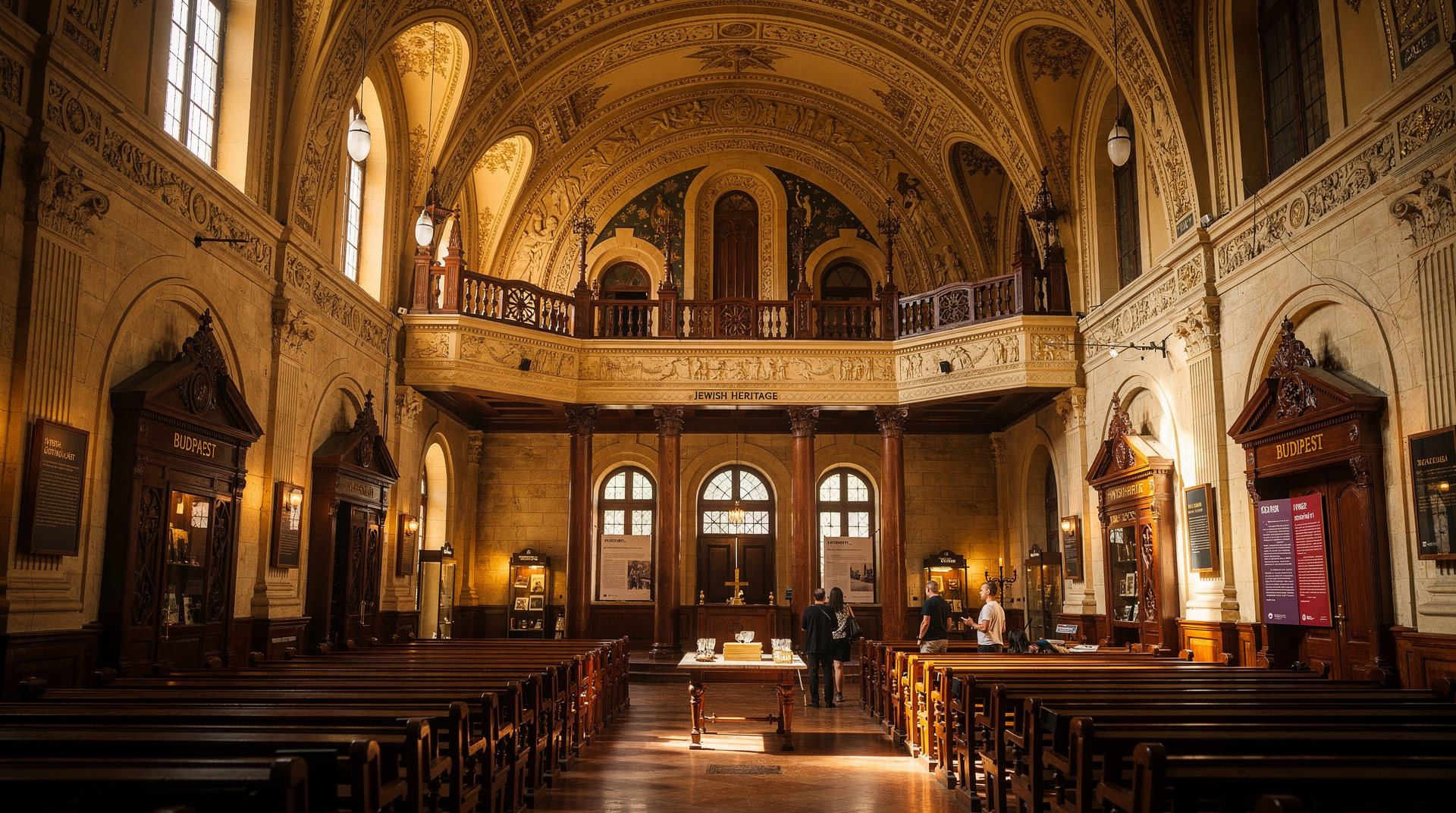
Inside, the scale is immediately apparent. The nave rises 14 metres under a coffered ceiling that seems to float. The gilded gallery, reserved historically for women, runs around three sides. The bimah (the central platform from which the Torah is read) sits in the centre of the nave rather than at the east wall — a characteristic of neolog (Hungarian reform) practice that distinguished this congregation from orthodox communities.
The organ, rebuilt after wartime damage, is one of the largest in Hungary. The ark housing the Torah scrolls is set into the eastern wall under an elaborate canopy. The stained glass windows — some original, some restored — filter soft light across the interior.
During World War II, the building served as a stable and radio station. The Nazis stripped decorative elements and damaged the structure. Significant restoration began in the 1990s, funded by the Hungarian government and by the Emanuel Foundation, co-chaired by Tony Curtis (whose parents were Hungarian Jewish immigrants).
The Hungarian Jewish Museum
The museum occupies a purpose-built wing adjoining the synagogue, erected in 1930–31 on the supposed site of Theodor Herzl’s birthplace (a plaque marks the spot on the exterior). The collection spans two millennia of Jewish life in Hungary.
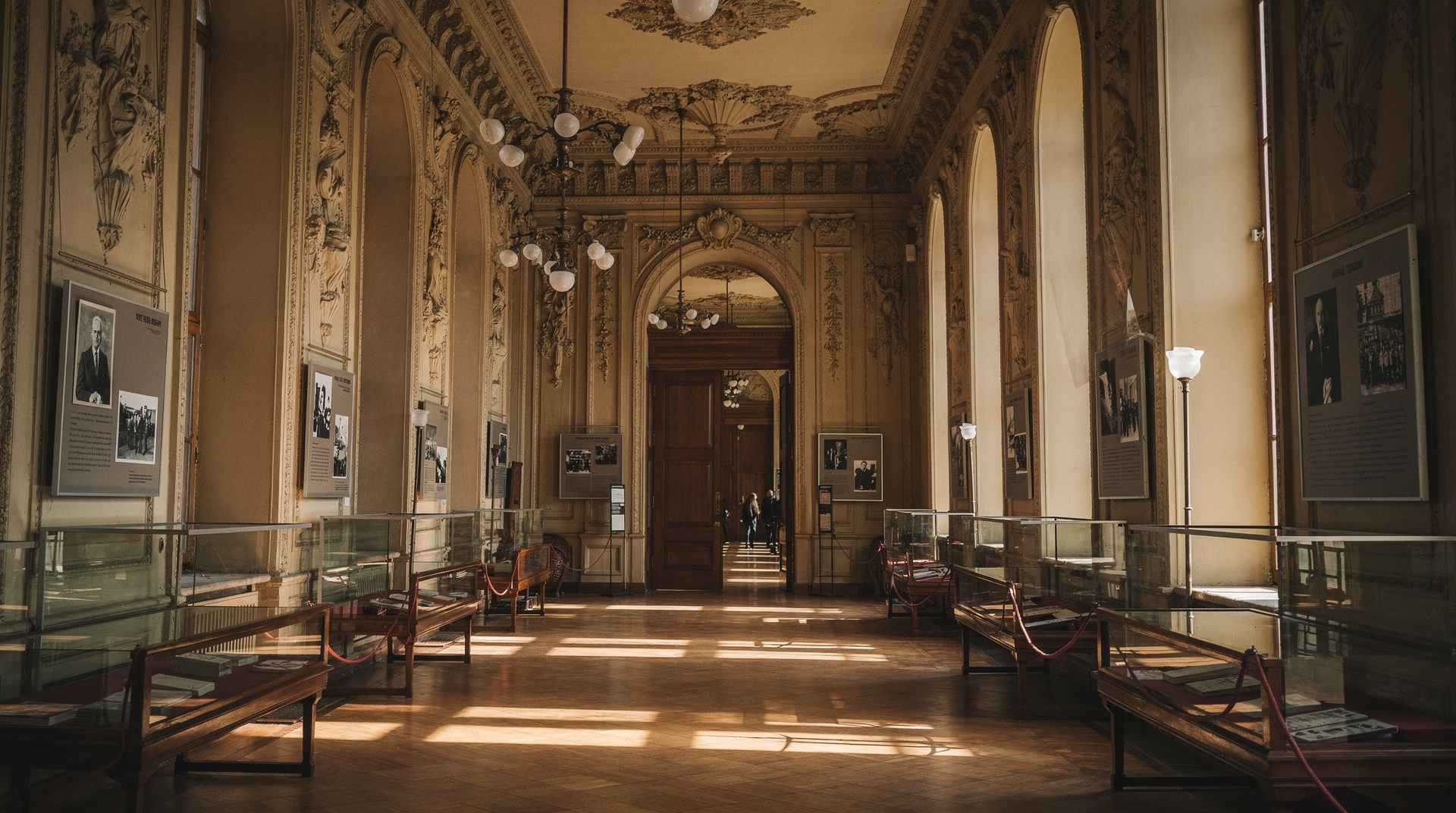
Ground floor: medieval gravestones from the old Óbuda Jewish cemetery, ceremonial objects (menorahs, seder plates, Torah ornaments), and documents tracing Jewish settlement patterns across Hungary’s regions. The objects are beautiful in isolation; the museum succeeds best in showing the breadth and depth of Jewish cultural life in Hungary before the 20th century.
Upper floor: the Holocaust room. Documents, photographs, transport lists. A section dedicated to Raoul Wallenberg and Carl Lutz, whose Swiss protective letters saved additional thousands alongside Wallenberg’s Swedish passports. The display is restrained but the content is not. Allow 30–45 minutes here.
The Raoul Wallenberg Memorial Garden
The courtyard behind the synagogue is where the visit changes register entirely.
During the siege of Budapest in late 1944 and early January 1945, the ghetto’s death rate outpaced the capacity to transport bodies. Around 2 000 people — many of whom had died of disease and starvation rather than direct violence — were buried in mass graves in this courtyard. After the war, survivors and the community debated what to do with the space. The graves were left in place, and the courtyard was transformed into a memorial garden.
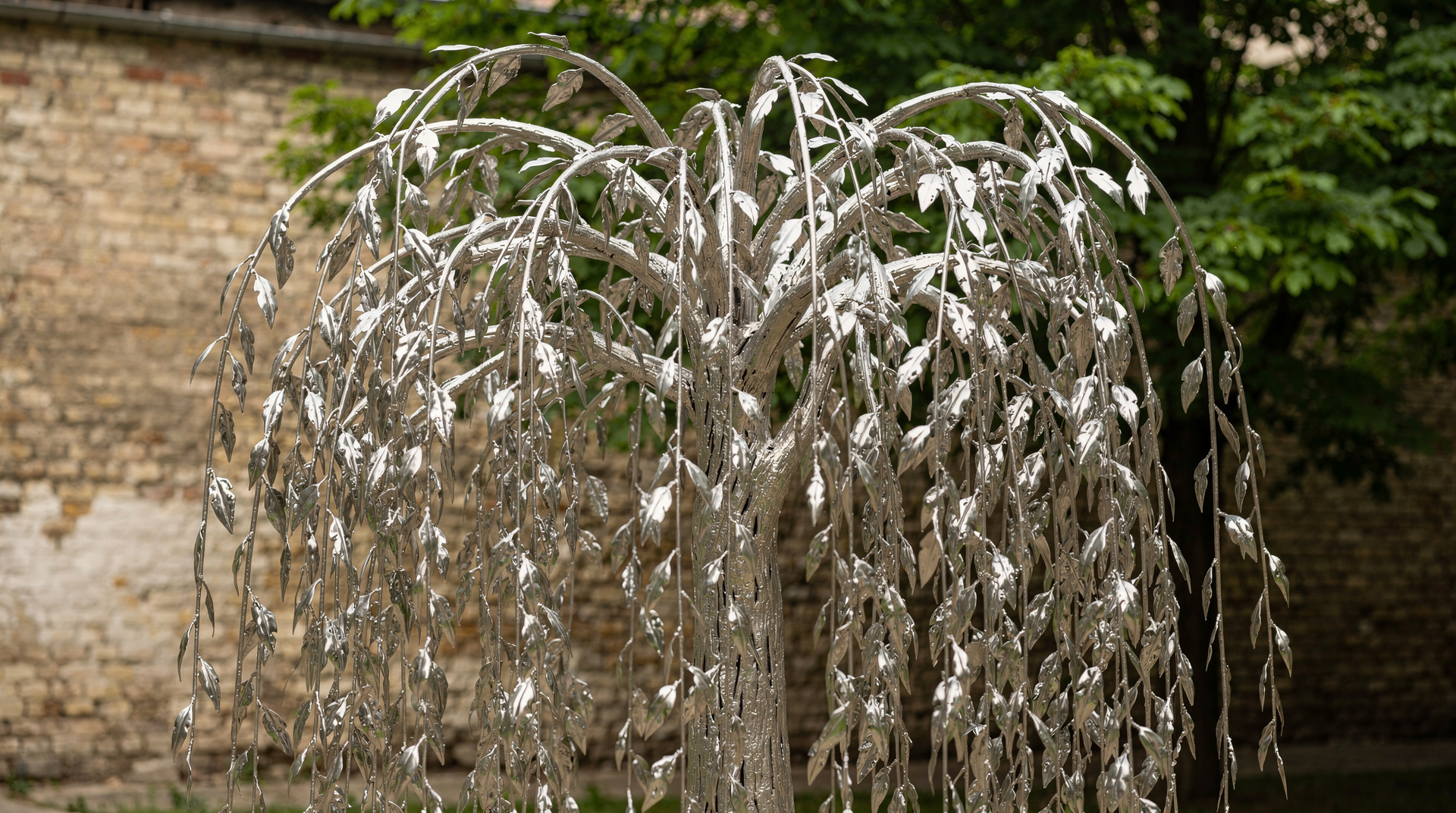
The Emanuel Tree stands at the centre. Imre Varga, the Hungarian sculptor best known for his Wallenberg memorials across Europe, designed a weeping willow in metal — the drooping branches evoking mourning, the form evoking the biblical Tree of Life. Each leaf carries a name. Families continue to send names; new leaves are added. Standing next to it, you realise the leaves are dense — thousands of them — and that each one represents a specific person.
The Wallenberg Memorial, a relief portrait by sculptor Pál Pátzay, stands at the garden entrance. Wallenberg arrived in Budapest in July 1944 as a Swedish diplomat; he issued Schutzpässe (Swedish protective passports) that had no legal validity but were honoured by nervous Hungarian authorities in the chaos of late 1944. He also established Swedish “safe houses” across the city. Estimates of how many people he saved range from 15 000 to 100 000 depending on methodology; the lower end is documented, the higher plausible.
Soviet forces arrested Wallenberg on 17 January 1945. He was taken to Moscow and never released. A Soviet statement in 1957 claimed he had died of a heart attack in Lubyanka Prison in 1947, but the timing, the cause and the circumstances have never been credibly established. The Russian government has never fully opened its files.
Heroes’ Temple
The third building in the complex is the Heroes’ Temple (Hősök temploma), built in 1931 as a memorial to the 10 000 Hungarian Jews who died in World War I fighting for Hungary. The irony — and tragedy — of this dedication haunts the space. Men who died for the Hungarian state saw their families deported by that state thirteen years later. The temple now hosts smaller religious services and occasional events.
How to plan your visit
Independent visit: Budget 1.5–2 hours. Buy the combined ticket at the entrance (synagogue + museum + garden + Heroes’ Temple). Audio guides are available in multiple languages. Saturdays and Jewish holidays are closed.
Guided tour: A tour led by a specialist — particularly one with historian credentials — adds substantially to the experience. The Jewish Quarter walking tour with synagogue entry pairs the interior visit with a walk through the surrounding streets, covering the ghetto boundary, the Kazinczy Street Orthodox Synagogue, and the Rumbach Street Synagogue.
For visitors who want the most rigorous historical experience, the Jewish history guided walk with a historian covers the district with archival-level depth, including documents and photographs not available in the museum.
Timing: Arrive early morning (opening time) on a weekday for the quietest experience. July and August afternoons are the most crowded. The late afternoon light — particularly in summer when the sun angles onto the façade around 17:00–18:00 — is the most photogenic.
What to skip: Resellers outside the entrance offering “skip the line” packages are unnecessary. The queue on normal weekday mornings is short. Buy at the official desk.
Getting there
The synagogue is on Dohány Street (Dohány utca 2), a five-minute walk from Astoria metro station (M2 line, red line). Trams 47 and 49 stop nearby on the Körút. It is walkable from the downtown Pest area in about 10–15 minutes.
What to do nearby
After the synagogue, the Jewish Quarter itself rewards a slow walk. Kazinczy Street has the Orthodox synagogue (with kosher restaurant), the Rumbach Sebestyén Street Synagogue (1872, designed by Otto Wagner), and Szimpla Kert, the original ruin bar.
For historical continuation, the House of Terror on Andrássy Boulevard is a 20-minute walk north. It covers the Hungarian state’s role in both the Nazi and Soviet periods, making it a natural companion to the Jewish Quarter visit. The best museums in Budapest guide ranks the full range of options across the city.
The Jewish quarter heritage guide goes deeper on the neighbourhood’s history and the ruin bar scene. The free walking tours Budapest guide lists tip-based tours that depart from the synagogue entrance daily. For a full cultural day, combine the synagogue in the morning with the Hungarian history primer framework and an evening at one of the nearby ruin bars — a pairing that captures the district’s extraordinary contradictions.
Fitting the synagogue into a wider Budapest itinerary
The synagogue sits at the edge of District VII, the Jewish Quarter, so most visitors treat it as the anchor for a morning that continues into the neighbourhood’s streets and courtyards — the transition from the Memorial Garden’s quiet weight to Kazinczy utca’s bars and street art is one of the more striking contrasts a single Budapest neighbourhood offers, and it’s worth pausing for a coffee somewhere between the two rather than moving straight from one register to the other.
If you’re building a longer history-focused day, pairing this visit with Communist Budapest sites gives a fuller picture of the 20th century here — occupation followed by occupation. For a first-time visitor slotting this into a short trip, the synagogue fits naturally into the morning of Day 2 on the Budapest 3-day itinerary, and the wider Budapest travel guide has the full framework for sequencing museums, history, and lighter activities across a stay.
Before you go in: setting the right frame of mind
This is not a monument you tick off between a coffee and a bath. Visitors who arrive straight from the thermal pools or a hangover-soft night in the ruin bars often find the shift in tone abrupt. If you can, give yourself a quiet half hour beforehand, ideally somewhere other than the pavement outside. Reading a little of the Hungarian history primer the evening before makes the museum labels land harder, because the names and dates stop being abstract.
Bring a small bag, or none at all. Security at the entrance is part of the visit, and a lighter load keeps the queue moving for everyone. Phones and cameras are best kept for the exterior and the courtyard approach; inside, follow whatever signs and staff tell you on the day, since rules on photography can change with services and events.
Etiquette inside and around the complex
The synagogue is still used by a living congregation, which shapes the atmosphere. Speak quietly, walk slowly, and do not step into areas that are roped off. Children are welcome, but older ones will get far more from the visit if a parent explains in advance what happened in the ghetto; the Budapest with kids guide has wider thoughts on judging what a family is ready for.
In the Memorial Garden, avoid treating the graves as a backdrop. Photographs of the Emanuel Tree are common, but posed portraits and selfies sit badly in a place where people are buried beneath the grass. If you want a record of the visit, take a wide shot of the willow and leave it there.
Choosing between independent and guided
Going alone suits people who read quickly, like to linger, and already know the outline of 1944. A guide suits those who want the human stories behind the objects, or who feel uneasy navigating the museum’s Holocaust room without someone to talk it through afterwards. Many visitors do both over a longer stay: the museum alone one morning, then a walk through the surrounding streets with a guide another day.
If you prefer a longer, slower format, the half-day Jewish heritage tour gives the district more room than a standard walk. For a shorter guided option, the past and present Jewish district walk introduces the neighbourhood, and you can then decide whether to buy the interior ticket separately. Our best walking tours in Budapest comparison shows how these formats differ in pace and depth.
Combining the visit with food and a rest
After a heavy morning, a proper break matters. The streets around the synagogue have plenty of options, from traditional Hungarian cooking to modern kitchens; the traditional Hungarian dishes guide will help you order with confidence, and the coffee houses in Budapest guide covers the places where sitting for an hour is the whole point. If you would rather have something quick, street food in Budapest is within easy reach.
For vegetarians, or visitors who keep kosher, planning the meal ahead is wise; see vegetarian and vegan Budapest for ideas, and check opening days, since many kosher places keep their own Shabbat schedule.
Reading the neighbourhood afterwards
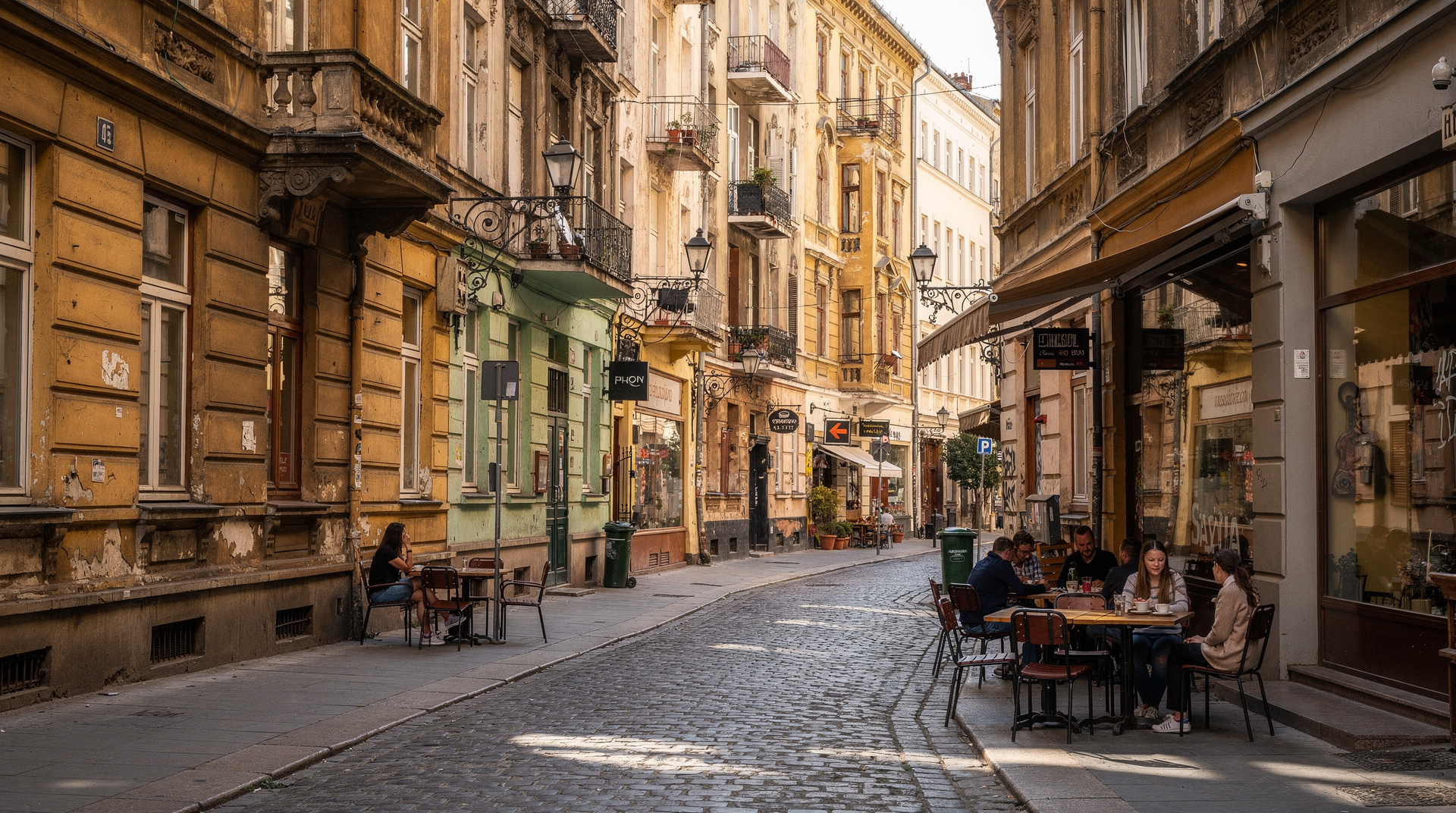
Once you leave the complex, the streets themselves become part of the story. The ghetto was not a distant place with a fence around it; it was a set of ordinary apartment blocks, courtyards and shopfronts that people still live and work in today. Walking past them with the museum fresh in your mind changes how the quarter reads. The Budapest neighbourhoods guide shows how District VII sits alongside the rest of Pest, and the Buda vs Pest comparison explains why this side of the river feels so different from the castle hill.
If the visit leaves you wanting a more personal act of remembrance, the Shoes on the Danube memorial on the river bank is a natural next stop, and it connects directly to the events you have just learned about.
Fitting it into your trip
On a short stay, the synagogue works best placed early, when your energy is highest, with lighter plans afterwards. The Budapest weekend break itinerary and the Budapest 2 days plan both leave room for a morning like this. For a slower pace, the first-timer highlights route spaces out the heavier sites. Travellers planning around the calendar can also check best time to visit Budapest, since the festival and holiday calendar can affect which days the complex is open.
Frequently asked questions about Dohány Street Synagogue
How much does entry to the Dohány Street Synagogue cost?
A combined ticket covering the synagogue, the Hungarian Jewish Museum, the Raoul Wallenberg Memorial Garden and the Heroes' Temple costs approximately 5 000–7 000 HUF (€12–18) depending on the package. Guided tour add-ons cost more. Buy directly at the entrance to avoid reseller premiums.Is the Dohány Synagogue open on weekends?
It is open on Sundays but closed every Saturday (Shabbat) and on major Jewish holidays. Opening hours vary by season — typically longer in summer (until 18:00 or later) and shorter in winter. Always check the current schedule on the official website before visiting.Is a guided tour of the Dohány Synagogue worth it?
Yes, for most visitors. The building's architectural details are readable without a guide, but the story of the ghetto, the mass graves in the garden, and the community's history before and after the war requires context that plaques alone do not provide. A historian-led tour takes approximately two to three hours and covers all the key sites in the district.What is in the Raoul Wallenberg Memorial Garden?
The garden behind the synagogue occupies the former ghetto courtyard where around 2 000 people were buried in mass graves during the winter of 1944–45. The graves remain beneath the garden. The Emanuel Tree, a metal weeping willow sculpture by Imre Varga, stands at the centre; its leaves bear the names of Holocaust victims. The garden is open during synagogue hours and included in the ticket.What should I wear to visit the Dohány Synagogue?
Dress modestly — shoulders and knees covered for all visitors. Men must cover their heads inside the synagogue; kippot are provided free of charge at the entrance. This is an active place of worship, not only a tourist site, so respectful dress is both required and appropriate.How does the Dohány Synagogue visit fit with the rest of the Jewish Quarter?
It works best as the anchor for a morning in District VII: start at the synagogue and Memorial Garden, then walk the surrounding streets to see the Rumbach Synagogue and Kazinczy's Orthodox synagogue, before continuing into the ruin bar streets for the afternoon or evening. See the District VII guide for the fuller neighbourhood walk.
Top experiences
Bookable activities with verified prices and instant confirmation on GetYourGuide.