Best ruin bars in Budapest: the honest guide to rom kocsmák

What are the best ruin bars in Budapest?
Szimpla Kert (Kazinczy utca 14) is the most famous ruin bar and still one of the best. For multi-room clubbing, Instant–Fogas (Akácfa utca 51) is the biggest venue. Anker't (Paulay Ede utca 33) is calmer and better for conversation. All are in District VII within 10 minutes' walk of each other.
What makes Budapest’s ruin bars unique in Europe
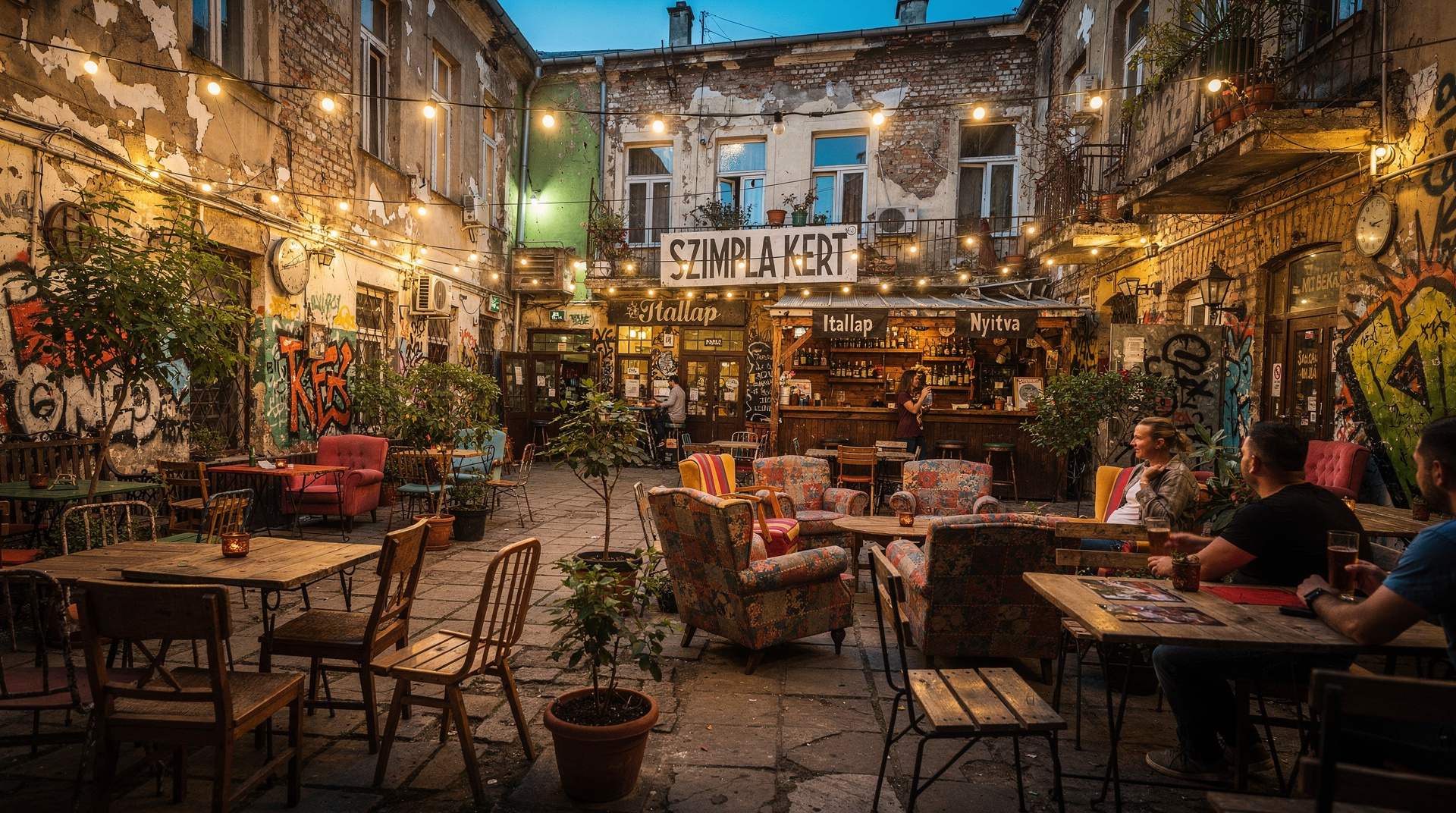
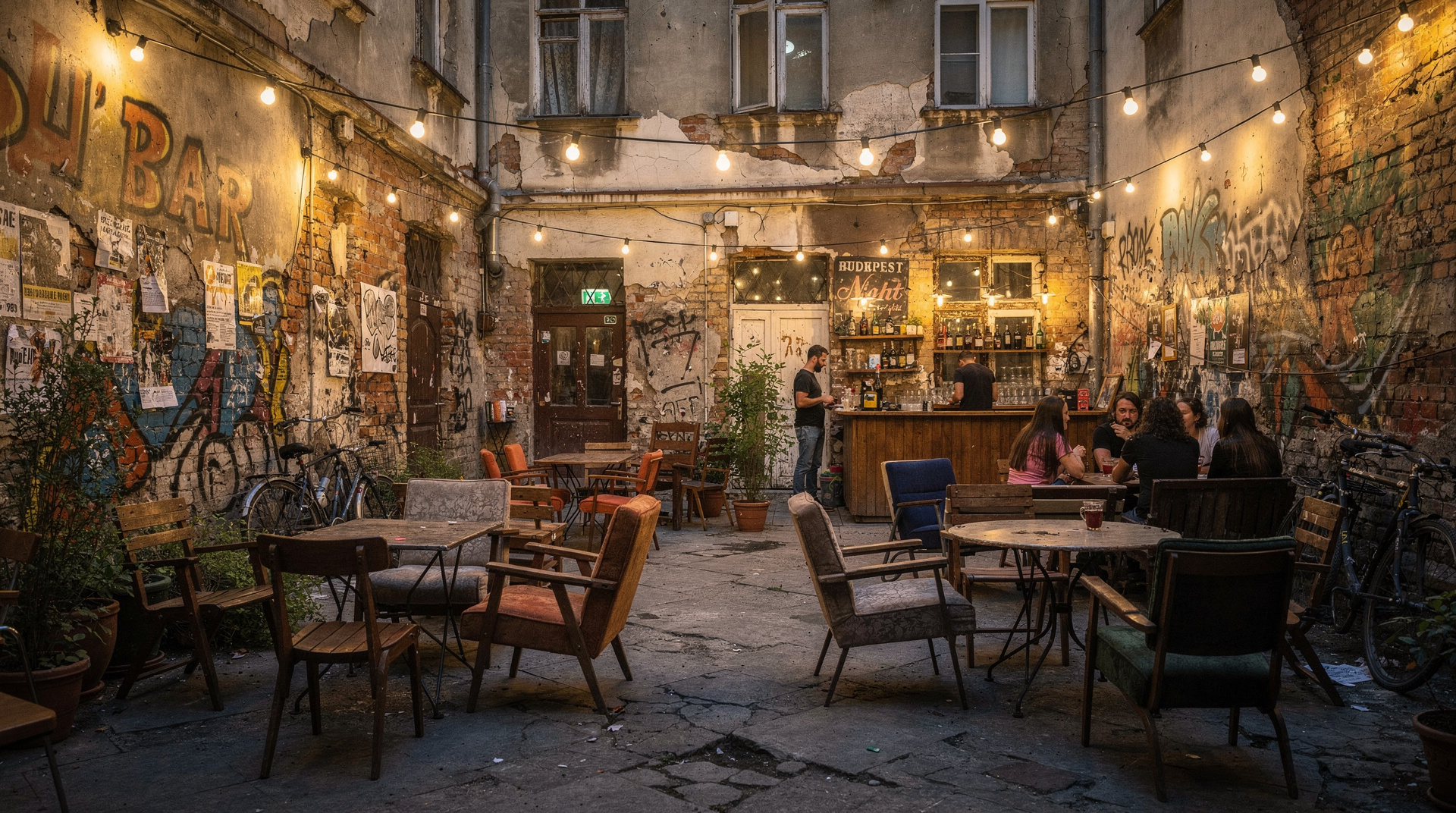
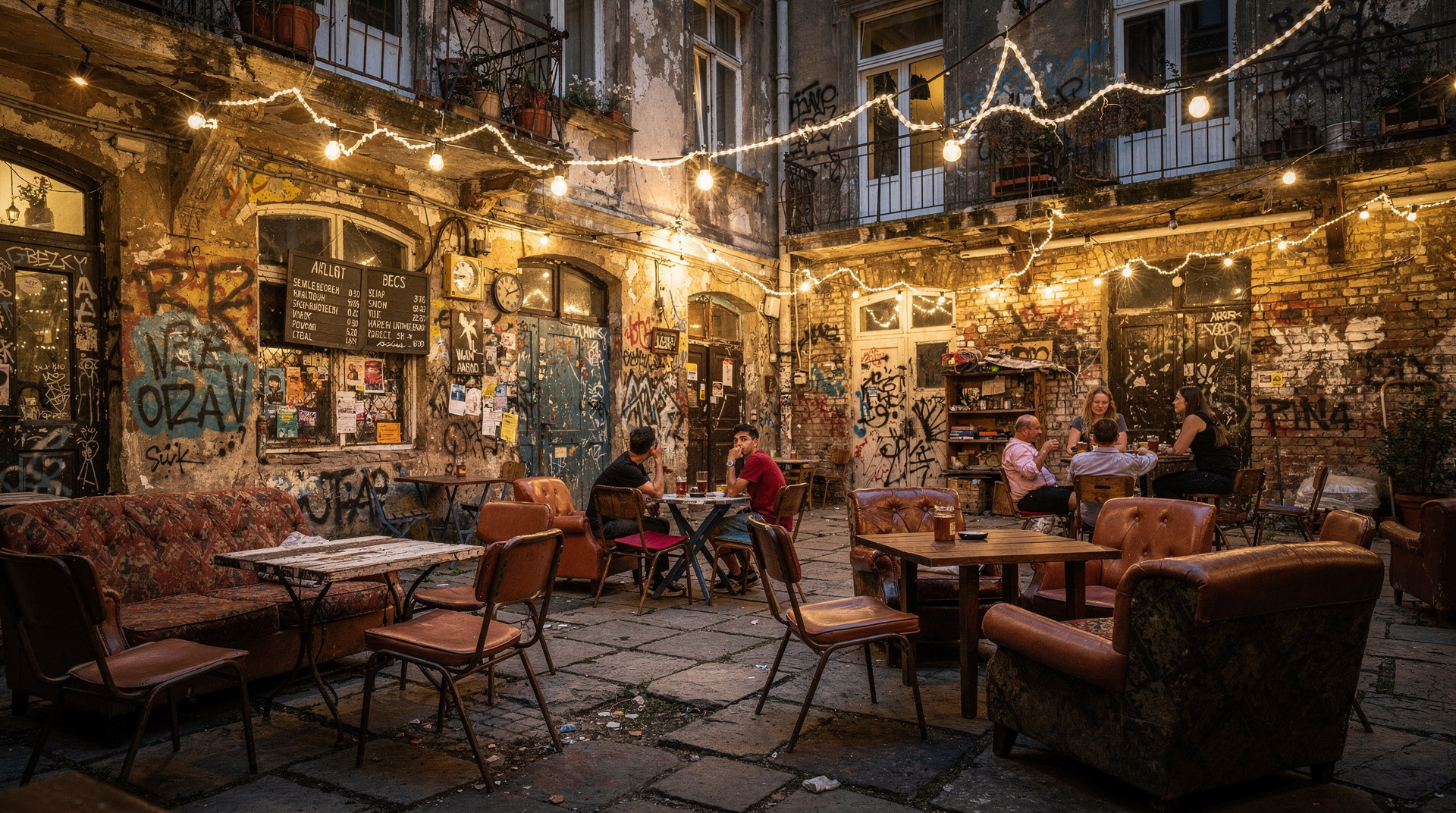
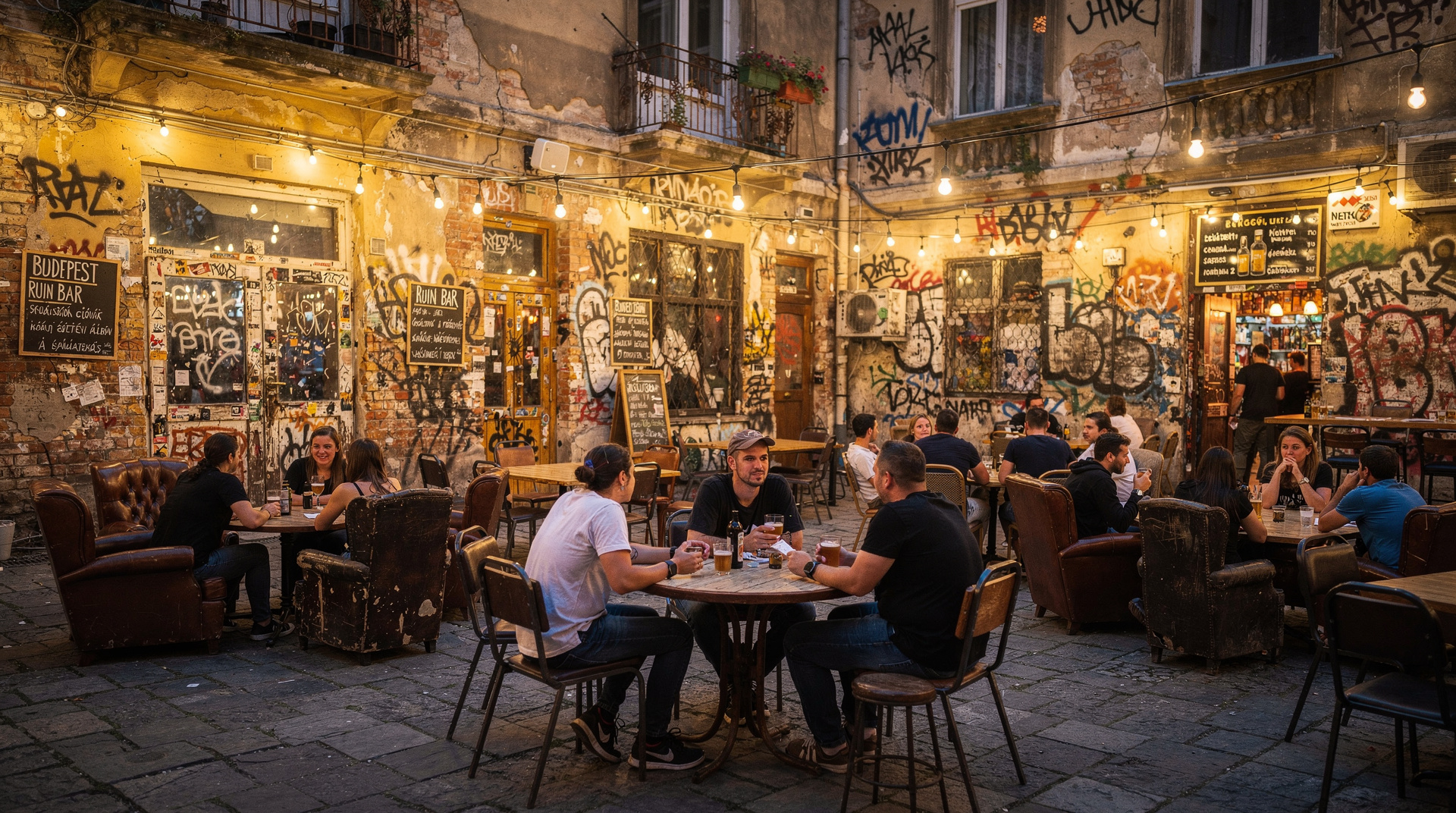
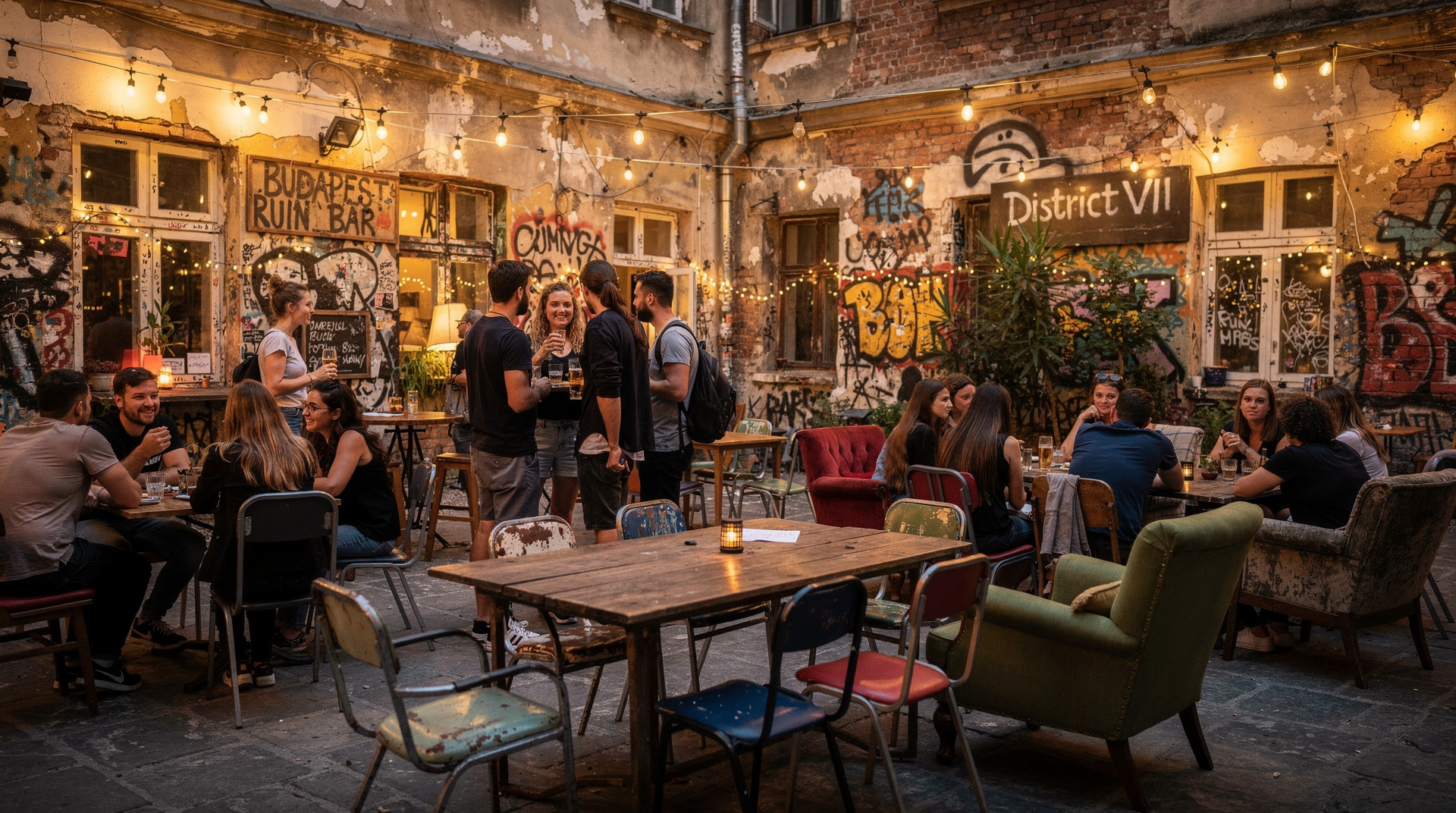
Walk through Kazinczy utca in District VII on any evening and you’ll understand why Budapest’s ruin bars have been written about in every major travel publication on earth. A gap in the terraced housing reveals a courtyard: exposed brick walls hung with vintage signs, string lights over mismatched garden furniture, a bar serving draught beer for €2.50, a DJ setting up in the far corner, and perhaps 200 people of a dozen nationalities sharing communal tables.
This happened because of history. After World War II and four decades of state socialism, many buildings in the former Jewish Quarter were left to decay. In 2002, a group called Szimpla opened the first ruin bar in a condemned building on Kertész utca. The concept — cheap rent, anarchic décor, no investment in fittings — spread rapidly. A few buildings were eventually demolished; others, including Szimpla Kert, stayed and became Budapest landmarks.
Today the ruin-bar district is also one of the city’s best bar-hopping areas, with everything from serious cocktail bars to underground clubs within a 15-minute walk.
| Where | District VII, mostly around Kazinczy utca |
| Beer | Around 900–1,600 HUF at reputable venues |
| Best time | Weekday evenings or Sunday afternoon for calm; Fri/Sat 22:00+ for peak energy |
| Getting there | Metro M2 to Blaha Lujza tér; tram 4/6 |
| Watch for | The konzumlány scam near Deák tér and Váci utca — not inside the district itself |
Szimpla Kert: the original and still essential
Kazinczy utca 14, District VII
Open daily 12:00–04:00 (shorter hours on some weekday mornings).
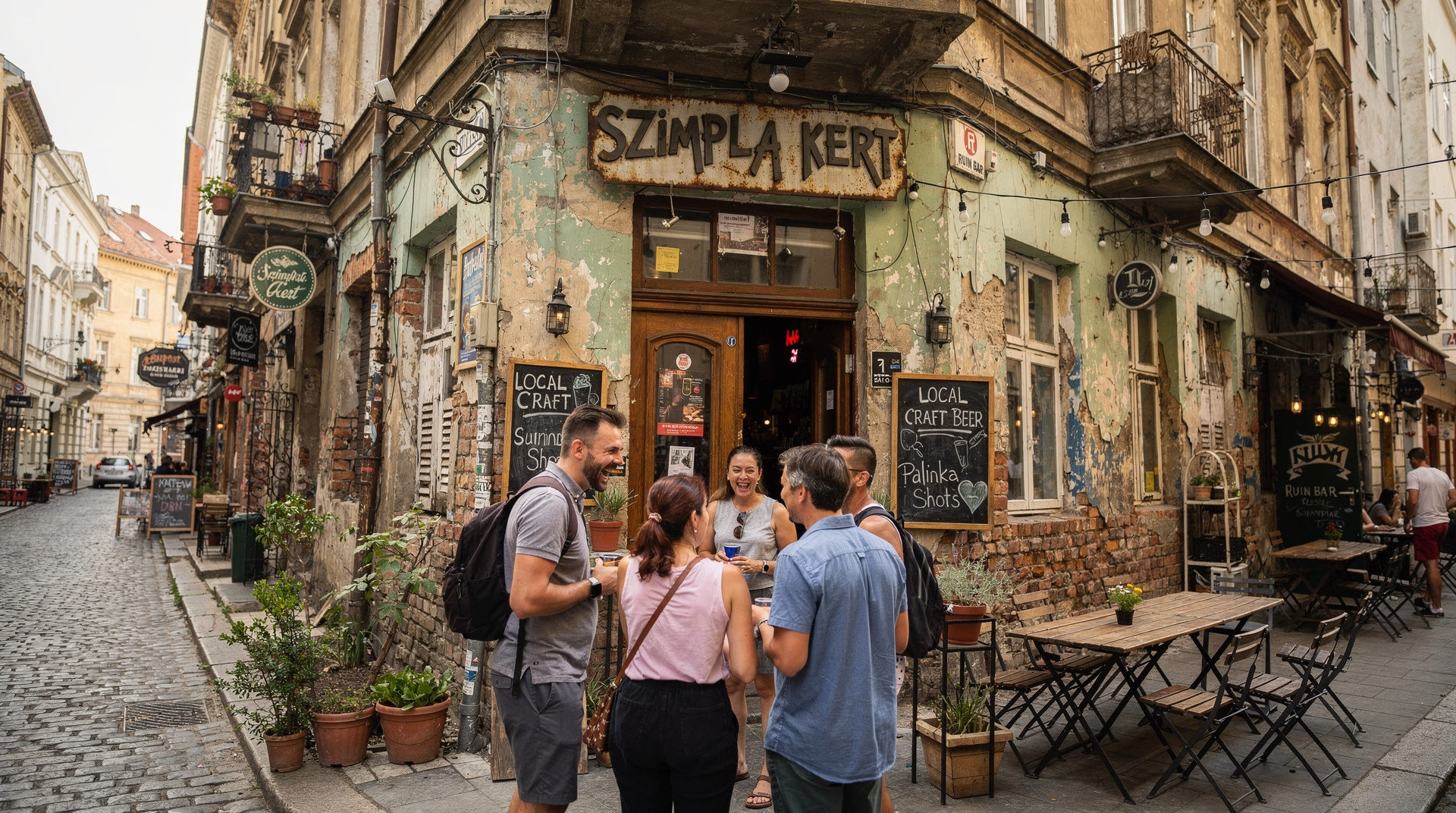
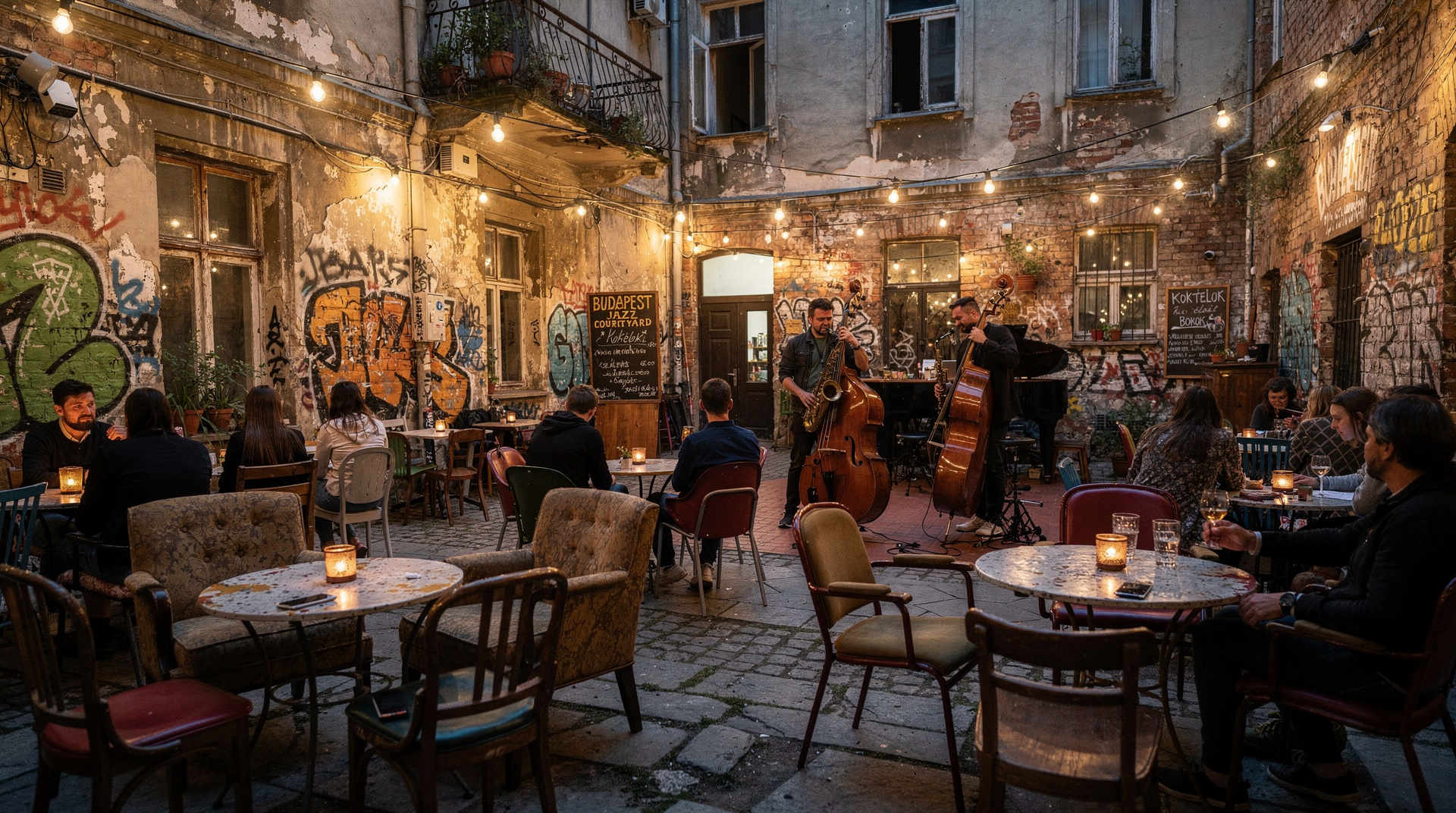
Szimpla Kert opened in its current location in 2004 and has been written into Budapest’s cultural fabric ever since. The three-storey interior of a former factory is a museum of salvaged objects: a Trabant car embedded in a wall, bathtubs used as seating, a tree growing through the roof. Each room has a different character — one plays jazz, another has a DJ booth for evenings, the courtyard functions as a beer garden.
Prices (2026): Draught beer 950–1,350 HUF (€2.40–3.40); cocktails 2,200–2,800 HUF (€5.50–7); pálinka shots 650–900 HUF; coffee from 600 HUF.
When to go: Sunday afternoon from 13:00 for the weekly farmers’ market — stalls selling local produce, bread, cheese, honey, and crafts alongside the regular café service. One of the most pleasant hours you can spend in Budapest at zero cost. Weekday evenings from 19:00 are mellow; Friday/Saturday from 22:00 are very busy.
One honest note: Szimpla’s reputation means it now attracts significant tour-group traffic from April to October. Don’t let that put you off — the space is large enough to absorb crowds, and the prices have not inflated to match the fame. For a more intimate ruin-bar experience, see Ellátó Kert and Anker’t below.
If you would rather visit several venues in one go, a ruin bar tour with 7 drinks and VIP club entry is a straightforward way to sample the district without planning the evening yourself.
The ruin bars occupy condemned courtyard buildings in the old Jewish quarter, and which ones are open changes with the leases rather than the season: a guided walk through the iconic ruin bars is led by someone who knows which doors are currently worth opening.
Instant–Fogas: the biggest multi-room venue
Akácfa utca 51, District VII
Open Wednesday–Saturday 22:00–06:00. Entry free before midnight; 1,500–2,500 HUF after.
Instant–Fogas is technically a merger of two former venues and now occupies an entire city block across multiple buildings. Inside: six rooms with different music (electronic, hip-hop, indie, house), a ruin-bar courtyard open in summer, and a capacity of over 1,000. This is where Budapest’s club nights happen — international DJs play here; the production values are high.
The ruin-bar aesthetic is maintained in the courtyard and some indoor spaces, but the main rooms are proper clubs. If you’re looking for dancing rather than conversation, this is the venue. Drinks prices are higher than Szimpla (beer 1,200–1,600 HUF / €3–4) but still below Western European club prices.
Anker’t: the calmer option for conversation
Paulay Ede utca 33, District VI
Open daily 16:00–01:00 (longer on weekends).
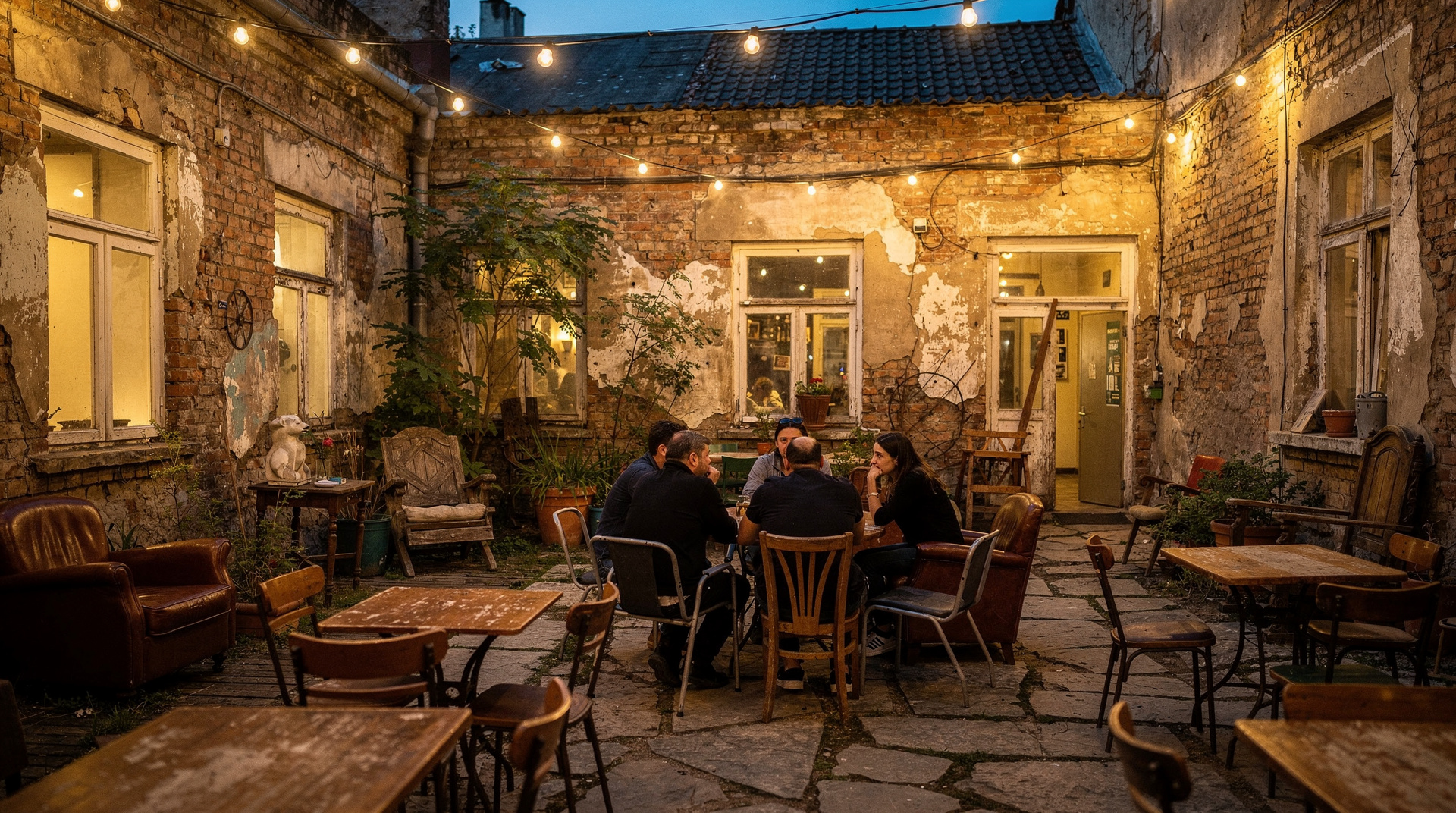
Anker’t occupies a large courtyard behind an art-nouveau building on the edge of the opera district. It has the ruin-bar aesthetic — industrial fittings, exposed brick, hanging plants — but a notably calmer atmosphere. Tables have more space; music volumes stay conversational until around 21:00. Local professionals and visitors in their 30s–40s tend to prefer it to the louder alternatives.
Excellent beer selection including Hungarian craft options (Legenda, HopTop); food menu available (Hungarian snacks + pizza) until midnight.
Ellátó Kert: for the local crowd
Kazinczy utca 48, District VII
Open daily from 16:00.
Ellátó Kert (roughly: “supply garden”) is one of the more local-feeling ruin bars — further from the tourist flow than Szimpla, quieter, and with a loyal neighbourhood clientele. The garden is large and strung with fairy lights; draught beer is around 850–1,000 HUF. No entry fee, no gimmicks.
Mazel Tov: ruin-bar building, restaurant atmosphere
Akácfa utca 47, District VII
Open daily 12:00–01:00 (kitchen until midnight).
Mazel Tov is built inside a bombed-out courtyard that’s been fitted with a glass roof and greenery. The kitchen serves Israeli-inspired mezze (hummus, falafel, shakshuka) at around 2,500–4,000 HUF per dish. It’s as much a restaurant as a bar, which makes it a good choice for groups where not everyone wants to drink. The cocktail list is genuinely interesting — try anything with local pálinka.
This is one of the few ruin-bar spots consistently popular with visitors who don’t enjoy loud music or late nights — the courtyard is beautiful and the food is good value.
Kőleves: Jewish Quarter kitchen and bar
Kazinczy utca 41, District VII
Open daily from 12:00.
Kőleves (“stone soup”) is a Hungarian kitchen and bar in the heart of the ruin district. The food is traditional (lentil soup 1,800 HUF, duck leg with red cabbage 4,200 HUF) and reliably good quality. It functions as a neighbourhood restaurant during the day and a bar by night. Good for a meal before hitting the bars.
Organised experiences in the ruin-bar district
Guided crawls: The guided ruin-bar pub crawl is run by local nightlife experts and covers 4–5 bars including at least one club. Included: welcome drink, guide for the evening, VIP entry to venues. Cost around €20–25. It’s the easiest way to see several bars in one evening without managing logistics yourself.
A close alternative is the ruin pub crawl with free VIP entry, 6 shots, games and photos, which leans towards the party side of the district: shots and games rather than bar history.
Street food pairing: The ruin bars and street food walking tour combines 2–3 bar stops with Budapest street food tastings — lángos, chimney cake, traditional bites — making it a good afternoon/early-evening activity rather than a late-night event.
The scam warning every ruin-bar visitor needs
Budapest’s nightlife zone also has a well-documented scam: the konzumlány (consumption-girl). A woman approaches you outside bars, suggests you join her at “a place she knows,” and orders freely — you receive a bill of 50,000–200,000 HUF (€125–500). She earns a commission from the bar.
The reputable venues listed in this guide have no connection to this scam. The risk is highest near Deák tér, Vörösmarty tér, and the areas immediately around Váci utca — not in the heart of the ruin-bar district. Never let a stranger choose your bar; always check the menu price list before ordering. Full details at common scams in Budapest and ruin bar rip-offs.
District VII: the wider bar neighbourhood
The ruin-bar district overlaps with the Jewish Quarter, one of the most historically significant areas of Budapest. The Dohány Street Synagogue — the largest in Europe — is five minutes’ walk from Szimpla Kert. The Jewish Quarter heritage guide covers the history of the neighbourhood before the ruin bars arrived.
During the day, the same streets hold excellent coffee shops (Espresso Embassy on Arany János utca, Fekete on Ferenczy István utca), casual lunch spots, and bookshops. By evening they transform into one of Europe’s most vibrant bar areas.
For a full map of where things fit, see our guide to Budapest’s party districts and best areas for nightlife.
Getting there and practical notes
Transport: Metro M2 (red line) to Blaha Lujza tér or Keleti pályaudvar; tram 4/6 to Wesselényi utca. The ruin district is also walkable from Deák tér (15 min) and the Basilica (10 min).
Late-night transport home: Tram 4/6 runs 24 hours on Rákóczi út — the easiest option at 3 a.m. Bolt (ride-hailing app) is reliable from the area; avoid street taxis in the nightlife zone. Details in our taxis and Bolt guide.
Budget: Plan 5,000–8,000 HUF (€12.50–20) for a full evening across several bars if you’re drinking moderately. A pub crawl (€20–25 all-in) often works out cheaper than independent bar-hopping once you factor in club entry fees.
For season-by-season nightlife conditions and planning the rest of your trip, see the Budapest 3-day itinerary.
Ruin bar culture: what it means beyond the drinks
The ruin-bar phenomenon in Budapest is frequently reduced to its visual elements — the mismatched furniture, the Trabant in the wall, the exposed brick. These are real, but they’re symptoms of a more interesting underlying reality.
When the first ruin bars opened in the early 2000s, they were doing something that the Hungarian state had done in reverse for forty years: taking what was derelict and making it useful. The communist approach to unused buildings was to ignore them, wait for them to collapse, and either demolish them or quietly privatise the ruins to connected parties. The ruin-bar entrepreneurs took a different approach — acknowledging the decay, working with it rather than against it, and finding that the aesthetics of abandonment were commercially viable.
This created a paradox that Budapest has never fully resolved: the ruin bars that preserved derelict buildings against demolition also attracted the gentrification that has made those same buildings unaffordable. Szimpla Kert saved the Kazinczy utca block from developers in 2004; by 2015, the same success had driven property prices high enough to displace the residents who had lived there for decades. The ruin bars are both the agents and the victims of the neighbourhood’s transformation.
For visitors, this context doesn’t diminish the experience but it does deepen it. When you sit in Szimpla Kert’s courtyard, you’re in a space with a genuine history — of wartime damage, communist neglect, creative reinvention, and commercial success — not in a purpose-built theme park.
The ruin bars’ food and drink: what to actually order
Beyond beer and cocktails, the ruin bars have developed food cultures worth knowing:
Szimpla Kert: The Sunday market brings artisan food producers into the courtyard. On other days, a basic kitchen produces sandwiches, soups, and snacks. The pálinka selection is genuinely interesting — ask what’s from small producers (kézműves).
Anker’t: The strongest food offering among the classic ruin bars. A full menu of Hungarian snacks and dishes, available until midnight on weekdays. The gombás paprikás (mushroom stew) and a glass of Bikavér is a reasonable dinner.
Mazel Tov: The best food in the ruin-bar district by a margin. The kitchen produces genuine Israeli-Hungarian fusion — hummus that would be creditable in Tel Aviv, shakshuka made with Hungarian peppers, and cocktails that use pálinka alongside more conventional spirits.
Instant–Fogas: Minimal food offering — the venue is primarily a club. Snacks at the bar; nothing substantial.
For a more structured food experience in the ruin-bar district, the ruin bars and street food walking tour pairs bar visits with Hungarian street food tastings — a good format for visitors who want the food and the atmosphere together.
The ruin bar scene by day: a different experience
Most ruin bars operate as café-bars from noon onwards, and the daytime experience is genuinely different from the evening:
Szimpla Kert from 12:00: Predominantly local workers and residents on weekdays. Coffee drinkers, laptop workers, small groups having lunch. The space feels enormous when it’s half-empty; the architecture is more visible. Music is quieter (usually jazz or ambient). This is how Budapestians actually use the space.
Anker’t from 16:00: The large courtyard fills slowly from 16:00 with an after-work crowd. By 18:00, most tables are occupied. The atmosphere is conversational; nobody is shouting over music. Good for a pre-dinner drink with a view of the courtyard architecture.
Ellátó Kert from 16:00: Almost entirely local from opening to about 20:00. The corner tables by the garden wall are the best spots; arrive by 17:30 for a choice of seats.
The daytime ruin-bar visit combines naturally with a morning at the Dohány Street Synagogue (opening from 10:00, five minutes’ walk) and a lunch at Kőleves or Kádár Étkezde. The Budapest 3-day itinerary suggests this as a natural District VII day programme.
Photography in the ruin bars
The ruin bars are among the most photographed spaces in Budapest. A few notes for visitors with cameras:
Light: The best light for interior photography is during the day when natural light comes through skylights and open roofs. Evening light at Szimpla Kert — string lights and fairy lights against dark walls — is atmospheric but technically challenging.
Permission: Photography for personal use is universally fine. Photography for commercial use (branding, social media with commercial intent) requires permission from the venue management. In practice, personal photography is entirely uninhibited.
Best shots:
- The Trabant embedded in the wall at Szimpla Kert (iconic; photograph it before the crowds arrive at 21:00)
- The courtyard at Szimpla from the upper-floor gallery (shows the full scale)
- The covered glass-roof courtyard at Mazel Tov (excellent in daytime)
- The narrow alley approach to any of the Kazinczy utca bars (captures the urban fabric)
For a photographically-led experience of Budapest nightlife, see the photography tours guide.
Seasonal ruin-bar guide
Spring (April–May): Garden areas open; mix of locals and early-season tourists. The most uncrowded version of the peak-season experience. Evenings can be cool — some outdoor areas have heaters.
Summer (June–August): Maximum capacity. All outdoor areas fully open; music loudest; most tourists. The authentic local experience is harder to find in peak season but still present — visit on a Tuesday or Wednesday evening.
Autumn (September–October): Excellent. The crowds thin from mid-September; the evenings are crisp; the outdoor areas have their last weeks before closing for winter. Best overall balance.
Winter (November–March): The indoor areas of all ruin bars remain open and heated. The atmosphere is warmer (figuratively and literally) than summer — less anonymous, more regular-clientele feeling. Szimpla Kert’s Sunday market continues in winter, with seasonal foods.
For the full nightlife context across all seasons, see the Budapest nightlife guide.
Frequently asked questions about Best ruin bars in Budapest
What exactly is a ruin bar?
A ruin bar (rom kocsma) is a bar set inside a derelict building or courtyard, typically in Budapest's District VII. The interiors are intentionally unfinished — mismatched furniture, exposed brick, graffiti, salvaged objects. The style began around 2002 when entrepreneurs took over buildings awaiting demolition; many stayed permanently and became landmarks.Is Szimpla Kert still worth visiting in 2026?
Yes, though it's now a tourist institution rather than a secret. Prices remain reasonable (beer 900–1,400 HUF / €2.25–3.50), the courtyard is atmospheric, and the Monday farmers' market is one of the best in the city. Avoid Friday/Saturday nights if you dislike crowds; Sunday afternoon is relaxed and almost entirely local.What does a drink cost at a ruin bar?
At the main ruin bars: draught beer 900–1,400 HUF (€2.25–3.50), cocktails 2,000–3,000 HUF (€5–7.50), pálinka shots from 600 HUF (€1.50). Away from Váci utca and the main tourist strip, prices are honest. Always check the menu before ordering — bars without visible prices are a red flag.When is the best time to visit ruin bars?
Weekdays are ideal: calmer, mostly local crowd, no queue. Friday and Saturday from 22:00 are the busiest and loudest. If you want the social atmosphere without the crush, Thursday nights hit a good balance. Sunday afternoon at Szimpla Kert is a different experience — relaxed, almost café-like.Are ruin bars appropriate for couples or older visitors?
Yes. Most ruin bars operate as café-bars during the day (Szimpla from 12:00) and only get loud after 22:00. Couples often enjoy the afternoon: coffee in a courtyard, a glass of wine, then dinner nearby. Mazel Tov (in a ruin-bar building on Akácfa utca) is popular with 30s/40s visitors thanks to its Israeli-inspired kitchen and quieter atmosphere.Do ruin bars have a dress code or entry fee?
No dress code at ruin bars — trainers, casual clothes are fine. Entry is free before midnight at most venues. After midnight, club rooms within larger venues like Instant–Fogas charge 1,500–2,500 HUF (€3.75–6.25) entry. A guided walking tour is a good way to get historical context before exploring on your own.Which ruin bar is best for a quieter, more local evening?
Ellátó Kert and Anker't are the two calmest options among the well-known ruin bars. Ellátó Kert stays largely local even on weekends, while Anker't's larger tables and conversational volume until around 21:00 suit visitors in their 30s and 40s who want atmosphere without shouting over music. Szimpla Kert on a weekday afternoon or Sunday morning is also noticeably calmer than its evening reputation suggests.
Top experiences
Bookable activities with verified prices and instant confirmation on GetYourGuide.