Jewish Quarter heritage guide: Budapest's most layered neighbourhood

What is Budapest's Jewish Quarter?
The Jewish Quarter (District VII) is the historic heart of Budapest's Jewish community, centred on Dohány Street Synagogue — the largest in Europe. It contains synagogues, memorials, a ghetto wall remnant and the ruin bars that emerged after 2001.
The district that carries Budapest’s deepest history
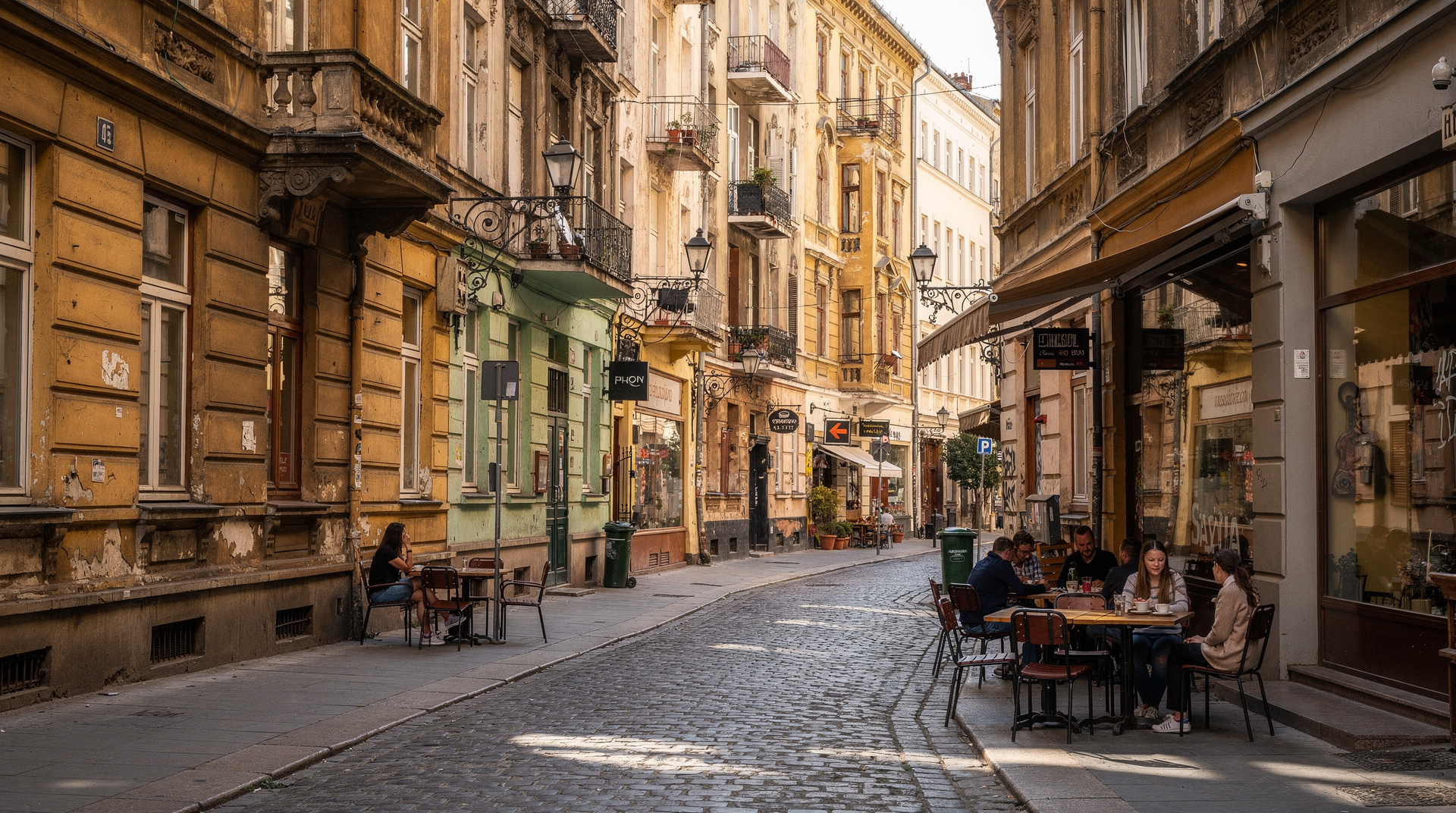
A ten-minute walk from the ruin bars of Kazinczy Street takes you to the edge of what was once the Budapest Ghetto. The same streets that host cocktail menus and vintage furniture today were sealed off by a wooden fence in November 1944, trapping around 70 000 people in a space designed for far fewer. Budapest’s Jewish Quarter — officially the VII district, Erzsébetváros — is one of Europe’s most layered urban spaces: medieval Jewish presence, 19th-century prosperity, wartime trauma, communist-era erasure, and post-2001 cultural rebirth, all compressed into a walkable grid of streets.
This guide covers the key sites, the essential history, and how to plan your visit — whether you have two hours or half a day.
| Where | District VII (Erzsébetváros), metro M2 Astoria |
| Cost | Around 5,000–7,000 HUF for the synagogue complex ticket |
| Time needed | 2–3 hours self-guided, half a day with lunch |
| Getting there | Metro M2 to Astoria, or Tram 47/49 |
| Best time | Weekday morning for the memorial sites, early evening for the streets |
Why this neighbourhood exists where it does
Jews first settled in the Pest flatlands during the late medieval period, though large-scale Jewish immigration came in the 18th and 19th centuries, when Habsburg rule gradually lifted restrictions on Jewish residence and trade. By 1900, Budapest had a Jewish population of around 200 000 — roughly 25% of the city — making it one of the largest Jewish communities in Europe. Many were deeply assimilated, identifying as Hungarians of the Jewish faith. The neighbourhood that developed around Dohány Street reflected this confidence: grand apartment buildings, a vast neolog (reform) synagogue, and a prosperous merchant class.
The district never had the character of a sealed ghetto until 1944. Until German occupation, Budapest’s Jewish community, though subject to antisemitic legislation since 1938, remained physically present throughout the city. What we call the “Jewish Quarter” today is partly a construction of memory — the area around the Dohány Street Synagogue that has been restored and commemorated since the 1990s.
The Dohány Street Synagogue: Europe’s largest
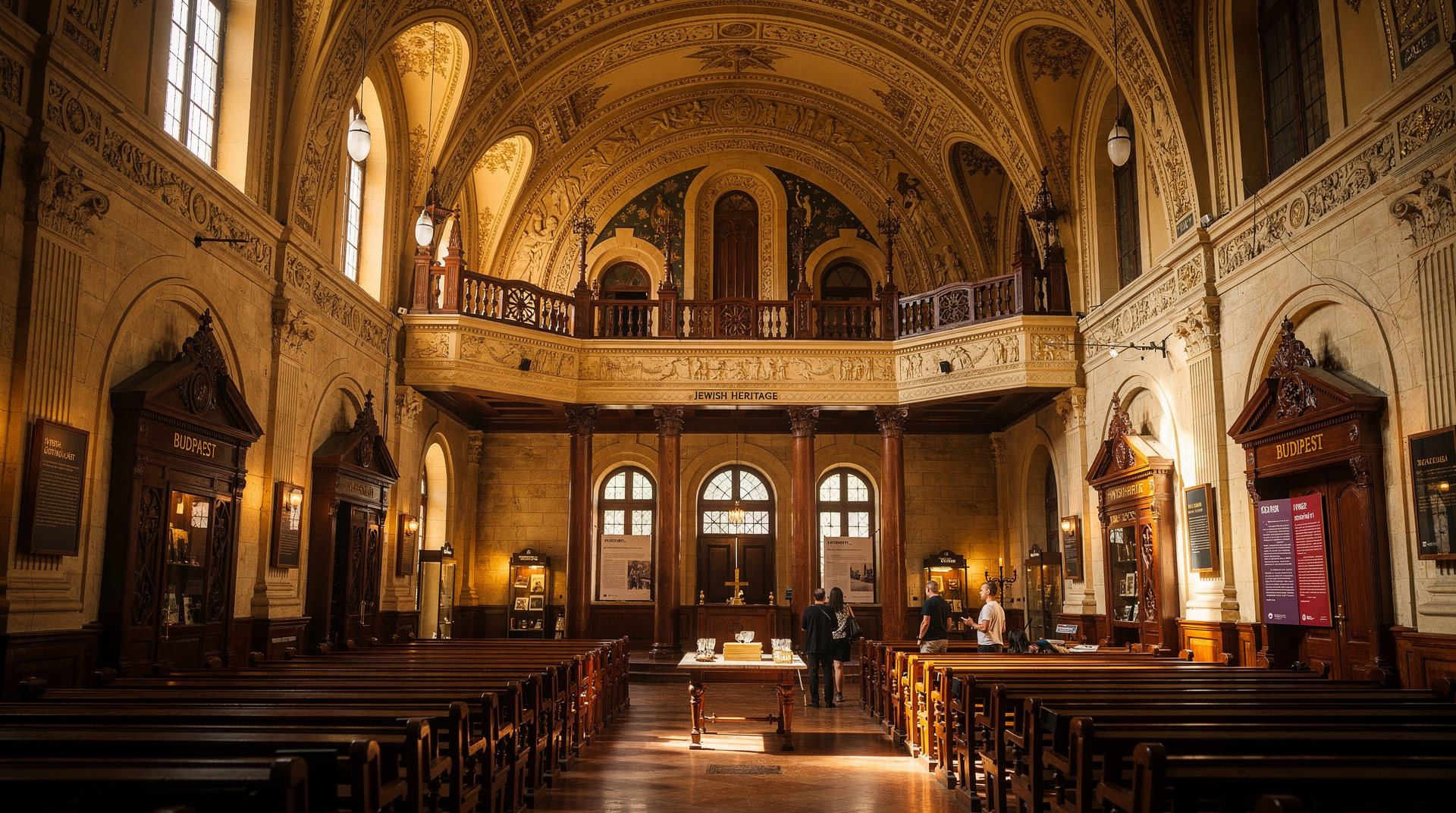
The Dohány Street Synagogue (Dohány utcai zsinagóga), completed in 1859, is the largest synagogue in Europe and the second largest in the world after Temple Emanu-El in New York. It seats 3 000 worshippers. The architect, Ludwig Förster, designed it in a Moorish Revival style that was deliberate — the Jewish community wanted to demonstrate that Jewish aesthetics could stand alongside Budapest’s finest public buildings. The twin onion-domed towers are now an emblem of the city.
The interior is opulent: a 5 000-pipe organ (Franz Liszt performed at its inauguration), gilded decoration, and a sweeping gallery. The synagogue was used as a stable and radio station during World War II and was damaged but not destroyed. Restoration began in the 1990s with support from the Hungarian government and the Emanuel Foundation.
Tickets for the synagogue complex — which includes the Hungarian Jewish Museum, the Raoul Wallenberg Memorial Garden, and the Heroes’ Temple — cost around 5 000–7 000 HUF (€12–18) depending on the package. Opening hours vary seasonally; Saturdays are closed. Buying tickets at the door avoids reseller markups.
For deeper context, a guided tour with synagogue entry pairs the architectural walk with an explanation of the community’s history and the wartime events. Historians who specialise in this period can add archival details no self-guided audio tour provides.
The Hungarian Jewish Museum
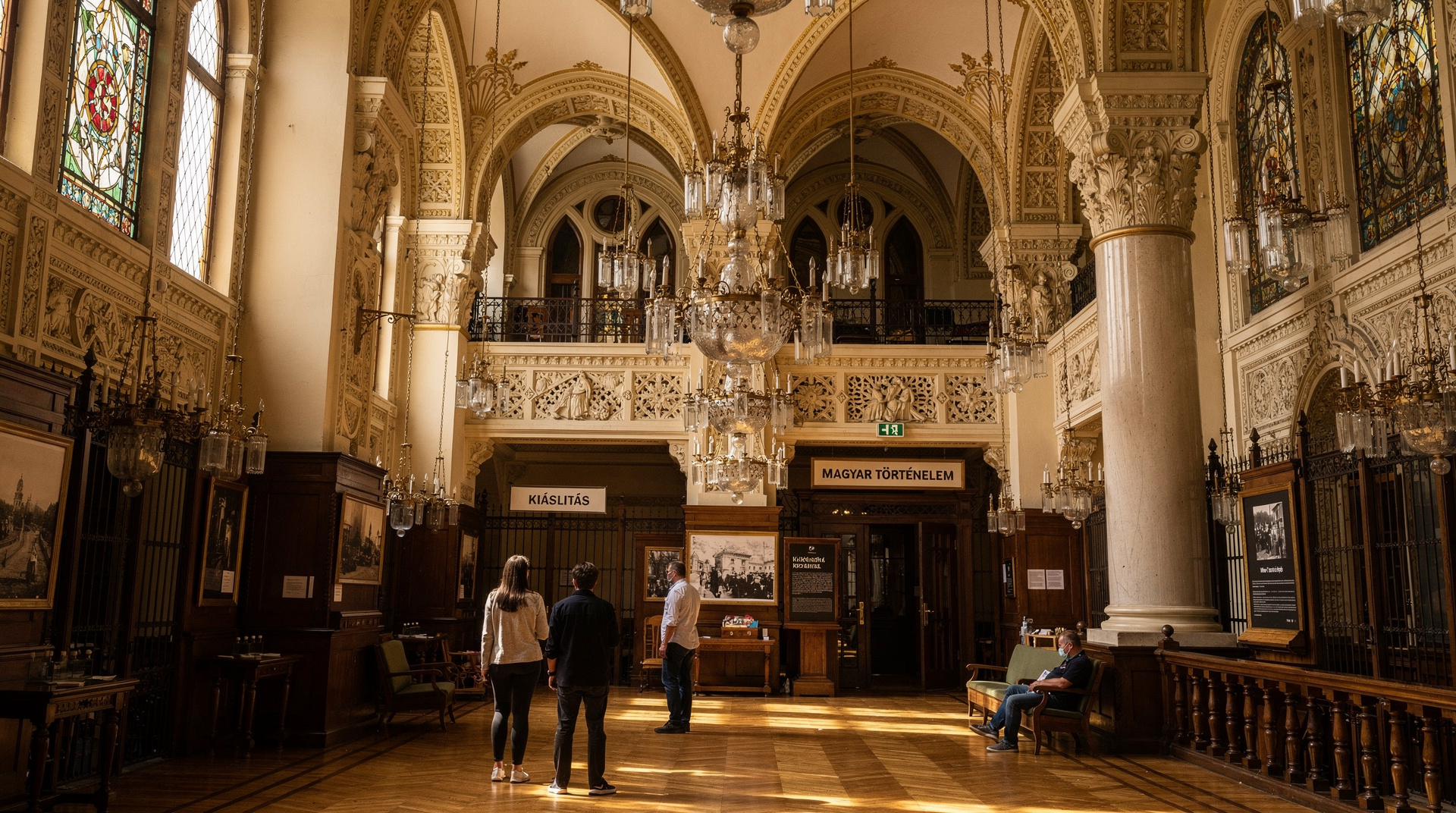
Attached to the synagogue, the museum covers 2 000 years of Jewish life in Hungary. Highlights include medieval gravestones, artefacts from Budapest Jewish households across centuries, and a dedicated Holocaust room. The collection is modest in scale but thoughtfully curated. Allow 45–60 minutes. It is included in the main synagogue ticket.
The Raoul Wallenberg Memorial Garden
Behind the synagogue lies one of the most affecting spaces in Budapest. The Raoul Wallenberg Memorial Garden occupies what was the courtyard of the ghetto — where some 2 000 people were buried in mass graves during the winter of 1944–45, too many dead to transport elsewhere. The graves remain beneath the garden. A simple plaque marks the site.
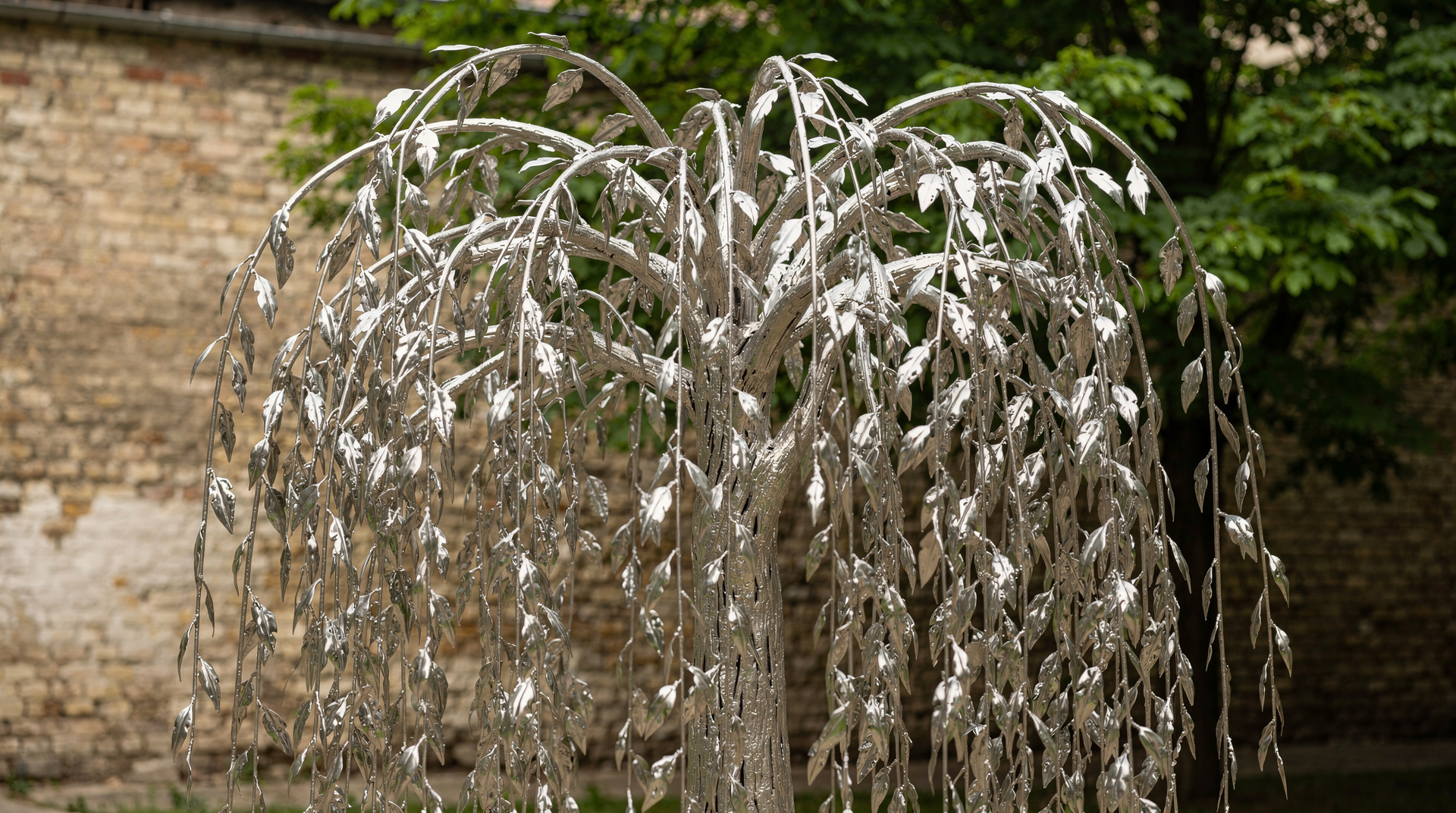
The Emanuel Tree, a weeping willow sculpture by Imre Varga, stands at the garden’s centre. Cast in metal, its branches carry hundreds of individual leaves, each inscribed with the name of a victim. It was dedicated in 1991; names continue to be added by families who find records. Many visitors stand here for a long time.
The garden is named for Raoul Wallenberg, the Swedish diplomat who issued Swedish protective passports (Schutzpässe) to tens of thousands of Budapest Jews during the last months of the war. He is thought to have saved 100 000 people. He was arrested by Soviet forces in 1945 and died in Soviet custody; the exact circumstances remain disputed. His memorial stands near the garden entrance.
The ghetto boundary and what remains of it
The Budapest Ghetto, established on 29 November 1944, was a roughly rectangular zone bounded by Dohány, Király, Wesselényi and Kertész streets. A wooden fence sealed the perimeter. At its most crowded, around 70 000 people lived in buildings designed for 15 000. Disease and starvation killed thousands before Soviet troops liberated the ghetto on 18 January 1945.
A short section of the original fence was incorporated into a small memorial installation on Király Street, though the physical remnants have faded. The Wallenberg Memorial on the corner of Wesselényi and Síp Street marks another point on the former perimeter. Walking the boundary is possible in about 20 minutes, though the streets themselves give little indication of what happened unless you know what to look for — which is precisely why guided tours matter.
A self-guided walk with the Jewish Quarter private walking tour provides exactly this orientation, connecting the physical streetscape to the documented events.
Kazinczy Street Synagogue
One block north of Dohány Street, the Kazinczy Street Orthodox Synagogue is a smaller, more intimate space built in 1913. Unlike the neolog (reform) Dohány synagogue, this served the Orthodox community, which observed stricter religious practice. The synagogue was restored after decades of communist-era neglect and holds regular Shabbat services. It has a kosher restaurant attached — one of the very few in Budapest — which serves traditional Hungarian-Jewish dishes for lunch on weekdays. Entry to the synagogue is possible outside prayer hours with a small donation.
The Rumbach Sebestyén Street Synagogue
A few minutes’ walk away, the Rumbach Sebestyén Street Synagogue (1872) was designed by Otto Wagner before he became the dominant figure of Viennese Secession architecture. It served the Status Quo community — a Hungarian Jewish denomination between the orthodox and neolog streams. Long derelict, it reopened after restoration in 2022 and now hosts concerts and cultural events alongside religious use. The Wagner-designed interior is architecturally significant; visiting it is less well-known than the Dohány synagogue but often more rewarding for those interested in architecture.
The ruin bars: how trauma became nightlife
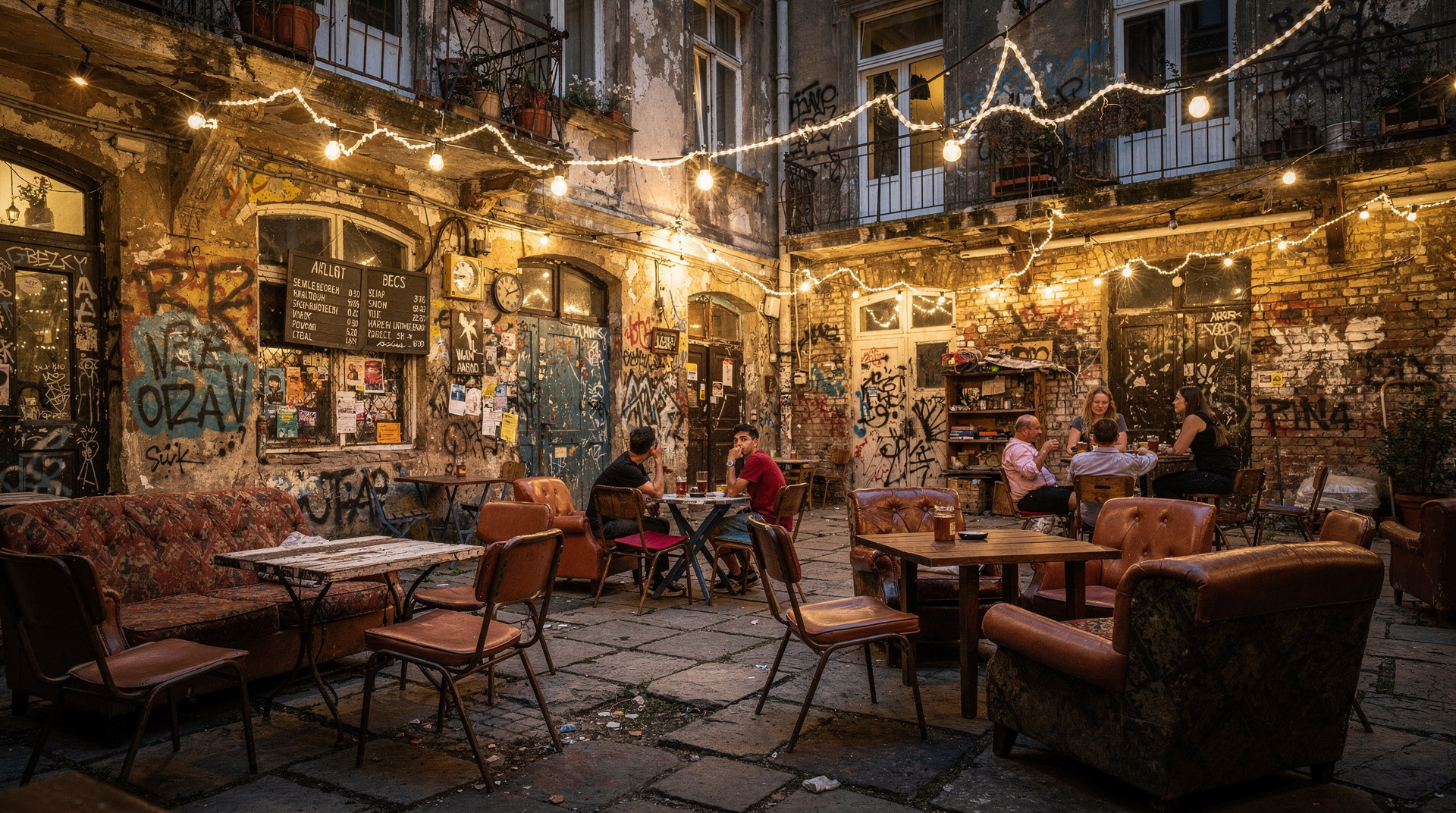
The ruin bars of District VII emerged after 2001 in a neighbourhood that communist-era housing policy had left partially derelict. Szimpla Kert opened in 2002 in a bombed-out building on Kazinczy Street — the same street as the Orthodox synagogue. The concept: leave the decay, fill the space with salvaged furniture, and charge honest prices for beer.
Szimpla Kert became one of the most photographed bars in Europe. Its success spawned dozens of imitators across the district. The neighbourhood revived economically; buildings that had been empty for decades were converted. The ruin bar scene brought tourists, which brought gentrification, which brought complaints from residents and the Jewish community that the atmosphere was incompatible with a site of remembrance.
The tension is real and ongoing. The Dohány Street Synagogue’s director has publicly criticised the bar scene’s presence immediately around the memorial complex. For visitors, the most respectful approach is to maintain the boundaries instinctively: daytime hours at the synagogue and memorial sites; evening hours at the bars. The two activities occupy the same streets but different registers, and the district asks you to shift between them consciously.
Beyond the synagogues: courtyard galleries and living community
Away from the memorial sites, the Jewish Quarter’s Gozsdu Udvar — a chain of connected courtyards running between Király and Dob streets — shows the district’s other layer: 21st-century Budapest creativity built into 19th-century apartment blocks. Small galleries, design shops and courtyard cafés occupy spaces that were near-derelict twenty years ago, and walking through Gozsdu Udvar mid-morning, before the evening bar crowds arrive, is a quieter way to see the same architectural fabric that hosts the ruin bars at night.
The Jewish community itself remains active and visible, not only historical. Budapest’s Jewish population today, estimated at 80,000–100,000, is the largest in Central Europe, and the district still functions as a religious and cultural centre — the Kazinczy Street Orthodox synagogue holds regular Shabbat services, the annual Jewish cultural festival in August brings concerts and events to the neighbourhood, and kosher food is available beyond the single landmark restaurant if you know where to look. Visiting with this in mind — a living community, not only a memorial site — changes how the district reads.
The Grand Jewish Heritage Tour
For a comprehensive half-day that covers the synagogues, the museum, the memorial garden and the ghetto context, the Budapest Grand Half-Day Jewish Heritage Tour runs approximately four hours with a specialist guide. It is one of the more thorough offerings in the district and includes museum entry. Suitable for visitors who want more than a walk-by impression.
Practical information
Getting there: Tram 47 or 49 to Astoria, or metro M2 to Astoria (5-minute walk). Bus 7 runs along Dohány Street itself. It is walkable from most central Pest hotels in 15–20 minutes.
Opening hours: The Dohány Street Synagogue complex is open Sunday–Friday (closed Saturday/Shabbat). Hours vary by season; check the official Dohány utca website before visiting. The Orthodox synagogue on Kazinczy Street has shorter hours; the Rumbach synagogue varies by event.
Tickets: Buy at the door or online directly from the synagogue. Avoid resellers. The combined ticket (synagogue + museum + garden) offers the best value.
Dress code: Shoulders and knees covered. Kippot (head coverings) are provided for men at the synagogue entrance.
Food nearby: The kosher restaurant at Kazinczy Street (Carmel) is a landmark. For general Hungarian food, the streets west of Dohány have more authentic and better-priced options than the tourist-facing eateries on Váci utca or Vörösmarty tér.
Connecting the Jewish Quarter to the wider city
The Jewish Quarter sits at the intersection of Budapest’s most significant historical threads. The House of Terror on Andrássy Boulevard, a 15-minute walk north, covers the same period from the perspective of the Hungarian state’s collaboration with both Nazi and Soviet regimes. The Hungarian history primer provides the full 1,000-year arc that contextualises what the 20th century meant for this country. The best museums in Budapest guide includes a ranking of where the Jewish Quarter fits in a broader cultural itinerary.
If you are planning a longer stay, consider pairing a morning in the Jewish Quarter with an afternoon at the Castle District — the contrast between the two Budapest histories, Buda and Pest, Habsburg and Jewish, is one of the city’s defining narratives.
For itinerary planning, the Budapest 3-day itinerary allocates half a day to the Jewish Quarter and connects it to the Parliament and city-centre walk. The District VII neighbourhood guide covers the area’s current restaurant and bar scene in more practical detail. For those interested in communist history connecting to the same district, communist Budapest traces what happened to the Jewish Quarter under the Soviet-backed regime after 1945.
The free walking tours Budapest guide lists the tip-based operators who cover the Jewish Quarter regularly — a good option if budget is a constraint. For families, the Budapest with kids page notes how to frame the history appropriately for younger visitors.
Daytime memorial vs evening nightlife: how to plan the split
| Time of day | What’s appropriate | What to do |
|---|---|---|
| Morning (9am–12pm) | Quiet, reflective visit | Synagogue, museum, Wallenberg Garden |
| Early afternoon | Still respectful, less crowded | Kazinczy and Rumbach synagogues, lunch |
| Early evening | Transition | Coffee, gallery courtyards, dinner |
| Late evening | Nightlife register | Ruin bars, Szimpla Kert and neighbours |
Treat the shift from memorial to nightlife as a conscious change of register, not a seamless continuum — the district itself asks this of visitors, and residents and the synagogue leadership have been vocal about the tension between the two.
Frequently asked questions about Jewish Quarter heritage guide
How long does it take to see the Jewish Quarter?
Allow at least two to three hours for a self-guided walk covering the Dohány Street Synagogue, the Hungarian Jewish Museum, Raoul Wallenberg Memorial Garden, and Emanuel Tree sculpture. Add another hour if you join a guided tour. Half a day is comfortable if you include lunch and a ruin bar stop.Can I visit the Dohány Street Synagogue without a tour?
Yes. You can buy a ticket at the door for the synagogue and museum. However, a guided tour provides essential context — the history of the ghetto, the mass graves in the garden, and the meaning of the Emanuel Tree. Consider a tour led by a historian for the deepest insight.What happened to Budapest's Jewish community in World War II?
Budapest's Jewish population numbered around 200 000 in 1944. Following German occupation in March 1944, tens of thousands were deported to Auschwitz within weeks. The Budapest Ghetto, established in November 1944, confined some 70 000 people in the district around Dohány Street. Nearly 15 000 perished there before liberation in January 1945. Raoul Wallenberg and the International Red Cross helped save tens of thousands through protective passports.Is the Jewish Quarter the same as the ruin bar district?
Largely, yes. District VII (Erzsébetváros) encompasses both the historic Jewish Quarter and the ruin bar scene that grew up in the early 2000s. Szimpla Kert, the original ruin bar, sits a few minutes' walk from the Dohány Street Synagogue. The coexistence makes the district unusually layered — you move between solemn memorial spaces and one of Europe's most vibrant nightlife areas within the same few streets.Is there a free Jewish Quarter walking tour?
Yes. Several operators run free (tip-based) tours departing from the Dohány Street Synagogue entrance. These cover the main sights in about two hours. For a paid historian-led tour with more archival depth, look atthe Jewish history guided tour with a historian .What is the Emanuel Tree?
The Emanuel Tree (also called the Weeping Willow or Holocaust Memorial Tree) is a sculptural weeping willow by artist Imre Varga, erected in 1991 in the Raoul Wallenberg Memorial Garden behind the synagogue. Each metal leaf bears the name of a Hungarian Jewish Holocaust victim. It is one of the most moving monuments in Budapest.When is the best time to visit the Jewish Quarter?
Weekday mornings are quietest. Summer afternoons are the busiest. The quarter is most atmospheric in the early evening when the ruin bars start to open and the golden light hits the synagogue façade. The Jewish community hosts festivals in summer, including a Jewish cultural festival in August.
Top experiences
Bookable activities with verified prices and instant confirmation on GetYourGuide.