Szimpla Kert guide: the original Budapest ruin bar
Is Szimpla Kert worth visiting?
Yes — it's the original ruin bar, the largest of its kind, and has a genuine daytime café culture alongside the night scene. Beer costs 950–1,350 HUF (€2.40–3.40). Sunday afternoon from 13:00 hosts the best farmers' market in the Jewish Quarter. For evenings, arrive before 22:00 to avoid queues on weekends.
The history behind the most famous bar in Budapest
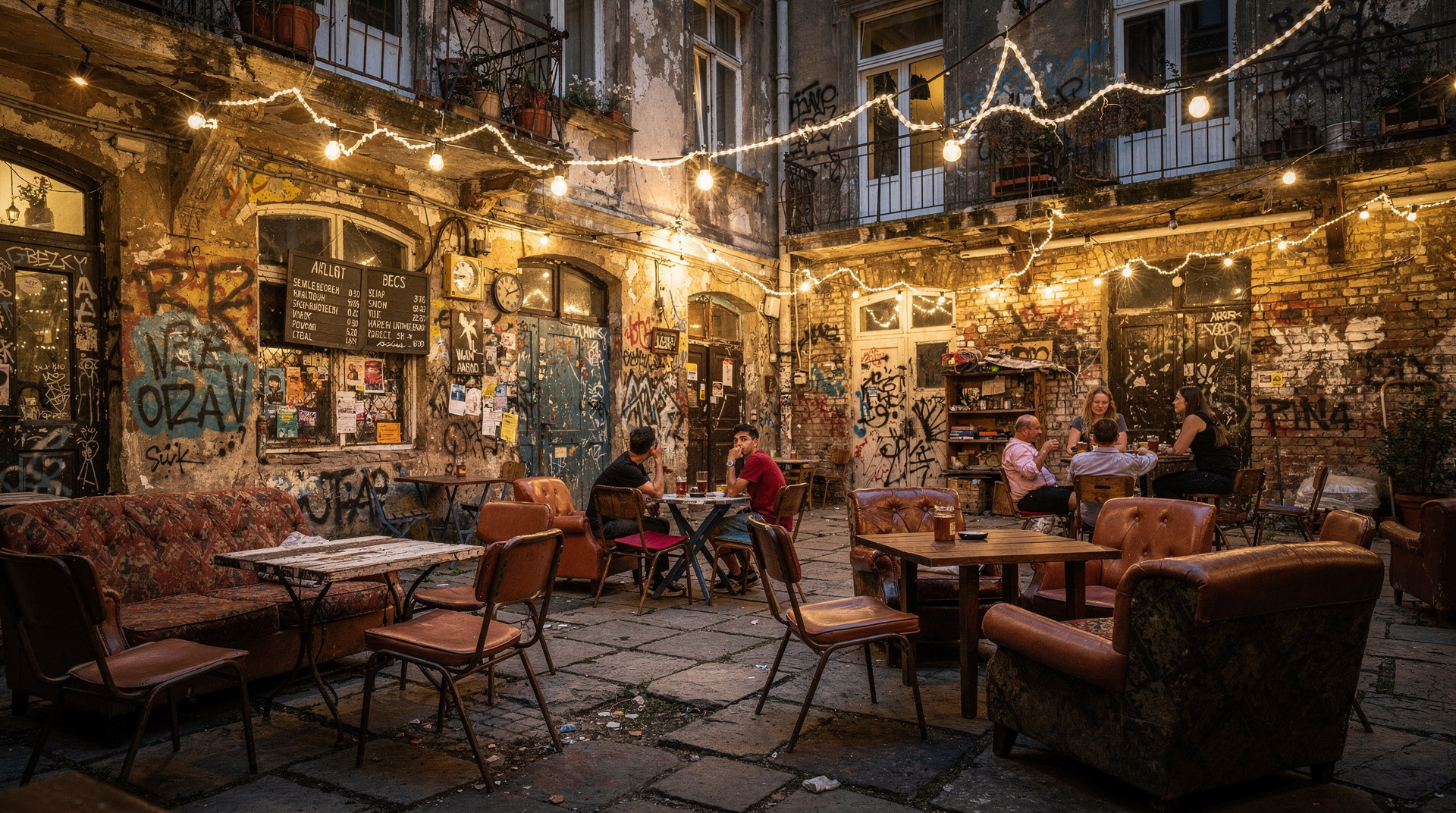
Szimpla Kert (roughly “simple garden”) was not the first ruin bar in Budapest — an earlier Szimpla on Kertész utca holds that distinction — but the Kazinczy utca location, which opened in 2004, became the template that defined the entire genre. The space it occupies was a condemned factory building awaiting demolition. Instead of waiting, a group of artists and entrepreneurs stripped it back to bare brick, filled it with salvaged furniture and junk-shop finds, and opened a bar.
Twenty-two years later, Szimpla Kert is still open, still in the same building, still furnished with the same chaotic aesthetic. The Trabant in the wall has been photographed by millions of visitors. The courtyard trees have grown through the roof. The pálinka selection is better than ever.
What’s remarkable is that the venue has aged without becoming a parody of itself. Prices remain fair. The Sunday farmers’ market — started to give back to the neighbourhood — has become one of the most-visited markets in the city. Local regulars still drink here alongside the tourists.
| Where | Kazinczy utca 14, District VII |
| Hours | Mon–Fri 12:00–04:00; Sat–Sun 09:00–04:00 |
| Cost | Free entry; beer 950–1,350 HUF |
| Best time | Sunday market (09:00–14:00) or weeknight evenings |
| Getting there | Metro M2 to Blaha Lujza tér, 10 min walk |
Layout and what to expect
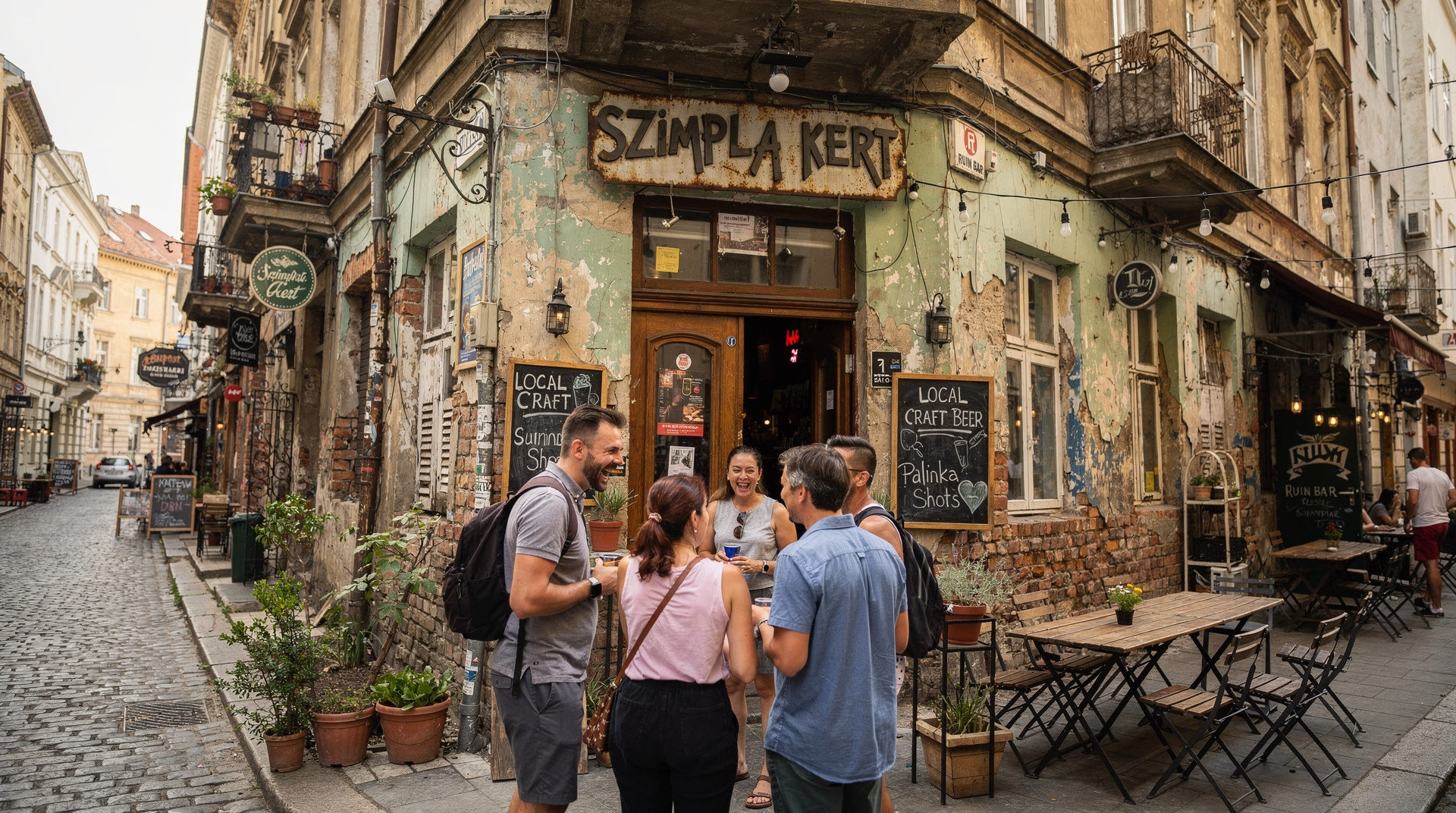
The building is a former factory arranged around an inner courtyard. From the Kazinczy utca entrance (number 14), you pass through a corridor into:
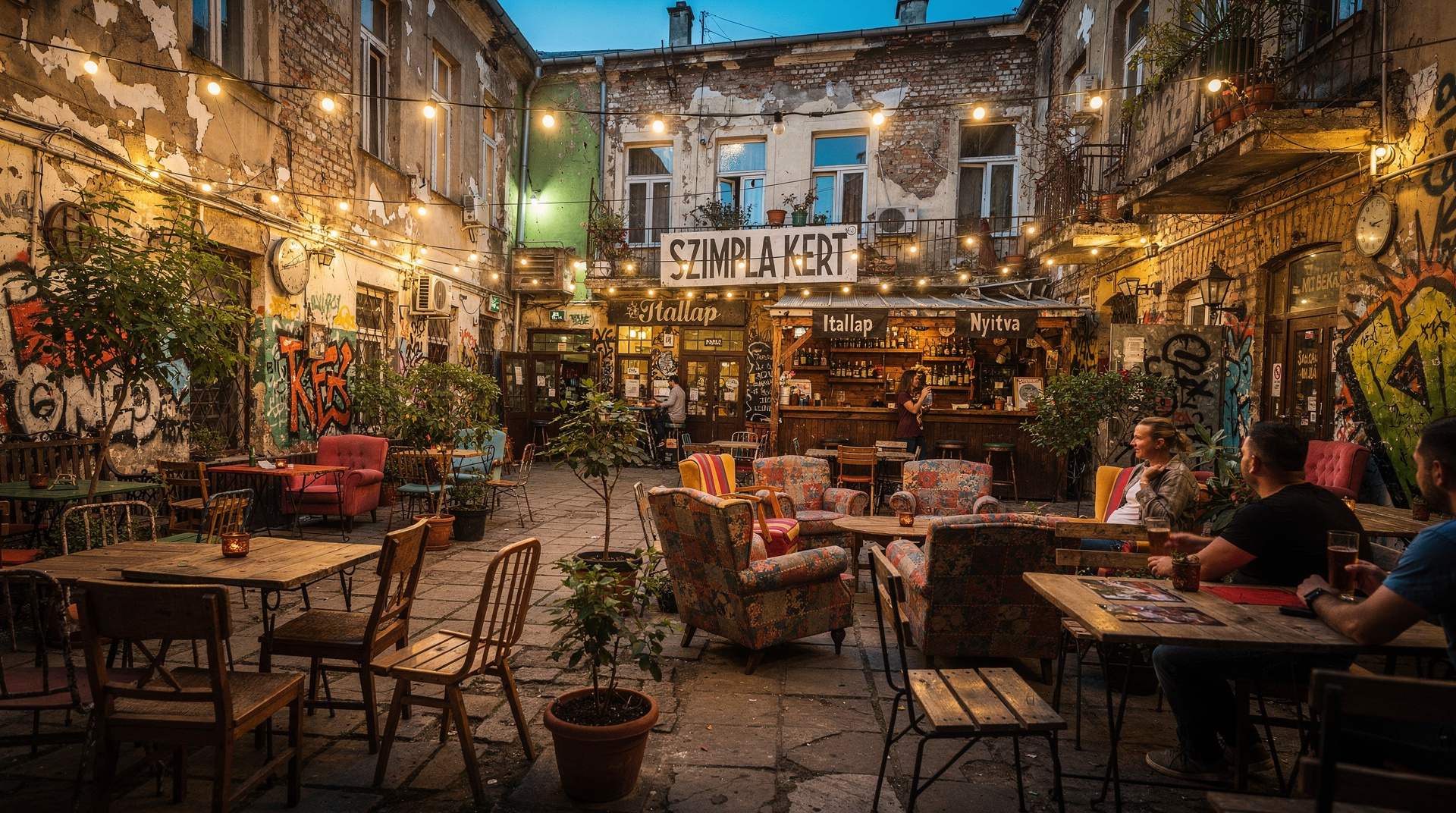
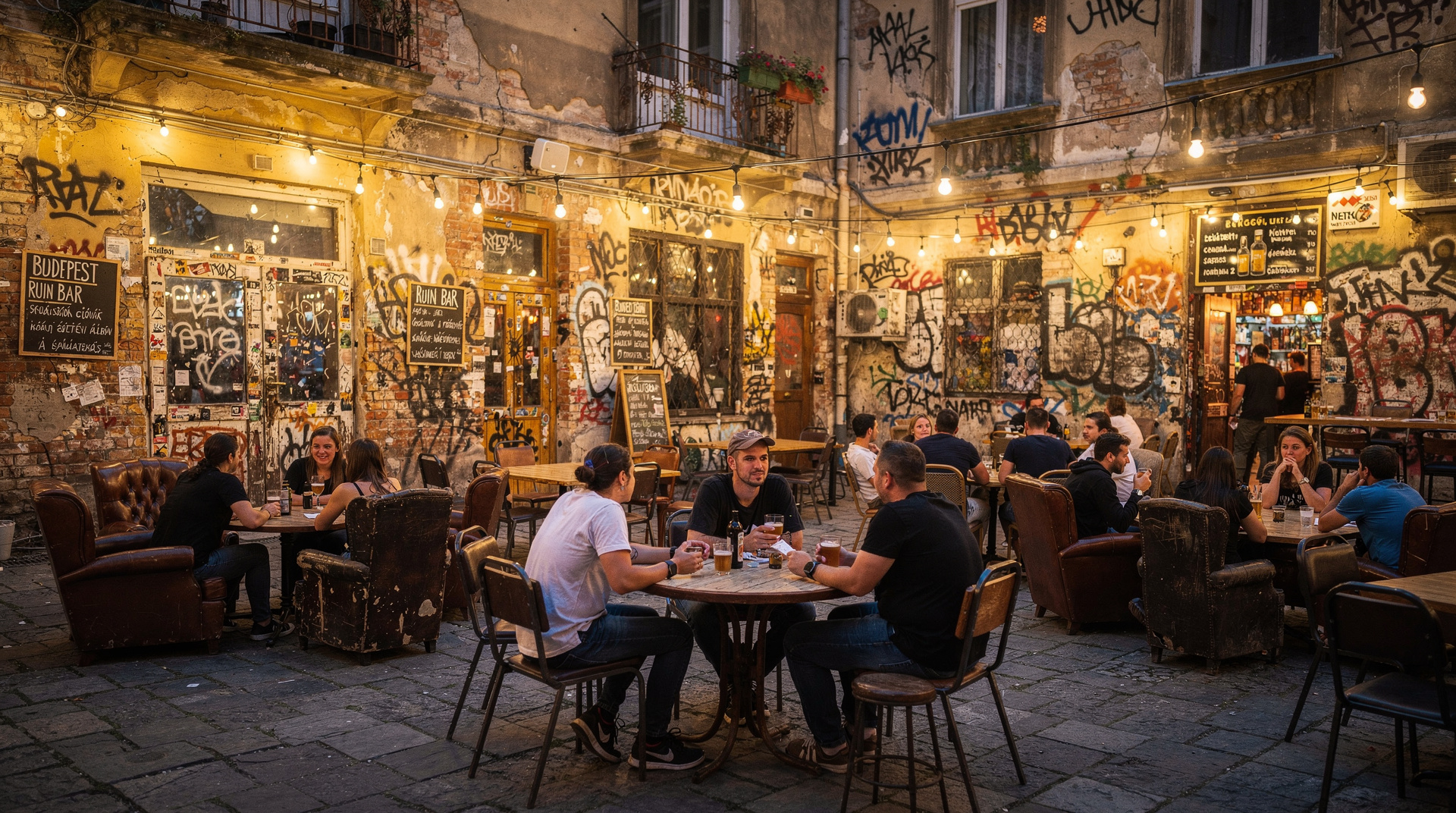
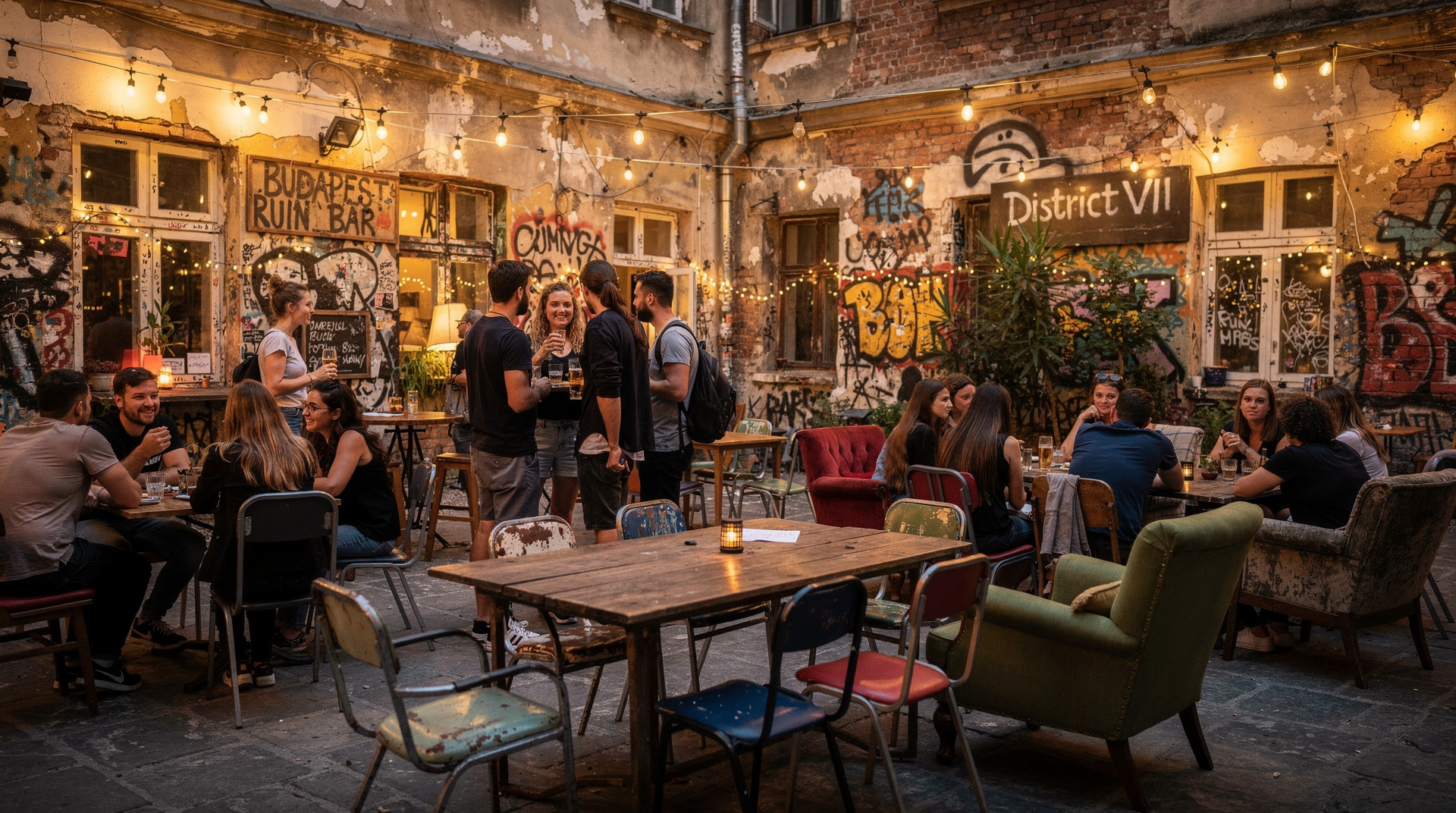
The main courtyard: The largest space, with mismatched garden chairs, communal wooden tables, string lights overhead, and a central bar serving draught beer. In summer this is the main gathering point; in winter parts are covered. The famous Trabant car is embedded in the wall here.
Ground floor bar rooms: Several interconnected rooms off the courtyard, each with a different atmosphere — one has a DJ booth active from around 22:00 on weekends, another is quieter with sofas. Vintage signs, painted walls, and salvaged furniture throughout.
Upper floors: Gallery-style spaces with additional seating, views down into the courtyard, and on weekends, a second smaller bar. The second floor has DJ equipment for larger events.
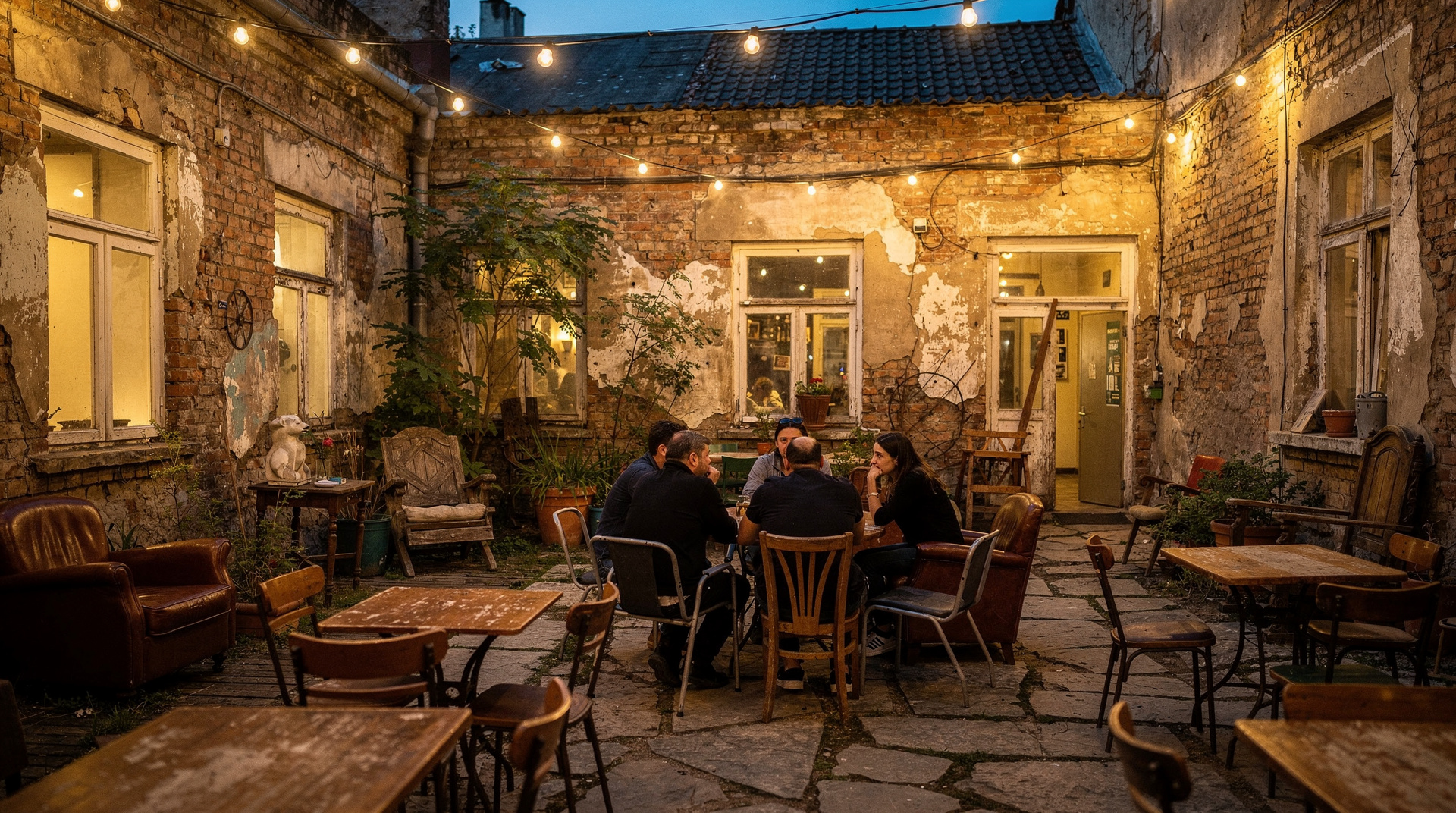
Back garden: A smaller outdoor area at the rear, usually quieter than the main courtyard.
When to visit for different experiences
Sunday morning (09:00–14:00): The farmers’ market
The weekly Sunday market transforms the courtyard into a proper food market. Around 20 stalls from regional producers sell: raw-milk cheese, artisan bread, wildflower honey, fermented vegetables, fresh fruit, cold cuts, homemade jams, and seasonal produce. Separate stalls have handcraft and art items.
This is the best version of Szimpla Kert and one of the best hours you can spend in Budapest. Entry is free and there’s no obligation to buy anything, though the cheese and honey stalls are excellent. The bar is open from 09:00 with coffee and breakfast options.
Weekday afternoons (12:00–18:00): Café mode
A calm, almost entirely local atmosphere. Coffee, laptop workers, students. Good for a quiet drink and a look around the décor. Cheapest time to visit.
Weekday evenings (19:00–22:00): Transition period
The crowd shifts from locals to a mix. Live music sometimes plays on weekday evenings (check their Facebook page for the calendar — Szimpla hosts film screenings, jazz nights, and folk music sessions).
Weekend nights (22:00–04:00): The peak experience
Busy, loud, international crowd. DJs play in the main room from about 22:30. Queues form at the entrance from about 23:00–01:00. There is no entry fee, but you may wait 10–20 minutes on busy Friday/Saturday nights. The courtyard stays smoky and crowded but atmospheric.
The scam-free honest note
Szimpla Kert has clear menus with visible prices at every bar station. There is no pressure to buy; staff will not add charges to your bill beyond what you ordered. The bar has no connection to the konzumlány (friendly-girl) bar scam — that operates at unmarked bars near Deák tér and Váci utca, not at established venues. See our ruin bar rip-offs guide for the full breakdown.
Organised tours that include Szimpla Kert
For a structured evening out, the ruin bar tour with 7 drinks and VIP club entry is a close alternative to finding your own way: it moves you through several ruin bars in the Jewish Quarter with drinks included and ends with club entry. This suits you if you would rather have the route and the first rounds organised for you than plan the evening yourself.
The ruin bars and street food walking tour pairs bar visits with Budapest street food tastings: lángos (fried dough with sour cream), kürtőskalács (chimney cake), and Hungarian snacks. A good afternoon activity that doesn’t require drinking.
What’s nearby
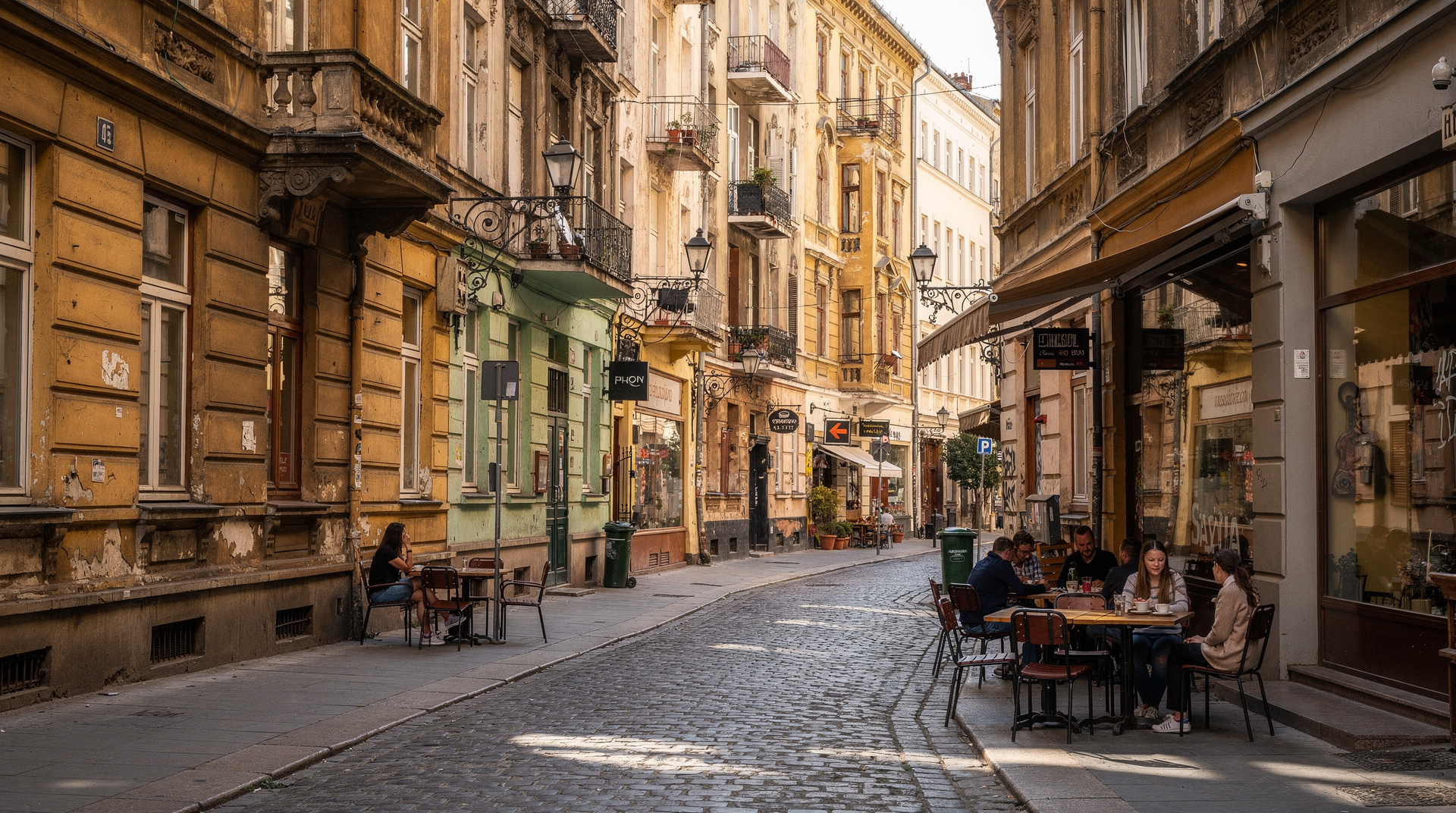
Szimpla Kert sits in the heart of the District VII Jewish Quarter, one of Budapest’s most historically significant and visually interesting neighbourhoods. Within five minutes’ walk:
- Dohány Street Synagogue (Dohány utca 2–8) — the largest synagogue in Europe; guided tours daily. See the Dohány Street Synagogue guide.
- Kőleves restaurant (Kazinczy utca 41) — Hungarian food at fair prices, good for a meal before hitting the bars.
- Mazel Tov (Akácfa utca 47) — Israeli-inspired kitchen in a ruin-bar courtyard; excellent hummus and cocktails.
- Ellátó Kert (Kazinczy utca 48) — lower-key ruin bar with a mostly local crowd.
For the broader neighbourhood and bar options, see best ruin bars in Budapest and the Budapest nightlife guide.
Getting there
Address: Kazinczy utca 14, Budapest 1075 (District VII)
Metro: M2 (red) to Blaha Lujza tér, then 10-minute walk west. Or M1/M2/M3 to Deák Ferenc tér, then 15-minute walk east.
Tram: 4 or 6 to Wesselényi utca stop (2 minutes’ walk).
On foot: From the Basilica, walk east along Paulay Ede utca and turn right onto Kazinczy utca (10 minutes). From Andrássy út, turn south at Király utca (10 minutes).
By Bolt (taxi): Drop-off point is Kazinczy utca 14; return trips from the same address are straightforward. See our Bolt and taxis guide.
For your wider trip planning, the Budapest 3-day itinerary suggests how to fit Szimpla into a full programme — typically a late-afternoon visit to Dohány Street Synagogue followed by an evening in the ruin-bar district works very well.
Szimpla Kert’s role in Budapest’s cultural transformation
It is not an exaggeration to say that Szimpla Kert changed the character of Budapest as a city. When it opened on Kazinczy utca in 2004, the Jewish Quarter was a neighbourhood in a slow decline — beautiful buildings left unpainted for decades, ground-floor shops closed, apartments subdivided into overcrowded units. The surrounding streets had an atmosphere of post-communist exhaustion.
The success of Szimpla Kert created a commercial proof of concept for the neighbourhood: a derelict factory could generate revenue; the aesthetic of decay was an asset rather than a liability; young people would travel from across Budapest (and then from across Europe) to drink in a bombed-out courtyard. Within five years, the entire Kazinczy/Akácfa/Dob utca triangle had transformed. Restaurants, bars, galleries, and boutiques followed the bars; property values increased; a neighbourhood that had been marked for demolition became one of the most desirable urban environments in Central Europe.
This was not planned. It was a consequence of one decision — to open a bar in a condemned building — that rippled outward in ways that none of the founders anticipated. Whether the transformation has been wholly positive is a legitimate question: property prices increased, long-term residents were displaced by commercial gentrification, and the tourism that followed the bars created its own pressures. But the physical transformation of the Jewish Quarter is inseparable from Szimpla Kert.
The Sunday farmers’ market in detail
The Szimpla Kert Sunday market (09:00–14:00) has been running since 2012 and has become one of the best food markets in Budapest. Unlike the Great Market Hall (which is primarily a retail market for established vendors), the Szimpla market emphasises small producers — farmers who bring their own goods directly to the city, artisans who make preserves or cheeses in small batches, and regional producers from the villages surrounding Budapest.
What you’ll find:
Cheese and dairy: Several small dairy producers from the villages within 100km of Budapest sell raw-milk cheeses — semi-hard, fresh curd, aged varieties. These cheeses are not available in supermarkets and are considerably more interesting than the commercial Trappista or Ementáli available elsewhere. Budget 1,200–3,000 HUF (€3–7.50) for a small cheese.
Bread: Wood-oven-fired sourdough loaves from small bakeries. Budapest has an excellent artisan bread revival; the Szimpla market has some of the best examples. Prices: 1,500–3,000 HUF (€3.75–7.50) per loaf.
Honey and preserves: A rotating selection of producers with regional honey varieties — forest honey, linden blossom, sunflower. Some also sell méhész (apiarist) products including propolis and beeswax candles.
Seasonal produce: Vegetables and fruit from small farms. In spring: asparagus, radishes, new potatoes. In summer: tomatoes, peppers, cucumbers, stone fruits. In autumn: squash, apples, walnuts. In winter: root vegetables, kale, stored apples.
Artisan crafts: A minority of stalls selling pottery, natural soaps, candles, and handmade clothing — less focused than the food stalls but adding to the market atmosphere.
The market is free to enter and there is no minimum spend requirement. The Szimpla Kert café is open from 09:00 on Sundays; you can buy a coffee and watch the market set up from a table inside.
Events at Szimpla Kert beyond the farmers’ market
The bar’s Facebook page (Szimpla Kert) is the primary source for events; the English-language site funtour.hu also aggregates events. Regular events beyond the market:
Film screenings: Occasional outdoor film nights in the courtyard in summer. Classic Hungarian films, international arthouse, and Budapest-relevant documentaries. Free or donation-based.
Jazz and acoustic music: On weekday evenings in the quieter seasons (October–March), Szimpla Kert hosts jazz sets and acoustic concerts. Quality varies but includes genuinely excellent local musicians.
Craft fairs and pop-up markets: Occasional themed markets — vintage clothing, handmade jewellery, art prints — typically on weekend afternoons.
Design and sustainability events: Szimpla has a stated commitment to sustainability and hosts events related to environmental issues — waste reduction, urban farming, community composting. These events are in Hungarian and primarily for local audiences but reflect the bar’s genuine civic identity.
Drinking at Szimpla Kert: a guide to the bars and areas
The bar has multiple service points; knowing where to go for what avoids unnecessary queue time:
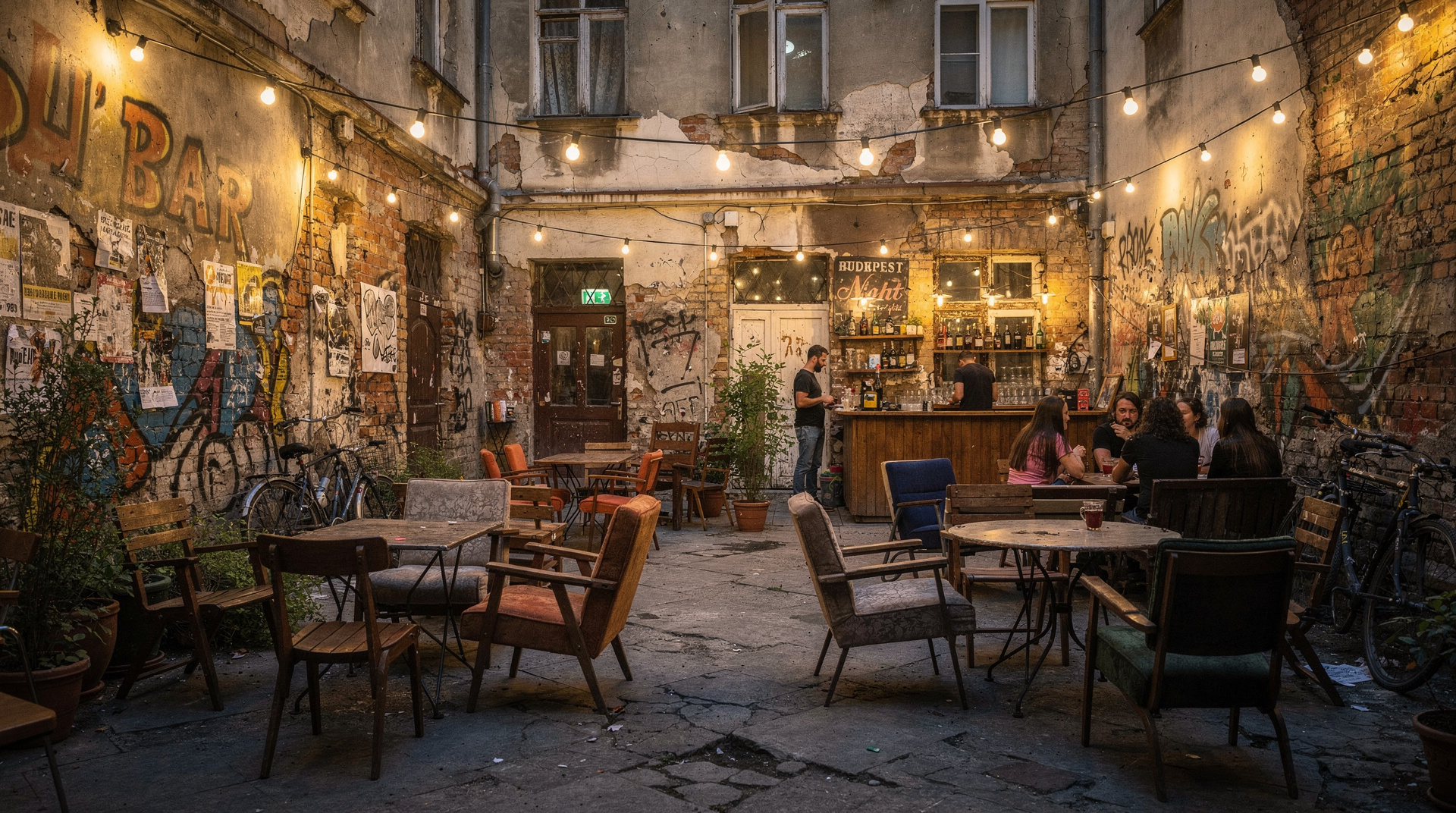
Main courtyard central bar: The longest bar in the venue, with the most beer taps. Draught options include Hungarian lagers (Dreher, Soproni), Hungarian craft beers (Legenda, HopTop), and imported options. Best for beer; quick service because the bar is long.
Indoor ground-floor bar room: A smaller bar near the DJ equipment with a more varied spirits selection. Better for cocktails and pálinka shots. Slightly more sheltered from rain and cold.
Upper floor gallery bar: On event nights, a second bar operates on the upper floor. Shorter queues because fewer people climb the stairs.
Recommendations:
- For first visit: a draught Hungarian beer (500ml glass) and a pálinka shot — the two items that most characterise the venue.
- For a longer evening: the Szimpla house wine is decent and well-priced. Ask for a white (fehér) or red (vörös) bor.
- For non-drinkers: lemonade (limonádé) and fruit juice are available; sparkling water (ásványvíz) is always on hand.
How Szimpla Kert compares to other ruin bars
Szimpla Kert is frequently compared to other ruin bars, usually to its disadvantage on the grounds of crowds. The comparison is fair:
Szimpla vs. Anker’t: Anker’t (Paulay Ede utca 33) is calmer, better for conversation, with similar aesthetics and slightly lower prices. If you’re visiting with someone you want to talk to, Anker’t on a Friday night beats Szimpla. If you want the iconic experience and the crowds don’t bother you, Szimpla on a Friday night is irreplaceable.
Szimpla vs. Ellátó Kert: Ellátó Kert (Kazinczy utca 48) has a more local clientele and lower prices. The space is smaller and less architecturally interesting than Szimpla, but the atmosphere is more neighbourhood-feeling. For visitors who want to feel less like a tourist, Ellátó Kert on a weekday evening is a better choice.
Szimpla vs. Instant–Fogas: Instant–Fogas (Akácfa utca 51) is what Szimpla might be if it had decided to become a proper club. Multiple rooms, DJs every night, younger crowd, louder music. The ruin-bar aesthetic is present but secondary to the club function. If you’re there to dance, Instant–Fogas; if you’re there for the atmosphere and conversation, Szimpla.
For the complete ruin-bar landscape, see best ruin bars in Budapest. For how to sequence a ruin-bar evening, see the Budapest nightlife guide and party districts in Budapest.
The history of the building
The physical history of Szimpla Kert matters to understanding what you’re visiting. The building at Kazinczy utca 14 was a factory and residential courtyard complex built in the late 19th century — typical of the dense, multi-use building stock in District VII. The courtyard layout (multiple wings surrounding a central space with galleries on each floor) was common in Budapest’s Jewish Quarter, where buildings were constructed to maximise residential density on expensive inner-city land.
After the Second World War and the nationalisation of private property under communism, buildings like this one fell into a maintenance cycle dictated by state housing authorities rather than private owners. Investment was minimal; repairs were done to keep buildings habitable but not to preserve or improve them. By the 1990s, much of District VII’s building stock was in a condition that Western European cities would describe as derelict — structurally sound but cosmetically deteriorated, with crumbling plaster, broken tiles, and courtyard spaces used for storage or left empty.
The first Szimpla opened not in this building but in a ground-floor space on Kertész utca in 2001. That original location closed; the Kazinczy utca courtyard opened in 2004 and became what is now the permanent Szimpla Kert. The founders’ deliberate choice to leave the building in its deteriorated state — using found objects, mismatched furniture, and the existing decay as aesthetic elements — defined the visual language of what would become the global ruin-bar concept.
District VII has changed substantially since 2004. The Jewish Quarter has become one of Budapest’s most sought-after areas for both short-term rental and permanent residence, with property values rising sharply. Szimpla Kert’s building is now valuable real estate; its continued existence as a bar is a deliberate cultural and commercial choice rather than a default outcome of cheap rent.
Photography at Szimpla Kert
Szimpla Kert is one of the most photographed spaces in Budapest, and for good reason. A few practical notes for photography:
Best time for interior photography: Weekday afternoons (14:00–17:00) before the evening crowd arrives. The light through the courtyard ceiling is good in summer; in autumn and winter the artificial lighting is more interesting photographically. The Sunday farmers’ market (09:00–14:00) is excellent for natural light and human interest.
What to photograph: The collected objects on the walls and ceiling (Trabant car body, vintage Hungarian TVs, lamps, mirrors), the courtyard gallery levels, the bar areas with their mismatched fixtures, and the faces of regulars on a quiet afternoon. On busy Friday and Saturday nights, photography is harder because the crowds are dense and the light is very low.
Asking permission: For close portraits of staff and regulars, asking is both respectful and more likely to produce good results — Hungarian bar staff are generally willing to pose briefly.
Phone vs. camera: The interior is dark; a phone with good low-light capability (iPhone 14 or later, recent Android flagships) will produce reasonable results. A DSLR or mirrorless camera with a wide-angle lens (24mm or wider equivalent) and a fast aperture (f/1.8 or wider) gives the best results in the low-light bar environment.
Understanding the Sunday farmers’ market
The Szimpla Kert Sunday farmers’ market (09:00–14:00, operating roughly October–June, weather-dependent) is one of the better markets in Budapest and significantly less tourist-oriented than the Great Market Hall. What’s sold:
Produce: Seasonal vegetables and fruit from small farms within approximately 100km of Budapest. In autumn: pumpkins, root vegetables, late stone fruit. In winter: stored apples, cabbages, root crops, fermented products. In spring: the first salad greens, asparagus, early tomatoes.
Processed foods: Hungarian artisan producers selling cheese, honey (including the forest honeys from the Bükk and Mátra hills, which are darker and more complex than acacia honey), charcuterie, jams, pickles, and fermented vegetables.
Ready to eat: Langos, fresh bread, pastries. Some stalls sell cooked breakfast items. Coffee from a market stall at around 400–600 HUF — cheaper than the bar prices, same quality.
Craft items: Handmade soap, beeswax candles, ceramics, and occasional textile items. The craft proportion of the market varies; the food producers are the consistent draw.
Why this market matters: the Great Market Hall (see central market hall guide) is architecturally magnificent but the upper floor has become largely a souvenir and tourist-food operation. The Szimpla market is smaller and has no tourist infrastructure — it’s a functioning local market in a courtyard that happens to be a famous bar on other days. Prices are aligned with local purchasing power, not tourist expectations.
Accessibility and getting around inside
Szimpla Kert occupies a converted 19th-century factory, and it shows in the layout: the ground-floor courtyard and the main bar rooms off it are reachable from the Kazinczy utca entrance without stairs, but the building was never designed with step-free access in mind. The upper gallery floors are reached by narrow original staircases, and several rooms off the courtyard have small level changes at the threshold. If mobility is a concern, the ground-floor courtyard alone still gives you the full Trabant-in-the-wall, salvaged-furniture experience — you won’t be missing the venue’s main character by staying at ground level. Staff are generally happy to point out the easiest route if asked. For a comparison of nearby venues with simpler single-level layouts, see best ruin bars in Budapest.
Seasonal differences at Szimpla Kert
The venue changes character across the year. Summer evenings push the crowd fully into the courtyard, with the upper galleries relatively quiet by comparison. Winter shifts the balance indoors — the covered rooms and ground-floor bars fill up while the courtyard, though still open, sees less lingering. The farmers’ market runs largely October–June (weather-dependent, per the market’s own schedule), so a July or August Sunday visit may find a smaller or absent market compared with the cooler months. If the Sunday market is your main reason for visiting, check the current season before planning around it.
Szimpla Kert with a group vs solo
Szimpla works well for both, but the experience shifts. In a group, the courtyard’s communal tables and multiple bar rooms are built for splitting up and regrouping — perfect for a bigger party who want to move between the DJ room and quieter corners without losing each other. Solo visitors do just as well, especially on a weeknight or at the Sunday market, where the shared-table layout and generally social crowd make striking up a conversation easy without feeling forced. See solo travel in Budapest for the wider picture on meeting people as a solo visitor.
Szimpla Kert for non-drinkers and daytime visitors
Not everyone visiting Szimpla wants to drink, and the venue works well without it. The Sunday farmers’ market is the best non-drinking version of a visit — coffee, fresh bread, cheese tastings and browsing, with the bar itself almost incidental. Weekday café-mode afternoons (12:00–18:00) are equally low-key: laptop workers and quiet conversation, good espresso, and the chance to see the architecture and salvaged-object décor without the evening crowd. Both lemonade (limonádé) and fresh juice are on the standard menu alongside alcohol, and nobody will treat you differently for ordering them. For families or anyone wanting the full daytime experience, pairing a market visit with the nearby Dohány Street Synagogue makes a full, alcohol-free District VII morning.
Frequently asked questions about Szimpla Kert guide
What are Szimpla Kert's opening hours?
Monday–Friday from 12:00 (noon) to 04:00. Saturday and Sunday from 09:00 to 04:00 (the earlier opening is for the Sunday farmers' market and Saturday brunch). Kitchen hours vary; drinks and snacks available all day.How much do drinks cost at Szimpla Kert?
Draught beer 950–1,350 HUF (€2.40–3.40), house wine from 800 HUF/glass, cocktails 2,200–2,800 HUF (€5.50–7), pálinka shots from 650 HUF, espresso from 600 HUF. Prices are honest and displayed on the menu — no surprise bills.What is the Sunday farmers' market at Szimpla?
Every Sunday from 09:00 to 14:00, the courtyard hosts a farmers' market with around 20 stalls selling local cheese, bread, honey, pickles, fruit, and artisan products. Free to enter, no minimum spend. One of the best places to buy local food in Budapest.Is Szimpla Kert too touristy now?
It is very well known and draws significant tour-group traffic in summer. That said, the prices haven't inflated to match the fame, the space is large, and it remains a working neighbourhood bar with regular local customers. For a less touristy ruin-bar experience, try Ellátó Kert, Anker't, or Kőleves kert.What is inside Szimpla Kert?
Three floors and a courtyard across a former factory building. Each area has a different character: the ground-floor courtyard is the main outdoor space; the first-floor gallery has tables and sofas; the second floor has DJ equipment. A Trabant car is embedded in one wall. Salvaged furniture, graffiti, and art throughout.Is Szimpla Kert wheelchair accessible?
Partially. The ground-floor courtyard and main bar areas are accessible via the Kazinczy utca entrance, but the building's uneven floors, steps between some rooms, and the narrow staircases to the upper gallery levels are not step-free. If accessibility is essential, stick to the ground-floor courtyard and ask staff about the easiest route in — they are generally helpful.Is there an entry fee at Szimpla Kert?
No — entry is free at all times, including the Sunday farmers' market. You only pay for what you order at the bar or market stalls. On the busiest weekend nights there can be a queue to get in once the venue nears capacity, but there is no cover charge.
Top experiences
Bookable activities with verified prices and instant confirmation on GetYourGuide.