Coffee houses in Budapest: the historic kávéház tradition and where to go today

What is the best coffee house in Budapest?
The New York Café (Erzsébet körút 9) is the most spectacular — a gilded Habsburg-era interior that's genuinely extraordinary. Centrál Kávéház (Károlyi Mihály utca 9) is more authentic and less touristy. For a neighbourhood café experience without the crowds, Espresso Embassy (Arany János utca 15) and Fekete (Ferenczy István utca 5) are the best third-wave options.
Budapest’s coffee-house culture: a living tradition
Budapest was, before Vienna, the city that defined the grand European coffee house. In the late 19th century, the kávéház was a social institution — open from early morning until midnight, charging only for coffee but providing warmth, newspapers, and effectively an office for writers, journalists, lawyers, and intellectuals who couldn’t afford private rooms. Writers would sit for twelve hours over a single espresso, conducting their correspondence and literary work at marble tables.
The communist era destroyed much of this culture — many grand coffee houses were nationalised and turned into something between a canteen and a supermarket. But Budapest retained more of the tradition than other Central European cities, and several legendary cafés survived, reopened, or were faithfully restored. Today the coffee-house culture runs from the genuinely grand (New York Café) to the neighbourhood presszó (simple, cheap, and local) to the third-wave specialty coffee shop (excellent espresso, no history).
This guide covers all three.
| Where | Grand cafés cluster around Vörösmarty tér and District VII; specialty coffee is more spread out |
| Cost | Espresso around 350–950 HUF at a presszó/specialty shop, 1,800–4,500 HUF at a grand café |
| Time needed | 30 minutes for a quick stop, 1–2 hours for a proper grand-café visit |
| Getting there | Central options are all metro M1/M2/M3-accessible |
| Best time | Weekday mornings for the grand cafés; any time for neighbourhood presszós |
The grand historic coffee houses
New York Café — Erzsébet körút 9, District VII
The New York Café (inside the New York Palace Hotel) is the most spectacular café interior in Central Europe. Built in 1894, the room has gilded baroque columns, frescoed ceilings, crystal chandeliers, marble floors, and multiple levels of seating connected by ornate staircases. It looks like what it is: a Habsburg-era palace that happened to be a café.
The honest assessment: the interior is genuinely extraordinary and worth seeing. The café experience itself is expensive and slightly tourist-facing — espresso starts around 2,500 HUF (€6.25), cakes at 2,500–4,000 HUF (€6.25–10), and a full breakfast at 8,000–14,000 HUF (€20–35) per person. The quality is respectable but not exceptional for the price.
Go for: a morning coffee to experience the interior. Arrive at opening (09:00) to avoid queues. Don’t go for lunch or dinner — the value proposition doesn’t hold.
Gerbeaud — Vörösmarty tér 7, District V
Gerbeaud has been on Vörösmarty tér since 1858, making it one of the oldest surviving café-confectioneries in Europe. The interior is solid Habsburg-era — marble tables, wood panelling, portrait paintings — though less spectacular than New York Café. The cake display is extensive: dobos torta, esterhazy torta, Gerbeaud-szelet (the house chocolate-nut cake), fruit tarts.
Honest note: Gerbeaud is tourist-priced. Espresso at 1,800–2,500 HUF (€4.50–6.25), cakes at 1,500–3,000 HUF (€3.75–7.50). The location on the main tourist square means you pay a location premium. The cakes are reliably good, not transcendent. For better pastry at lower prices, go to Auguszt or Ruszwurm (below).
Centrál Kávéház — Károlyi Mihály utca 9, District V
Centrál Kávéház is the best balance between historic authenticity and reasonable prices. Founded in 1887, it was a major literary café before being closed during communism and restored in 2000. The interior is elegant without being overwhelming; the food menu is proper (Hungarian dishes alongside pastry); the coffee prices are mid-range (espresso ~900–1,400 HUF / €2.25–3.50).
This is the best option for visitors who want the grand-café atmosphere without the tourist premium of New York Café or Gerbeaud.
Ruszwurm — Szentháromság utca 7, Castle District
The smallest historic café in Budapest — a single tiny room on Castle Hill, open since 1827. Serves coffee and its own pastries: dobos torta, Ruszwurm Szelet (almond-and-cream layer cake), and seasonal specials. Prices are fair (cake slices 800–1,200 HUF / €2–3). The room holds perhaps 15 people; arrive early or expect to wait.
Pastry shops (cukrászda): better pastry, honest prices
Auguszt Cukrászda — Fény utca 8, District II (Buda); multiple locations
Auguszt is a family-run confectionery that has operated since 1870. The pastry quality is excellent — the dobos torta here is often cited as the best in Budapest. Espresso around 600–800 HUF; cakes 600–1,200 HUF. The Fény utca location near Mammut shopping centre is the most accessible.
Daubner Cukrászda — Szépvölgyi út 50, District III (Óbuda)
A neighbourhood pastry institution in a quiet residential area — significantly less touristy than anything in the centre, with local families queuing for their weekend cakes. Dobos, esterhazy, and seasonal fruit tarts; prices are very fair (600–1,000 HUF per slice). Getting there requires tram 17 or 19 along the Danube or HÉV suburban train to Aquincum — worth it if you want to see a non-tourist Budapest neighbourhood.
Third-wave specialty coffee: the best espresso
Espresso Embassy — Arany János utca 15, District V
The benchmark for specialty coffee in Budapest. Single-origin espresso, excellent filter coffee, multiple brew methods. The interior is small and sometimes crowded; the coffee is consistently excellent by European standards. Espresso 700–900 HUF (€1.75–2.25). The staff are knowledgeable and the bean selection rotates.
Fekete — Ferenczy István utca 5, District V
A neighbourhood café in the quiet streets between the Jewish Quarter and the Danube. Good espresso, reliable pastry (from Auguszt among others), and a calm atmosphere that contrasts with the tourist pressure of the area. One of the best places for a morning coffee on the way to Szimpla Kert’s Sunday farmers’ market.
My Little Melbourne — Magyar utca 12, District V
Australian-influenced specialty coffee in a tiny room. Flat whites done properly, good filter. Popular with expats and young locals.
Food to order in a coffee house
- Dobos torta: Five to six layers of sponge cake with chocolate buttercream, topped with caramelised sugar. Hungary’s most famous cake, developed by chef József Dobos in 1884.
- Esterhazy torta: Walnut sponge layers with vanilla buttercream, decorated with icing in a distinctive feathered pattern.
- Rétes (strudel): Paper-thin pastry with sweet or savoury fillings. Apple, cherry, or cottage cheese are the standards.
- Flódni: A Jewish-heritage multi-layer pastry with poppy seed, walnut, and apple fillings; found at Jewish-quarter cafés and some cukrászdák.
- Palacsinta: Thin pancake/crepe with sweet fillings — jam, Nutella, cottage cheese.
For a food tour that covers Budapest café culture alongside other food stops, the eat, sip and explore food tour includes a café stop in the Jewish Quarter neighbourhood.
Combining coffee houses with sightseeing
The grand coffee houses work naturally alongside nearby sights:
- New York Café + Keleti station (5 min walk) + the Jewish Quarter bars (10 min walk)
- Gerbeaud + Vörösmarty tér + a walk across Chain Bridge
- Ruszwurm + Fisherman’s Bastion + Matthias Church (all on Castle Hill)
- Centrál Kávéház + Ferenciek tere + the Great Market Hall (15 min walk)
For a Budapest 3-day itinerary that incorporates coffee house visits, the planner suggests morning coffee at Centrál before Parliament, and an afternoon pastry break at Ruszwurm during a Castle Hill visit.
See best restaurants in Budapest for the full dining context and traditional Hungarian dishes for what you’ll find on the food menus.
The decline and revival of Budapest’s kávéház tradition
Budapest’s coffee-house culture reached its peak in the 1910s and 1920s, when the city had over 600 kávéházak. The most famous — the New York Café, Gerbeaud, Centrál, Japán — were meeting places for every strand of Hungarian intellectual and artistic life. Endre Ady wrote poetry there; Attila József argued with editors; artists sketched on napkins at marble tables.
The communist regime that took power after 1949 viewed the kávéház as ideologically suspect — bourgeois, unproductive, potentially seditious. Most were nationalised, converted into canteens, or simply closed. The famous New York Café became a sports goods store. Gerbeaud survived as a state canteen. Centrál closed entirely.
The physical buildings survived. After 1989, the liberalisation of the Hungarian economy made commercial revival possible. New York Café was purchased and restored to its pre-war grandeur (reopening 2006 as part of the Boscolo hotel group). Centrál was restored by a private investor (reopening 2000). Others followed.
What’s striking about the revival is its faithfulness. The restoration of New York Café, in particular, used original photographs and surviving architectural drawings to recreate the gilded interior as accurately as possible. The result is a room that looks essentially as it did in 1910 — which is why it remains one of the most spectacular interior spaces in Central Europe.
Coffee culture: Hungarian vs. Viennese vs. Italian
Budapest’s coffee culture occupies a middle position between Vienna and Italy, having absorbed influences from both. The key distinctions:
Hungarian espresso tradition (presszókávé): Strong, served in a small cup, black. This is the default; “kávé” in a presszó means espresso. Milk is available but not automatic. Price: 350–600 HUF (€0.88–1.50). The quality at a traditional presszó varies enormously — some are excellent, some use cheap industrial beans.
Viennese influence: The grand kávéházak (New York, Gerbeaud, Centrál) reflect Viennese coffee-house tradition more than Italian — larger cups, more milk options, the newspaper rack, the expectation of spending extended time at a table. A Melange (espresso with steamed milk and foam, similar to a cappuccino) is available at all grand cafés.
Third-wave specialty coffee: Since around 2010, Budapest has developed an excellent specialty coffee scene — single-origin, carefully roasted and brewed, often with filter coffee (pour-over, AeroPress) alongside espresso. Espresso Embassy, Fekete, and My Little Melbourne are the leaders. Espresso here costs 700–950 HUF (€1.75–2.40) — more than a presszó, less than a tourist-facing hotel bar.
The dobos torta: Hungary’s most famous cake
The dobos torta (Dobos cake) deserves more attention than it gets in most food guides. Created by József C. Dobos in 1884 and first presented at the National General Exhibition in Budapest that year, the cake was revolutionary: it used thin sponge layers (biszkóit) spread with chocolate buttercream, stacked to create a height and elegance that Hungarian pastry hadn’t previously achieved. The top layer of caramelised sugar — the signature element — was Dobos’s innovation for preserving the cake in an era before reliable refrigeration.
Dobos presented his cake to Emperor Franz Joseph and Empress Sisi; it became fashionable throughout the Austro-Hungarian empire. The recipe was finally released publicly in 1906 when Dobos retired, allowing cukrászdák across Hungary to produce it.
A properly made dobos torta has 5–7 layers, each approximately 5mm thick, with a thin chocolate buttercream. The caramel top is hard and shiny, scored into wedges. A bad version is dense, poorly layered, and has a caramel top that is either too thin (won’t crack properly) or too thick (breaks teeth).
Where to find the best: Auguszt Cukrászda (Fény utca 8) and Szamos (Vörösmarty tér 7, and multiple locations) are the most consistently recommended. Ruszwurm (Castle Hill) also makes an excellent version.
Coffee-house etiquette and customs
A few things to know before visiting:
Expecting to linger: Budapest coffee houses are not espresso-and-go establishments. Taking a table for an hour over a single coffee is entirely normal and expected. At Centrál Kávéház, you’ll see people with laptops, people reading books, and tables of friends in conversation — all staying as long as they wish. No one will rush you.
The “main waiter” system: In traditional kávéházak, you’re assigned to a specific waiter for your table. Do not wave at any passing waiter — find your waiter. This sounds archaic; it’s actually efficient once understood.
Newspaper racks: Gerbeaud and Centrál Kávéház maintain newspaper racks with Hungarian and some international dailies — a direct continuation of the historical function. Reading a newspaper at a marble table over coffee is entirely appropriate.
Tipping: At traditional café table service, 10% is standard. At counter service (presszó), rounding up to the nearest 100 HUF is normal.
Coffee houses for different visit types
For the first-time visitor: Centrál Kávéház (Károlyi Mihály utca 9) gives the genuine grand-café experience at reasonable prices. One morning coffee and a cake slice in this room is worth doing.
For the architectural experience: New York Café (Erzsébet körút 9) — budget 4,000–6,000 HUF for two coffees and two cakes, stay 45 minutes, and treat it as a museum visit with drinks rather than a regular café.
For the best coffee quality: Espresso Embassy (Arany János utca 15) — specialty espresso, knowledgeable staff, no tourist premium.
For the most authentic local experience: Any neighbourhood presszó in Districts VIII, IX, or XI — find one by walking away from the tourist areas and looking for a small room with regulars at the counter.
For the full Budapest eating landscape, see best restaurants in Budapest. For the food tour introduction that includes café stops, see best food tours in Budapest. For the walk that takes in key Jewish Quarter café-bars alongside the synagogue visit, see the Jewish Quarter heritage guide.
The Budapest coffee-house tradition in historical context
Budapest’s café culture reached its peak between 1890 and 1914, when there were over 400 kávéházak in the city. The scale is significant: more than one café per 1,000 residents in a city of 800,000. These were not primarily restaurants or bars — they were working spaces and social infrastructure.
The kávéház served as office, meeting room, salon, and editorial floor. Writers kept tables for months or years; editors accepted manuscripts submitted over the counter; artists held informal academies. The New York Café was the gathering point for virtually the entire Hungarian literary and journalistic establishment from the 1890s to the 1940s.
The destruction came in two waves. The Second World War damaged many buildings. But the more thorough elimination came with nationalisation after 1948 — the communist government systematically converted kávéházak to other uses, viewing the café as a bourgeois institution incompatible with socialist society. Some became presszók (state-run counter-service establishments without the literary ambience), others became workers’ buffets or state retail outlets, others were subdivided into apartments.
By 1970, Budapest had perhaps 20 functioning kávéházak from 400. The survivors — Gerbeaud, Ruszwurm, Centrál — persisted partly through being on tourist routes and partly through state-managed café trusts.
The revival began slowly in the 1990s and accelerated in the 2000s. Centrál Kávéház reopened in 2000 after complete restoration. New York Café reopened in 2006 as part of a luxury hotel conversion. The specialty coffee wave arrived roughly 2012–2015, bringing the third-wave espresso bar format to Budapest alongside the traditional kávéház revival.
Specialty coffee: Budapest’s third-wave scene
Alongside the traditional kávéház revival, Budapest has developed a serious specialty coffee scene that deserves attention separate from the grand cafés:
Espresso Embassy (Arany János utca 15, District V): The most respected specialty coffee shop in the city. Single-origin espresso, precise filter coffee, trained baristas who can explain the origin and processing of each coffee. No tourist premium — the clientele is a mix of local professionals and coffee enthusiasts. The coffee quality is excellent by European specialty standards.
Fekete (Ferenciek tere 5, District V): Downtown specialty coffee in a small but beautifully designed space. Consistent espresso, good pour-overs, excellent pastries from a neighbouring bakery. Popular with students from the nearby Eötvös Loránd University.
My Little Melbourne (Madách tér 3, District VII): Australian-influenced coffee culture in the Jewish Quarter. Flat whites done properly — a rarity in Central Europe outside Vienna. Also serves breakfast and brunch; popular on weekend mornings.
Kontakt (Móricz Zsigmond körtér 2, District XI): Away from the tourist areas in the Buda-side residential neighbourhood, Kontakt serves excellent specialty coffee to a local clientele. One of the better examples of how Budapest’s specialty coffee culture has spread beyond the downtown zone.
The distinction between these specialty coffee shops and the traditional kávéházak matters for planning: the specialty shops are for morning and afternoon coffee-focused visits; the kávéházak are for longer stays with pastry and atmosphere. They serve different purposes and both are worth doing.
Cakes and pastries: what to order
The traditional kávéház menu includes a selection of cakes (sütemény) and pastries (tészta) that merit specific guidance:
Rétes (strudel): Thin pastry rolled around a filling — apple (almás), sour cherry (meggyes), or cottage cheese (túrós). The Hungarian rétes has a thinner, more delicate pastry than the Austrian Strudel; the filling-to-pastry ratio favours the filling. Available at most kávéházak and cukrászdák (cake shops).
Dobos torta: The defining Hungarian cake — five to seven layers of sponge with chocolate buttercream, topped with caramel. Created by József Dobos in 1884 and presented at the National Exhibition; the recipe was kept secret until 1906 when Dobos donated it to the Budapest Confectioners’ and Gingerbread Makers’ Guild. A good dobos torta should have crisp caramel that cracks cleanly, not bends, when you tap it.
Krémes: Hungarian version of the vanilla slice — choux pastry or puff pastry with thick vanilla custard. Lighter than it looks; one of the more reliably good standard offerings.
Somlói galuska: A composed dessert of sponge, walnuts, raisins, chocolate sauce, and whipped cream — associated with the Gundel restaurant (District XIV) where it was created in the 1950s, but now widely available. Difficult to eat gracefully; delicious.
Rigó Jancsi: Chocolate sponge with chocolate cream filling and chocolate glaze, named after a 19th-century Romani violinist. Less commonly found than dobos torta but worth ordering when available.
At Gerbeaud (Vörösmarty tér 7), the whole pastry counter is visible before ordering — this is the best approach: look at what’s freshly restocked (cakes with condensation on the display cases are fresh), choose by appearance, and point if you don’t know the Hungarian name.
How Budapest compares to Vienna and Prague
Coffee-house culture is one of the few things Budapest, Vienna and Prague all genuinely share a Habsburg-era history in, but the modern experience differs. Vienna’s coffee houses (Café Central, Café Sperl) are more formal and considerably more expensive — a comparable espresso runs €4–5 versus Budapest’s €1.50–2.50 at most cafés outside the very top tier. Prague’s café scene leans more toward beer-hall-adjacent casualness and has fewer surviving grand 19th-century rooms. Budapest sits between the two: genuinely grand interiors (New York Café rivals anything in Vienna) at prices closer to Prague’s. See the Budapest vs Vienna and Budapest vs Prague comparisons for the fuller cost picture beyond coffee.
Vegan, dairy-free and gluten-free options
Budapest’s grand kávéházak were not designed with dietary restrictions in mind, and it shows — most cakes rely on butter, eggs and wheat flour as structural ingredients, not optional add-ons. That said, the specialty coffee scene has caught up faster than the historic cafés: Espresso Embassy and Fekete both offer oat or soy milk on request, and a small number of neighbourhood presszós in Districts VII and IX now stock plant-based milk as standard. Gluten-free cake is rare outside a handful of dedicated bakeries; do not expect it at Gerbeaud, New York Café or Centrál. If dietary restrictions matter to your trip more broadly, see the vegetarian and vegan Budapest guide for restaurant-level detail beyond coffee houses.
Working from a coffee house
Specialty coffee shops (Espresso Embassy, Fekete, Kontakt) are generally laptop-friendly with reliable Wi-Fi and outlets, and nobody minds a working visitor buying one coffee and staying an hour. The grand kávéházak are a different matter: New York Café and Gerbeaud are tourist-facing enough that a table is expected to turn over reasonably quickly at peak hours, even though the historic culture of lingering technically still applies. Centrál Kávéház sits in between — quieter mid-morning, busier at lunch — and its literary-café atmosphere genuinely suits an hour of writing or reading. Avoid opening a laptop at Ruszwurm; the room is far too small for it to be socially acceptable.
A one-morning coffee-house crawl
For visitors who want to sample the range in a single outing rather than choosing one café, a compact route works well starting in the Castle District and finishing in Pest. Begin at Ruszwurm on Castle Hill for a small pastry and coffee before the crowds arrive (opening time is best). Walk or take the funicular down to Clark Ádám tér, cross Chain Bridge, and continue to Centrál Kávéház for a proper sit-down coffee and a look at the restored literary-café interior — budget 45–60 minutes here rather than rushing it. Finish at Gerbeaud on Vörösmarty tér for a slice of dobos torta and a view of one of Budapest’s grandest squares before moving on to afternoon sightseeing. The full route, including walking time, takes roughly three hours and covers two river crossings’ worth of scenery along the way — a genuinely pleasant way to structure a slower morning between bigger sights.
An alternative, less touristy version swaps Gerbeaud for Espresso Embassy or Fekete, trading a grand finale for a better cup of coffee and a calmer room — a reasonable trade if quality matters more to you than spectacle by the third stop of the day.
Coffee houses by neighbourhood
| Area | Notable options | Character |
|---|---|---|
| District V (Belváros) | Gerbeaud, Centrál, Espresso Embassy, My Little Melbourne | Central, busiest, most tourist traffic |
| District VII (Jewish Quarter/Erzsébetváros) | New York Café, Fekete, My Little Melbourne | Mix of grand café and specialty coffee, close to ruin bars |
| Castle District (Buda) | Ruszwurm | Historic, tiny, best combined with sightseeing |
| District II/III (Buda residential) | Auguszt (Fény utca), Daubner | Local, cheaper, far fewer tourists |
| District XI (Buda residential) | Kontakt | Specialty coffee, genuinely local clientele |
Use this table to decide whether you want a central, sightseeing-adjacent stop or a deliberate detour into a quieter residential neighbourhood — both are worthwhile, but they serve different kinds of morning.
Fitting coffee houses into a wider Budapest plan
A coffee house works best as a pause between bigger sights rather than as a destination on its own. If you are still deciding how to shape your days, the first time in Budapest guide and the Budapest 3 days overview show where a slow morning fits. The first-timer highlights itinerary and the weekend break itinerary both leave room for a café stop, and the Budapest in 1 day plan works if you only have time for one grand room.
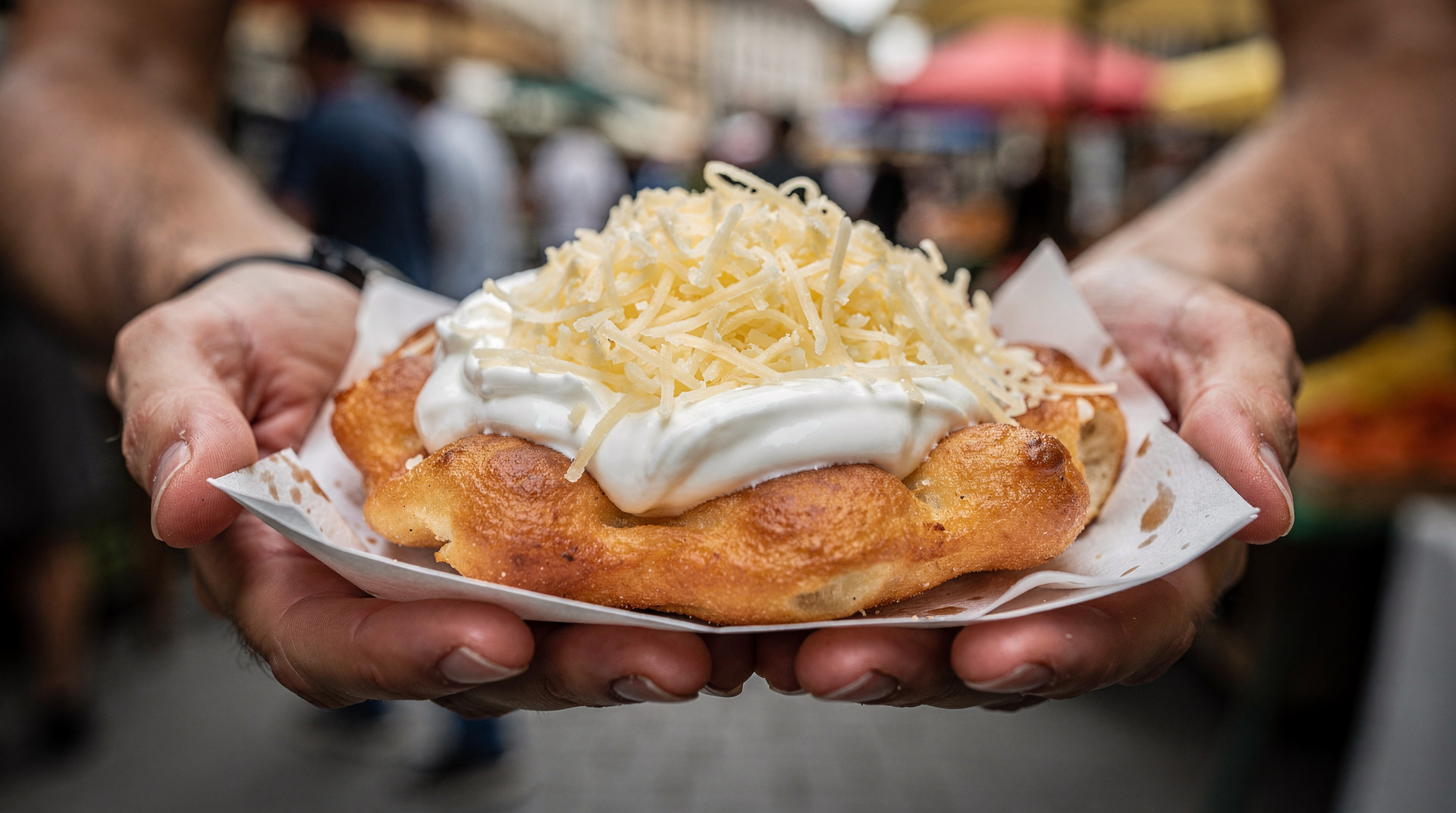
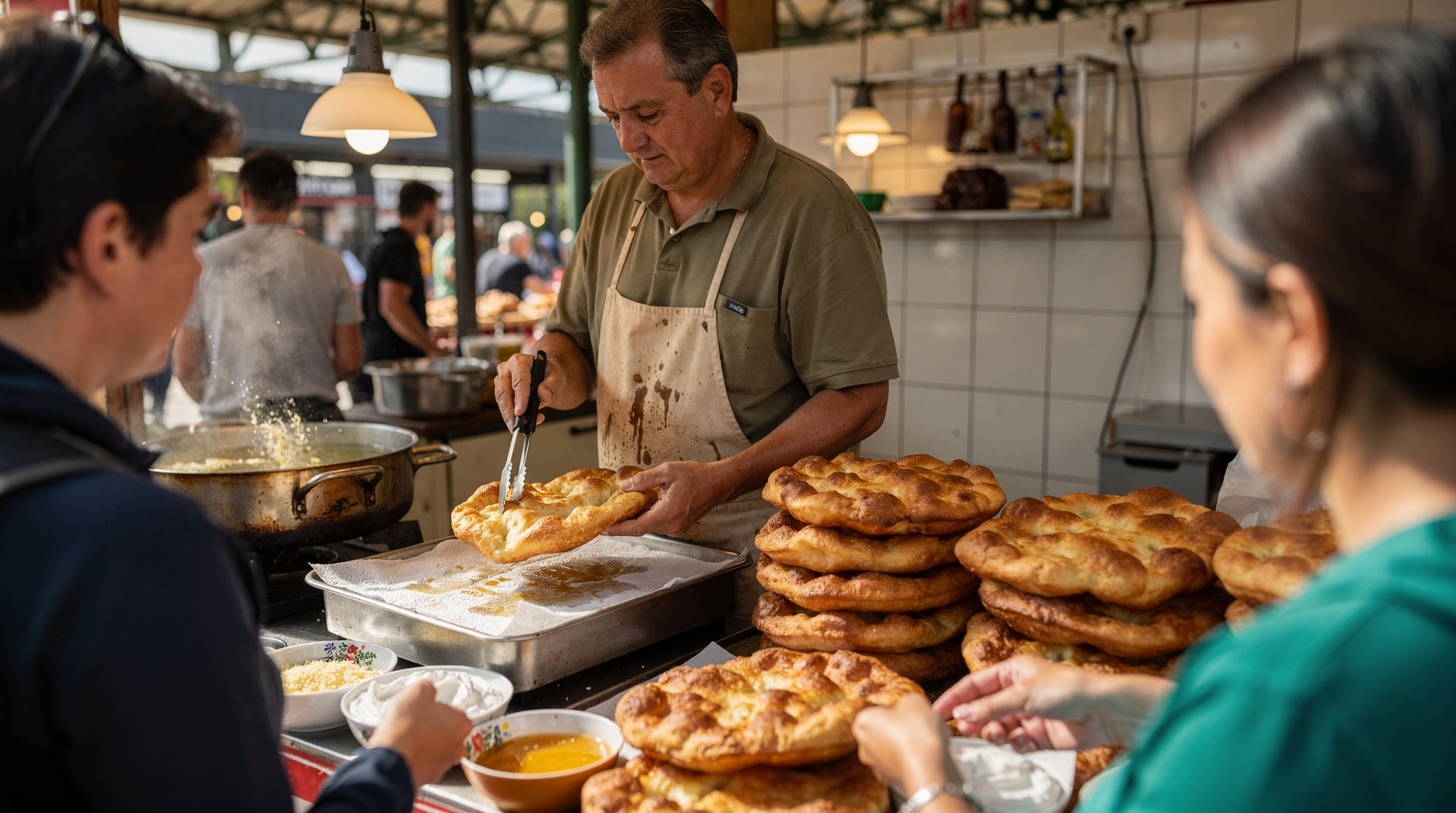
Pairing a café with a market visit is a good way to see how locals eat. The Great Market Hall guide covers the hall itself, and if you would rather have someone lead you, a guided walk that moves from the market stalls to a traditional tavern gives you the same mix of coffee-break pace and local food. For a cake-focused afternoon, the chimney cake guide is the natural companion to the pastries above.
Coffee houses also help in bad weather and in winter. When the days are cold, a long table at a kávéház is one of the most pleasant ways to wait out the rain; see Budapest in winter for how to pace those days, and the Budapest Christmas markets guide if you are visiting in the festive season. Travelling with children? The rainy day Budapest with kids guide is worth keeping handy alongside the cake list. For the Jewish Quarter end of the route, the District VII guide and the Jewish Quarter destination page help you place Fekete and My Little Melbourne in context, while the Castle District page does the same for Ruszwurm.
If you like to combine eating and drinking in one outing, the street food guide and the traditional Hungarian dishes guide cover what to eat between coffees, and the Budapest daily budget guide helps you decide how many grand-café visits fit your plans.
Frequently asked questions about Coffee houses in Budapest
What is a kávéház?
Kávéház means coffee house. Budapest's grand kávéház tradition dates from the late 19th century — large café spaces with marble tables, mirrored walls, newspaper racks, and all-day service. Writers, artists, and intellectuals would rent a table for hours. The tradition was suppressed during communism (many were turned into cafeterias) but has been revived; several originals survive.Is the New York Café worth the price?
Worth visiting for the interior, yes. Worth eating or drinking there as a regular café visit, probably not — coffee runs 2,500–4,500 HUF (€6.25–11.25), cakes 2,000–4,000 HUF (€5–10), and the food quality doesn't match the price. Go for a morning coffee, enjoy the interior, and eat elsewhere. Booking a table is required for a full meal.What should I order at a Hungarian coffee house?
Espresso (presszókávé) is the default; black coffee is strong and good. Cappuccino and café latte are widely available. For food: rétes (strudel slices), dobos torta (layered sponge with chocolate buttercream and caramel top, Hungary's most famous cake), and French-influenced pastries. At a traditional cukrászda (pastry shop), the pastry quality is usually better than the coffee.What is the difference between a kávéház, presszó, and cukrászda?
A kávéház is a grand café with full service, often food and full meal service alongside coffee. A presszó (presszo) is a smaller, simpler neighbourhood coffee shop — counter service, basic pastries, no pretension. A cukrászda is a pastry shop that also serves coffee but focuses on cakes and sweets. All three are worth knowing.
Top experiences
Bookable activities with verified prices and instant confirmation on GetYourGuide.