District VII Jewish Quarter guide: Budapest's most dynamic neighborhood

What is Budapest's Jewish Quarter known for?
Two things simultaneously: it's the historic heart of Jewish Budapest, home to the Dohány Street Synagogue (Europe's largest) and a significant WWII memorial site — and it's also Budapest's most lively nightlife district, with ruin bars, international restaurants, street art, and the Gozsdu Udvar courtyard complex. The tension between the two is part of the area's character.
| Where | Central Pest, east of District V, around Kazinczy and Dob utca |
| Time needed | Half a day for heritage sites; a full evening for nightlife |
| Getting there | Astoria or Deák Ferenc tér (M1/M2/M3); tram 4/6 along Erzsébet körút |
| Best time | Weekday morning for the synagogue; Sunday morning for Szimpla’s market; evening for bars |
| Cost | Free to walk; synagogue entry around 5,000–7,000 HUF |
A neighbourhood with two histories
District VII — officially Erzsébetváros (Elizabeth Town) — holds two significant histories simultaneously, and understanding both helps you navigate the neighbourhood honestly.
The first history: the Jewish Quarter of Budapest. From the 18th century until WWII, this area was the centre of Budapest’s large and culturally significant Jewish community. At its peak, Budapest had one of the largest Jewish populations in Europe — over 200,000 people. The Dohány Street Synagogue was the largest synagogue in Europe; the neighbourhood had dozens of smaller houses of prayer, kosher butchers, Jewish schools, and community organisations. The Budapest Ghetto established during WWII was centred here; the Memorial Park behind the Dohány Synagogue holds mass graves.
The second history: the neighbourhood’s post-2000 transformation into Budapest’s nightlife capital. After decades of neglect (and significant destruction during the WWII Ghetto period), the area’s cheap rents and atmospheric crumbling buildings attracted young creative entrepreneurs in the early 2000s. Szimpla Kert opened in 2001 in a former factory and became the template for the “ruin bar” — a decaying building made into an improbable social space. Dozens followed. The Jewish Quarter became the most dynamic neighbourhood in Budapest.
Both histories are real, and both are present today.
The Jewish heritage
Dohány Street Synagogue
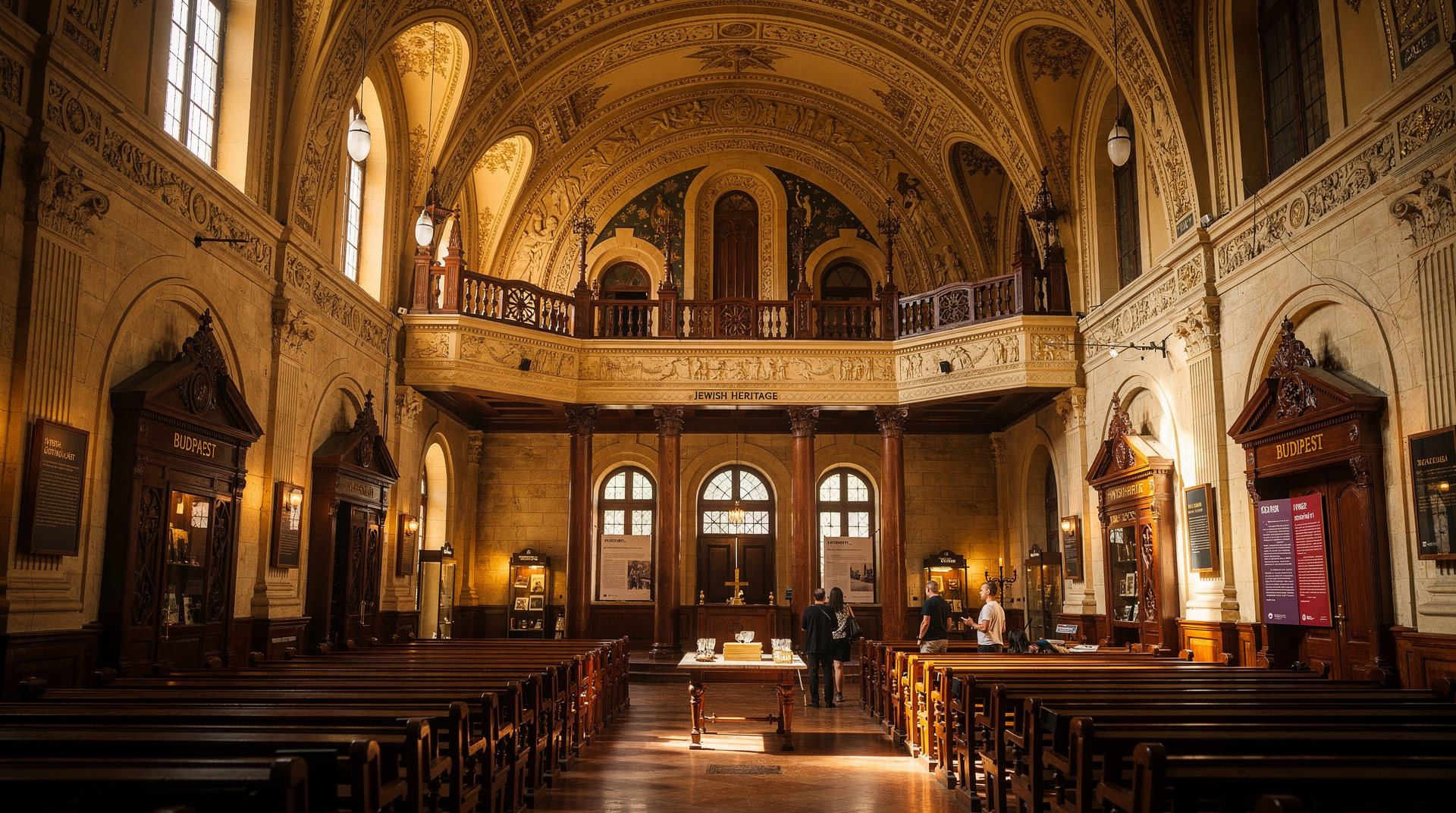
The Great Synagogue on Dohány utca is Europe’s largest synagogue and the second largest in the world. Built in 1859 in a Moorish Revival style (twin onion domes, striped brickwork), it seats over 3,000 people. The interior is extraordinary: the Romantic-style ark, the enormous pipe organ, and the gallery layout make it feel unlike any other Jewish building in Europe.
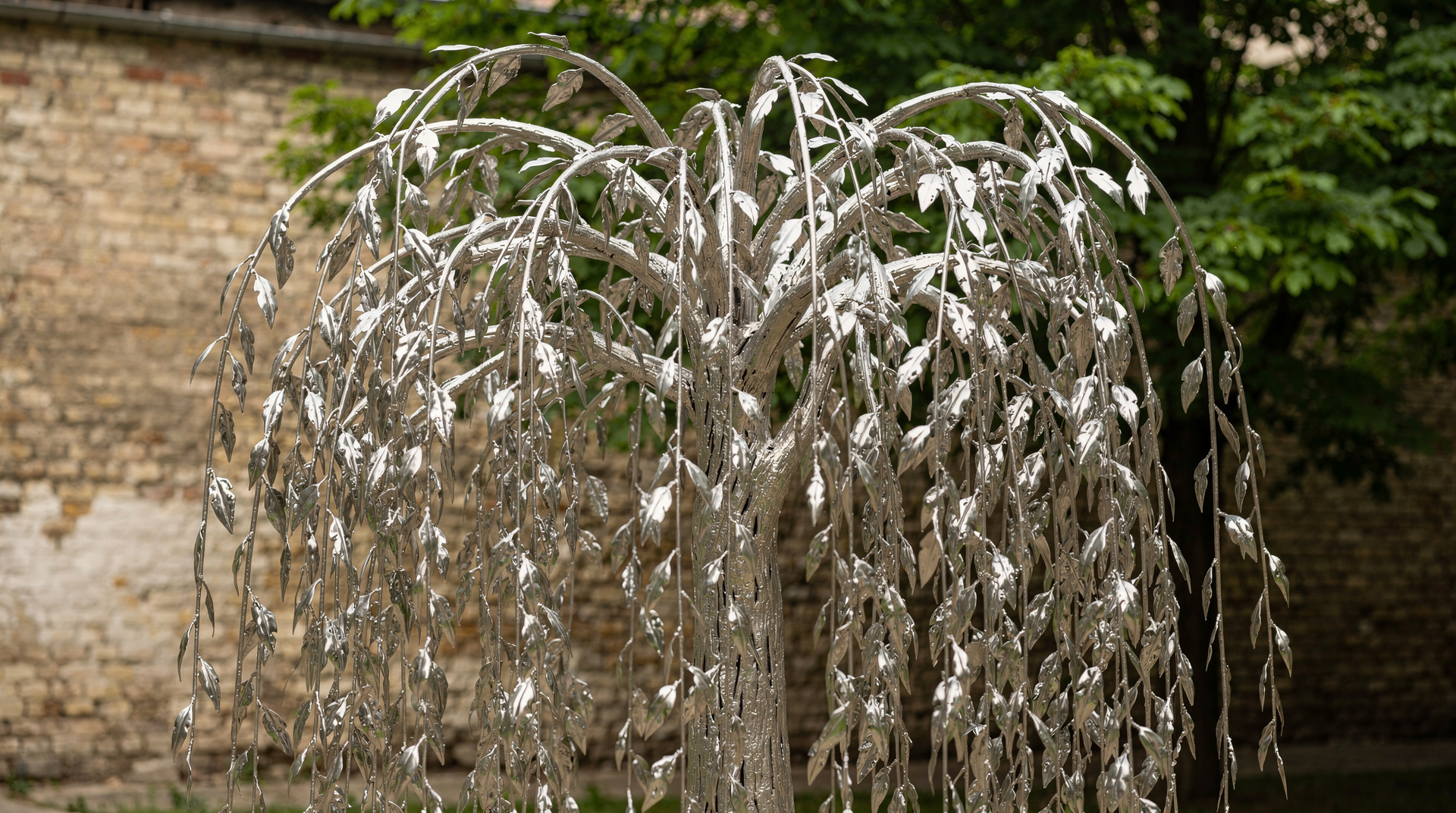
Behind the synagogue: the Raoul Wallenberg Memorial Park contains the Weeping Willow memorial (designed by Imre Varga), marking mass graves from the Budapest Ghetto. The Jewish Museum adjacent to the synagogue covers the history of Jewish Budapest in careful detail.
Tours of the synagogue run regularly; booking in advance is advisable in summer:
Jewish Quarter walking tour with Dohány Synagogue entryAdmission: approximately 5,000–7,000 HUF (€12–18) including museum. More at the Dohány Street Synagogue guide.
Rumbach Sebestyén utca Synagogue
A smaller, more intimate synagogue designed by Otto Wagner (the Viennese architect of the Secessionist movement) in 1872. Less visited than Dohány but architecturally fascinating — the Moorish-Byzantine interior is beautifully preserved and the scale is more human. Check opening hours; it hosts occasional Shabbat services and cultural events.
Jewish heritage walking tour
For the full historical context — not just the synagogue but the community’s 250-year story in this neighbourhood: Jewish Quarter private walking tour of Budapest
The ruin bars and nightlife
Szimpla Kert
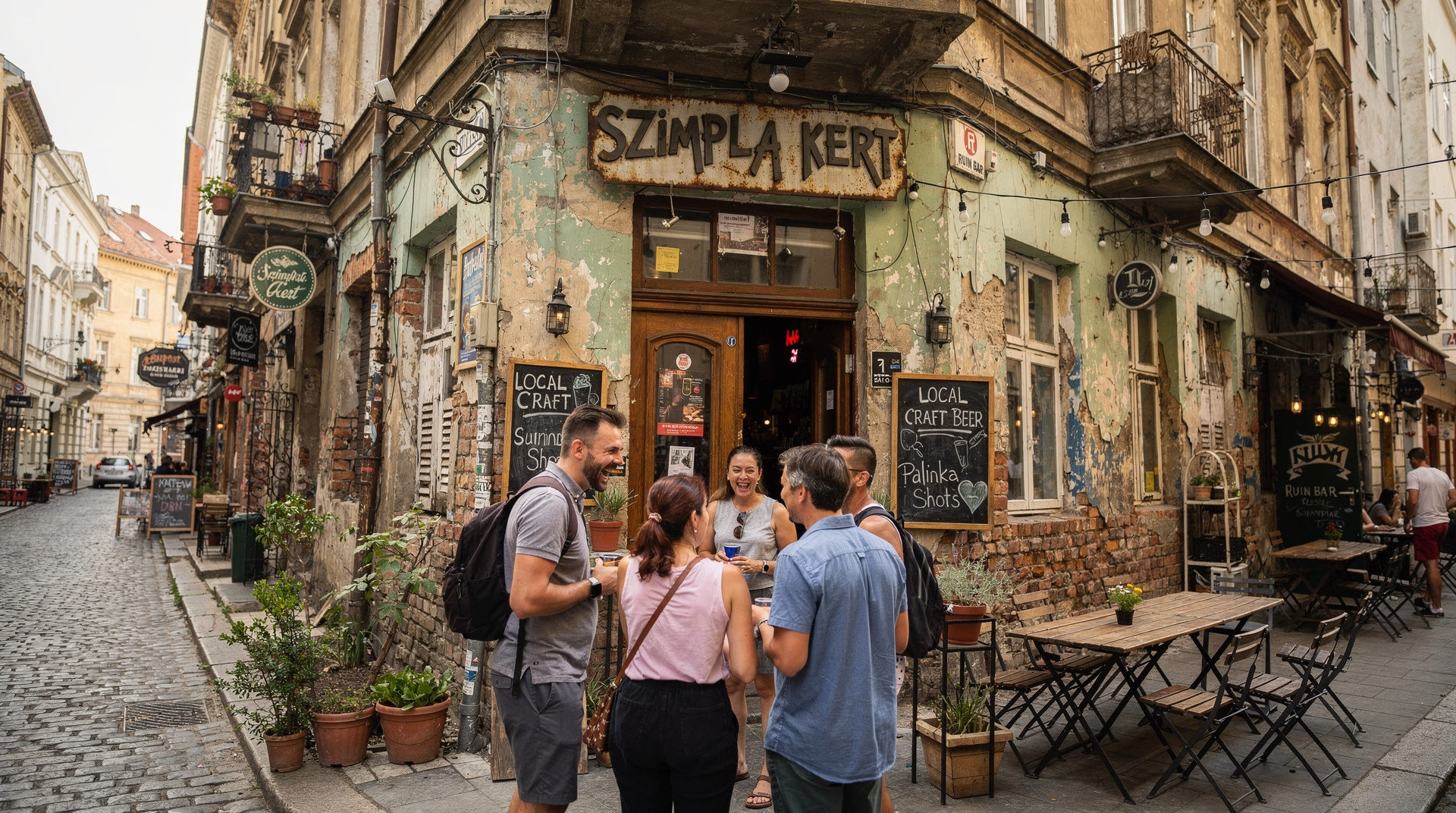
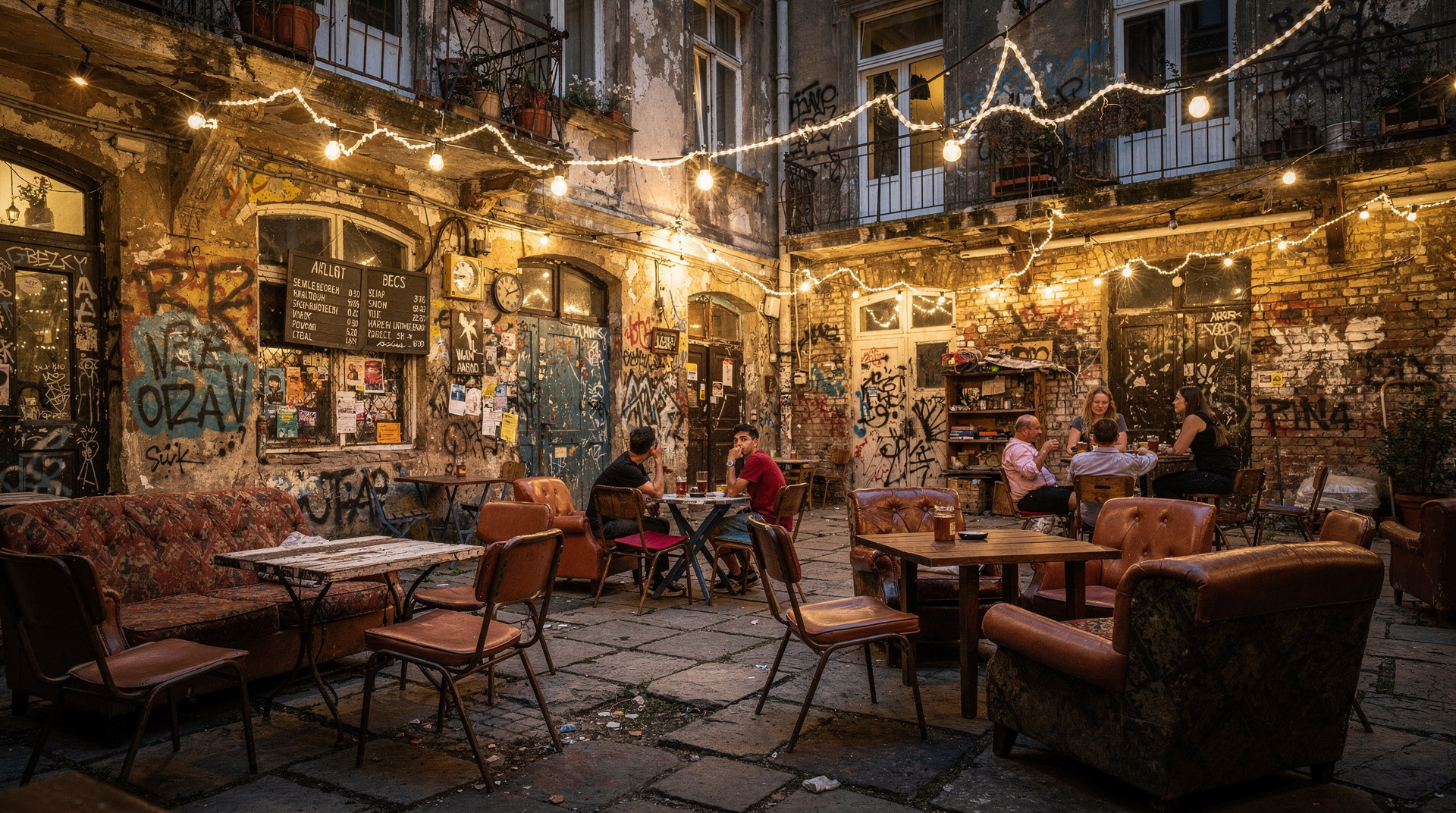
Szimpla Kert (Kazinczy utca 14) is the original Budapest ruin bar — opened in 2001 in a ruined factory, it invented a new approach to nightlife that has been copied across Europe. The interior is an organised chaos of mismatched furniture, found objects, old communist-era artefacts, climbing plants, and improvised art. Several independent bars and food stands operate within the space simultaneously.
Szimpla is best experienced at different times: the Sunday farmer’s market (09:00–14:00) is a Budapest institution, with organic produce, local honey, sourdough bread, and craft products alongside the bar’s usual atmosphere. The evening (from around 21:00) is when it functions as a bar, with multiple DJs and live music events.
On weekday evenings, it’s a more relaxed place for a beer. On Friday/Saturday nights in summer, it’s packed — arrive before 22:00 or expect a queue.
Gozsdu Udvar
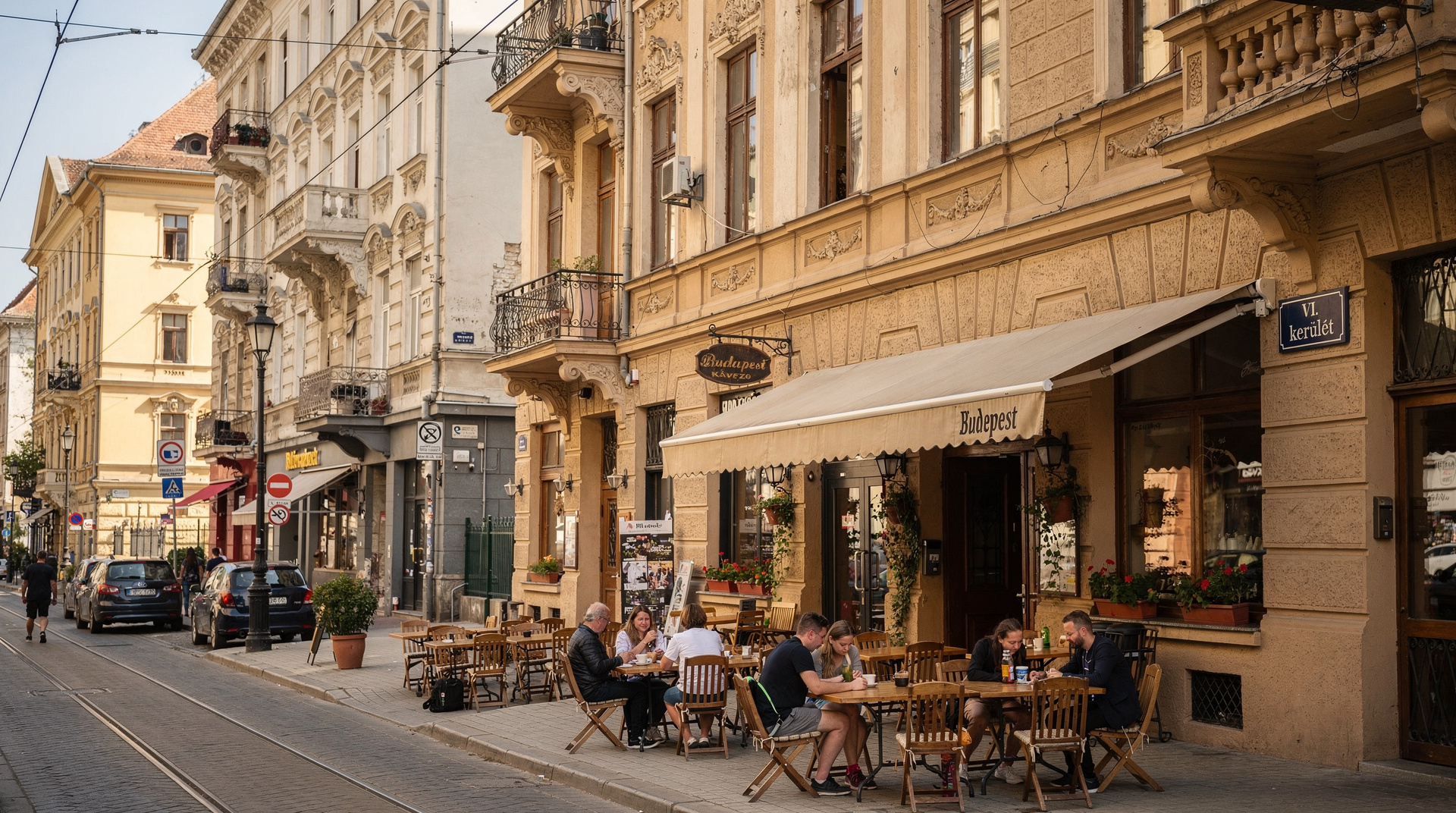
The covered arcade connecting Kiraly utca to Dob utca has been fully converted into a café and bar corridor. It’s more polished than Szimpla — not a ruin bar, but a pleasant sequence of small venues good for outdoor drinks and brunch. It’s also one of the safest and most accessible nightlife zones for less adventurous visitors.
Kazinczy utca and surroundings
Kazinczy utca is the main bar street. Beside Szimpla: Mazel Tov (Akácfa utca 47) is a Jewish-heritage-themed restaurant and bar with excellent cocktails in a beautiful courtyard; Élesztőház (Tűzoltó utca 22) is one of Budapest’s best craft beer bars; Anker’t (Paulay Ede utca 33) is another popular courtyard bar.
For a guided introduction to the bar scene: Budapest ruin bar pub crawl with nightlife guide
The comprehensive guide: best ruin bars in Budapest.
Eating in District VII
District VII has Budapest’s most diverse restaurant scene — international food has concentrated here as the neighbourhood has become more cosmopolitan.
Mazel Tov (Akácfa utca 47): Israeli-Hungarian fusion in a beautifully lit courtyard space. Hummus, grilled vegetables, kebabs, excellent cocktails. One of the most atmospheric restaurants in Budapest. Book ahead for dinner. Mains: 2,500–5,500 HUF.
Ruszwurm Cukrászda (technically in I., but nearby): The most famous pastry shop in Budapest, in the Castle District — worth the short detour.
Frankel Leó Bistro (District II, but worth mentioning): Not strictly District VII, but the Hungarian Jewish cuisine concept extends here.
Karavan Street Food Court (Kazinczy utca 18): An outdoor street food market behind Szimpla, operating spring–autumn, with rotating food trucks and stalls. Burgers, langos, BBQ, Asian fusion — 1,000–2,500 HUF. Budapest’s best outdoor street food spot.
Fritmann Pék (Wesselényi utca 29): Excellent bakery, good for breakfast before the synagogue visit — sourdough, pastries, coffee.
Street art and architecture
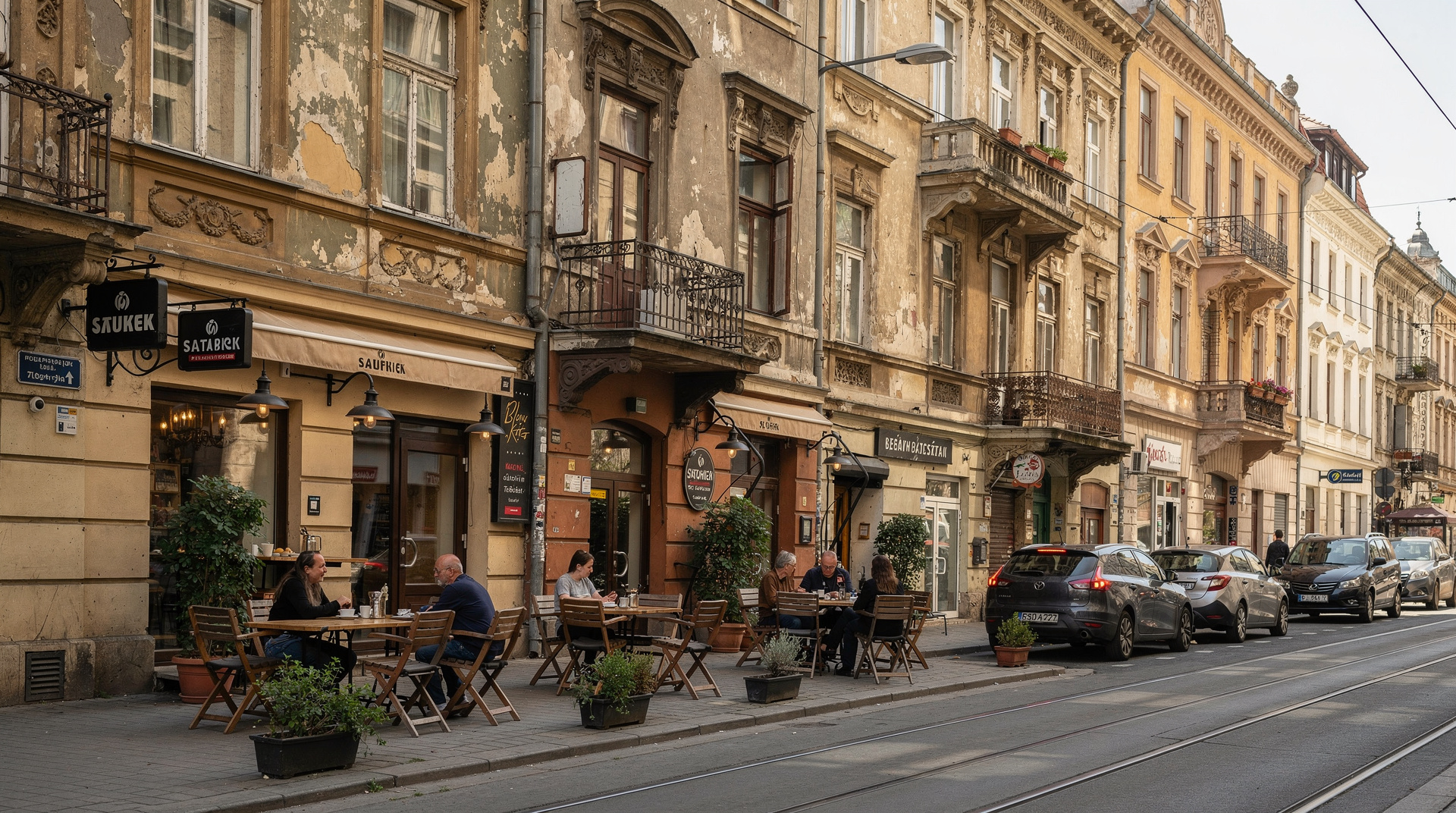
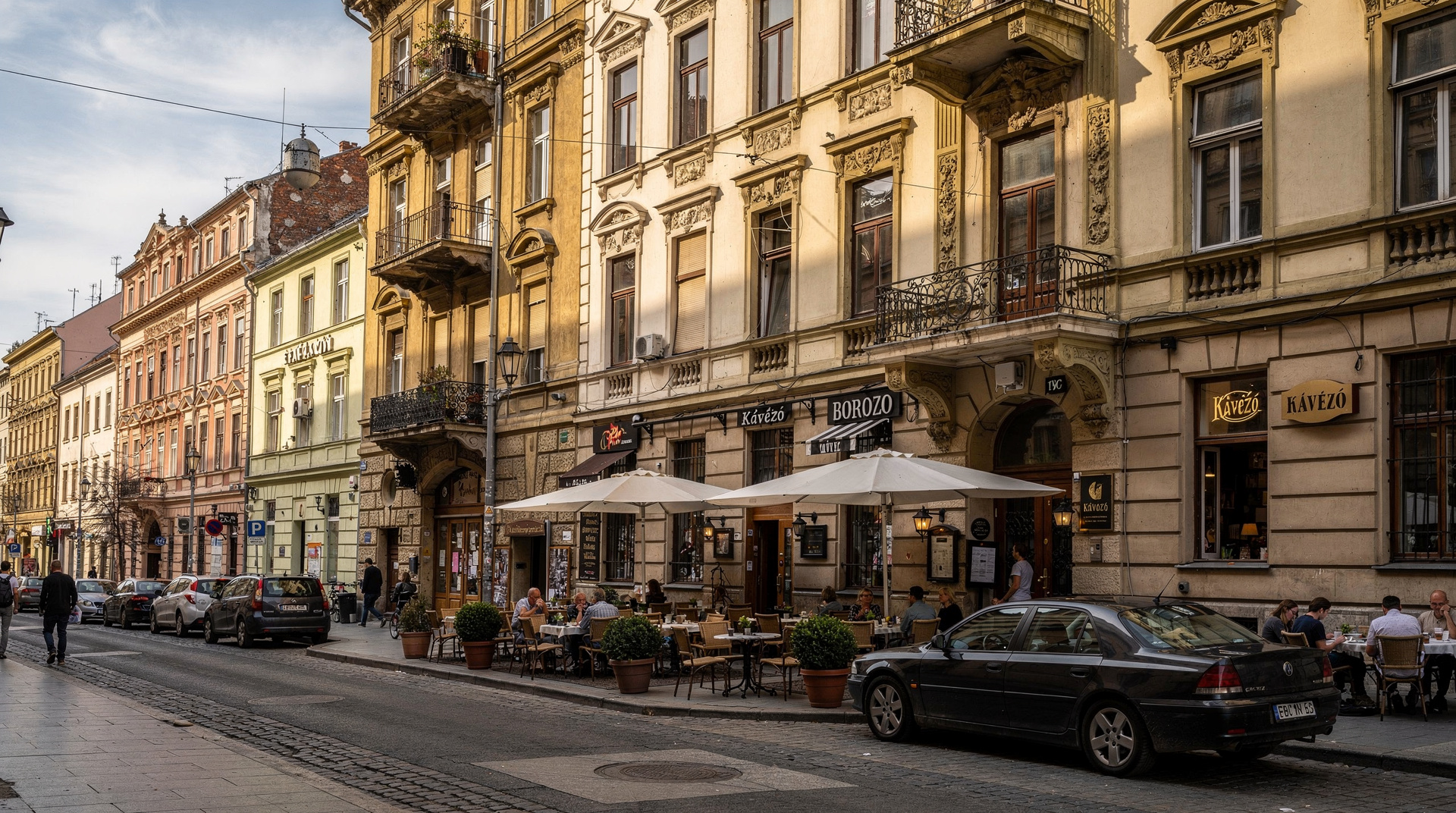
District VII has a significant street art scene, concentrated on and around Király utca, Kertész utca, and the side streets off Kazinczy. The area is also architecturally interesting beyond the ruin bars — the 19th-century apartment blocks have imposing façades, courtyards, and staircases that are worth looking at.
The building at Dob utca 16 (the entrance to the old Ghetto) has a memorial plaque and a remarkable carved Art Nouveau gate. The Great Synagogue’s exterior brickwork and the Rumbach Synagogue’s Secessionist detail are worth studying at close range.
Getting around
Metro: Deák Ferenc tér (M1/M2/M3 interchange) is the nearest major hub, 10 minutes walk. Astoria (M2) is closer to the heart of the Jewish Quarter.
Tram: Tram 4/6 runs along Erzsébet körút at the eastern edge of the district — connecting to the broader city efficiently.
On foot: The Jewish Quarter is entirely walkable; most venues are within a 10-minute radius of Kazinczy utca.
For the full neighbourhood context: Budapest neighborhoods guide and where to stay in Budapest. The Jewish Quarter destination page has additional practical details.
How to shape a day in the quarter
The simplest way to do justice to both histories is to separate them. Give the morning to the heritage sites, when you are fresh and the streets are quiet, and keep the evening for food and bars. Between the two, leave a gap: a long lunch, a coffee in one of the coffee houses of Budapest, or a walk back toward the river. That pause is what stops the day feeling like a jarring switch of tone.
If you are building the quarter into a wider plan, the one-day Budapest itinerary and the two-day itinerary both show where it fits, while the three-day overview gives it more breathing room. A short trip works too: the weekend break itinerary puts the synagogue in daylight and the bars after dark. If this is your first visit to the city overall, start with the first time in Budapest guide so the quarter lands in context.
Visiting the heritage sites with respect
The synagogues, the Memorial Park and the ghetto sites are places of worship and remembrance, not just photo stops. A few habits make a real difference:
- Move slowly and keep your voice low, especially in the Memorial Park behind the Dohány Synagogue, where the mass graves are.
- Check the current visiting rules and opening hours before you go, since they can change around services and religious holidays.
- Photograph with care. Ask yourself whether a selfie belongs in front of a memorial, and follow any signs inside the buildings.
- Take the history seriously before the evening. The Hungarian history primer is a useful short read, and the Shoes on the Danube memorial guide covers another site connected to the same period, a short distance away on the riverbank.
A guide changes how these places read. A historian-led walk, such as the Jewish history walk led by a professional historian, will explain what you are looking at in a way that signs alone cannot.
Choosing your kind of evening
Not every night here has to be a ruin bar marathon. The quarter supports several moods, and picking one in advance saves the usual indecision on Kazinczy utca.
- The classic night: Szimpla Kert first, then one or two neighbours. The Szimpla Kert guide explains how the bar works and when it is calmer.
- The quieter night: a courtyard dinner, a craft beer, and an early finish. The best bars for locals guide is a good source of ideas that avoid the loudest crowds.
- The late night: if you want to keep going after the main bars wind down, the late-night Budapest guide and the broader Budapest nightlife guide lay out the options.
Two cautions apply on any of them. Read ruin bar rip-offs before you go, so you know which drink and bill tricks to watch for, and keep the Budapest tourist traps guide in mind when a doorman or promoter approaches you in the street. For general reassurance about walking around at night, see is Budapest safe.
If the history of the scene interests you as much as the drinks, the blog posts on how ruin bars took over and the new ruin bars trace how the model spread and changed.
Food beyond the bars
Eating well here is not limited to the places listed above. The quarter is a good base for trying Hungarian classics as well as international kitchens. The traditional Hungarian dishes guide will help you read a menu with confidence, and the Budapest street food guide is the natural companion to a stroll past Karavan. For a more structured introduction, you can join a guided tasting such as the tasting walk focused on Jewish and Hungarian-Jewish cuisine, which links the food to the neighbourhood’s story.
A visit to the Great Market Hall makes a good counterpoint, because it shows the produce side of the same food culture in a single building.
Reaching the quarter and moving on
Because the quarter sits right beside the centre, it is easy to fold into the rest of your day. The downtown Pest destination page shows what surrounds it, and the St. Stephen’s Basilica guide and Hungarian Parliament guide cover grand sights you can pair with it. Be wary of the nearby Váci utca tourist trap when choosing where to eat before or after. For transit, the getting around Budapest guide and the BKK travel passes guide explain how to move between districts without overpaying.
Pairing District VII with the rest of the city
Most visitors combine District VII with District V Belváros next door — the two neighbourhoods sit five minutes apart on foot but feel like different cities, one grand and formal, the other lived-in and creative. For the deeper historical context behind the synagogues and the ghetto, the Jewish Quarter heritage guide goes further than this neighbourhood overview alone.
On the nightlife side, District VII anchors Budapest’s best areas for nightlife, and if craft beer rather than ruin bars is your priority, several of the craft beer bars covered in our dedicated guide are a short walk from Kazinczy utca. For street food specifically, see the Budapest street food guide, which covers Karavan and similar spots in more depth. If you’re planning a guided pub crawl rather than exploring independently, that guide compares the main operators.
Frequently asked questions about District VII Jewish Quarter guide
Is it disrespectful to visit ruin bars in the Jewish Quarter?
No — the ruin bars and the Jewish heritage coexist in this neighbourhood, and many locals from both communities see the area's current vitality as a form of cultural recovery. The original ruin bars emerged in the early 2000s precisely because the Jewish Quarter's buildings were neglected and cheap — using them creatively was a kind of reclamation. Szimpla Kert itself hosts farmer's markets and cultural events.What is the Gozsdu Udvar?
Gozsdu Udvar (Gozsdu Courtyard) is a covered arcade running through the block between Kiraly utca and Dob utca, built in 1904. It once served the Jewish community of the quarter. Now it's lined with cafés, bars, and restaurants, and serves as a social hub connecting several parallel streets. Good for drinks, brunch, and people-watching.Is District VII expensive?
More affordable than District V (Belváros), but gentrification is raising prices. A meal at a sit-down restaurant: 2,800–5,500 HUF for a main course. Craft beer in a ruin bar: 800–1,500 HUF. Street food: 500–1,000 HUF. By western European standards, still very affordable.What is the best time to visit the Jewish Quarter?
Sunday morning for the Szimpla Kert farmer's market (a Budapest institution). Evening for the ruin bars and restaurants. The Dohány Synagogue is best visited on a weekday morning to avoid tour groups. Friday evening (Shabbat) sees some beautiful candlelit services at the Rumbach Synagogue.Can I combine District VII with District V in one day?
Yes, easily — the two districts border each other and most sights are within a 10–15 minute walk. A common pattern is grand landmarks (Parliament, Basilica) in District V during the morning, then crossing into District VII for the synagogue and Memorial Park in the early afternoon, followed by dinner and ruin bars in the evening.
Top experiences
Bookable activities with verified prices and instant confirmation on GetYourGuide.