Chain Bridge Budapest: guide to crossing the Danube's most iconic bridge

Can you walk across Chain Bridge in Budapest?
Yes, Chain Bridge (Széchenyi Lánchíd) is open to pedestrians and free to cross on foot. The walk across takes about 10–15 minutes. It is the most scenic way to move between the Buda and Pest banks, with panoramic views of the Parliament to the north, Gellért Hill to the south and the Castle Hill above the western bank.
Budapest’s most symbolic crossing
Chain Bridge (Széchenyi Lánchíd) is not merely a bridge — it is the founding infrastructure of Budapest as a unified city. Before its completion in 1849, Buda and Pest were functionally separate towns connected only by seasonal pontoon bridges and, in winter, by crossing on foot over the frozen Danube.
The bridge’s sponsor was Count István Széchenyi, one of the great reformers of 19th-century Hungary, who — famously — pledged an entire year’s income to fund its construction after being stranded unable to cross the river to reach his father’s deathbed. His name has been attached to the bridge ever since.
Today, Chain Bridge is the most photographed and most symbolic structure in Budapest — the central element of the UNESCO World Heritage panorama that takes in the Danube, both banks and the Castle Hill. Walking across it is free, takes 10–15 minutes and offers some of the best views in the city.
| Where | Connects Clark Ádám tér (Buda) and Széchenyi István tér (Pest) |
| Cost | Free to walk |
| Time needed | 10–15 minutes to cross, longer with photo stops |
| Getting there | Tram 19 or bus 16 to Clark Ádám tér; metro M1 to Vörösmarty tér then walk |
| Best time | Early morning or after dark for photos, avoid Saturday midday in summer |
The engineering story
Chain Bridge was designed by English engineer William Tierney Clark (who also designed Hammersmith Bridge in London) and built under the supervision of Scottish engineer Adam Clark. The two towers rise 48 metres above the water; the central span is 202 metres. When completed in November 1849, it was the largest and longest suspension bridge in Europe.
The construction required solving a series of technical problems: the Danube at this point is 310 metres wide, regularly floods to significant heights, and the riverside geology on the Buda bank is limestone rock that required careful anchoring. Hungarian and British engineers worked together on a structure that remained structurally sound for nearly a century before wartime destruction ended it.
German forces retreating from Budapest in January 1945 blew up all five Danube bridges in Budapest. Chain Bridge was rebuilt between 1947 and 1949 as a symbolic priority — restoring the connection between Buda and Pest as the country rebuilt — and reopened on 20 November 1949, exactly 100 years after its original inauguration.
Walking the bridge
The pedestrian walkways run on both sides of the roadway. The crossing takes approximately 10–15 minutes at a comfortable pace. Stop at the midpoint of the central span for the most open views in both directions:
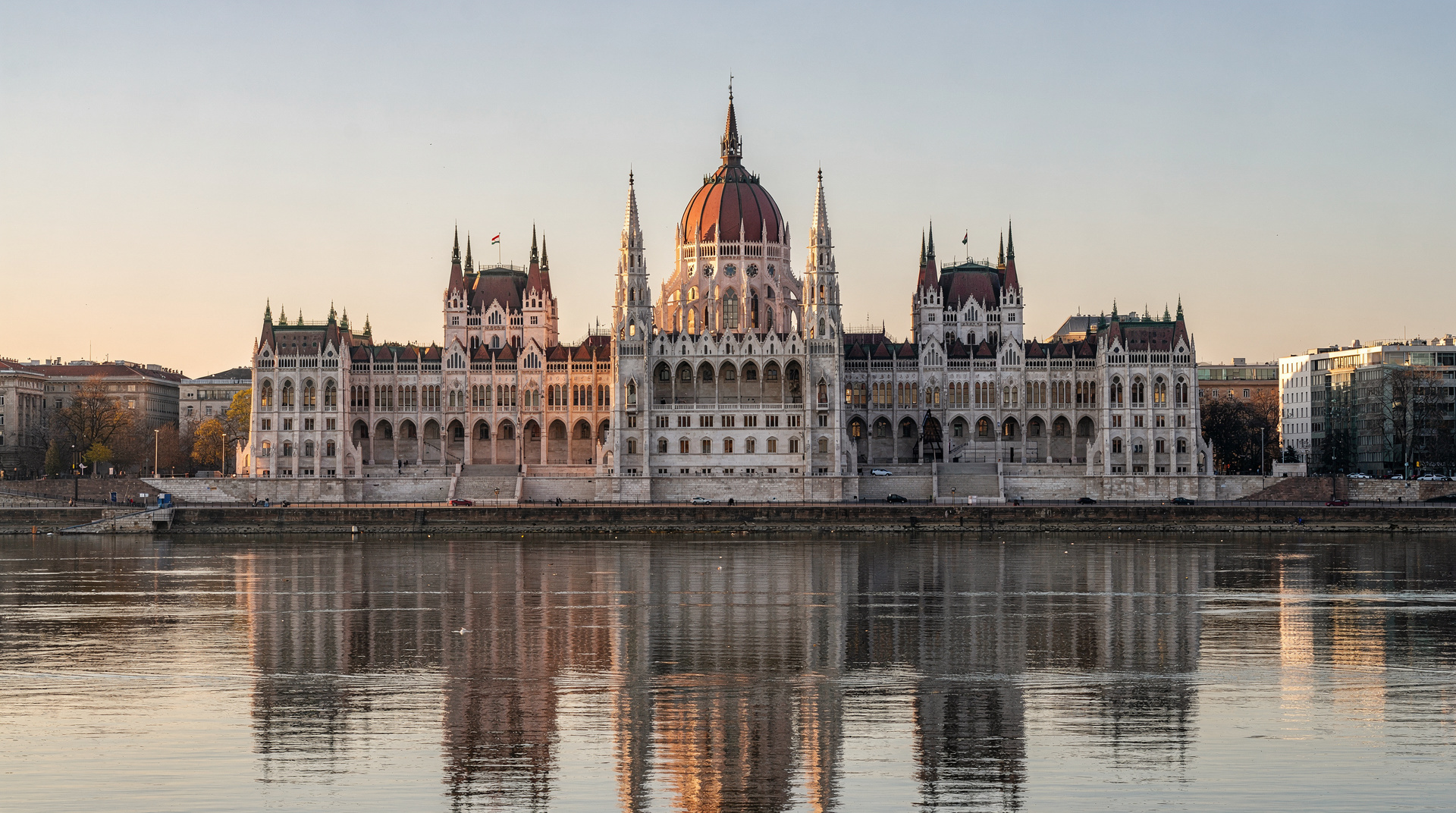
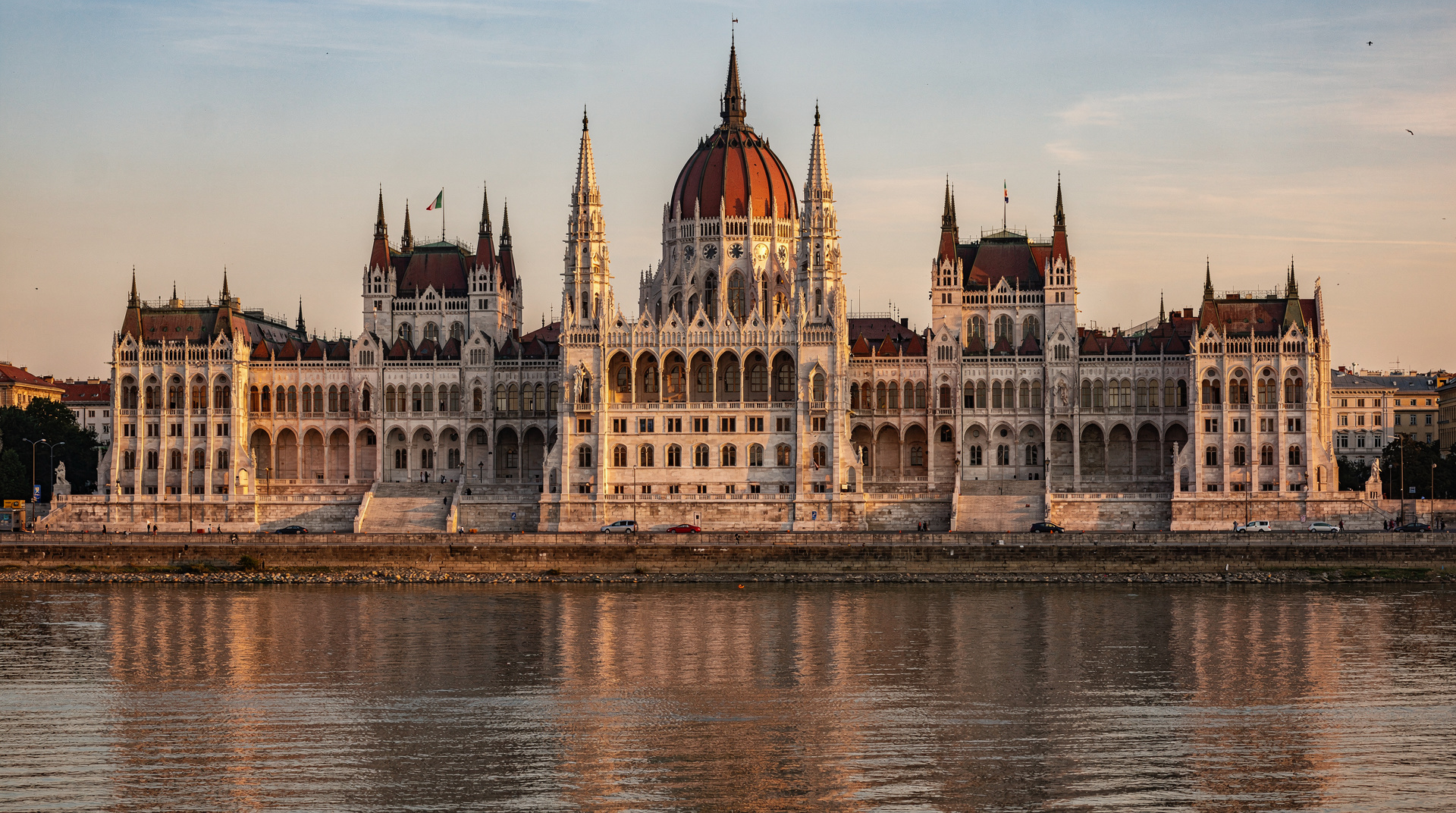
Northward: Parliament fills the skyline on the Pest bank. On a clear day the Danube bends away in both directions, with the green slopes of the Danube Bend visible in the far north.
Southward: Gellért Hill rises steeply on the Buda bank. The Liberty Bridge (Szabadság híd) is visible in the mid-distance, with the Buda hills behind it.
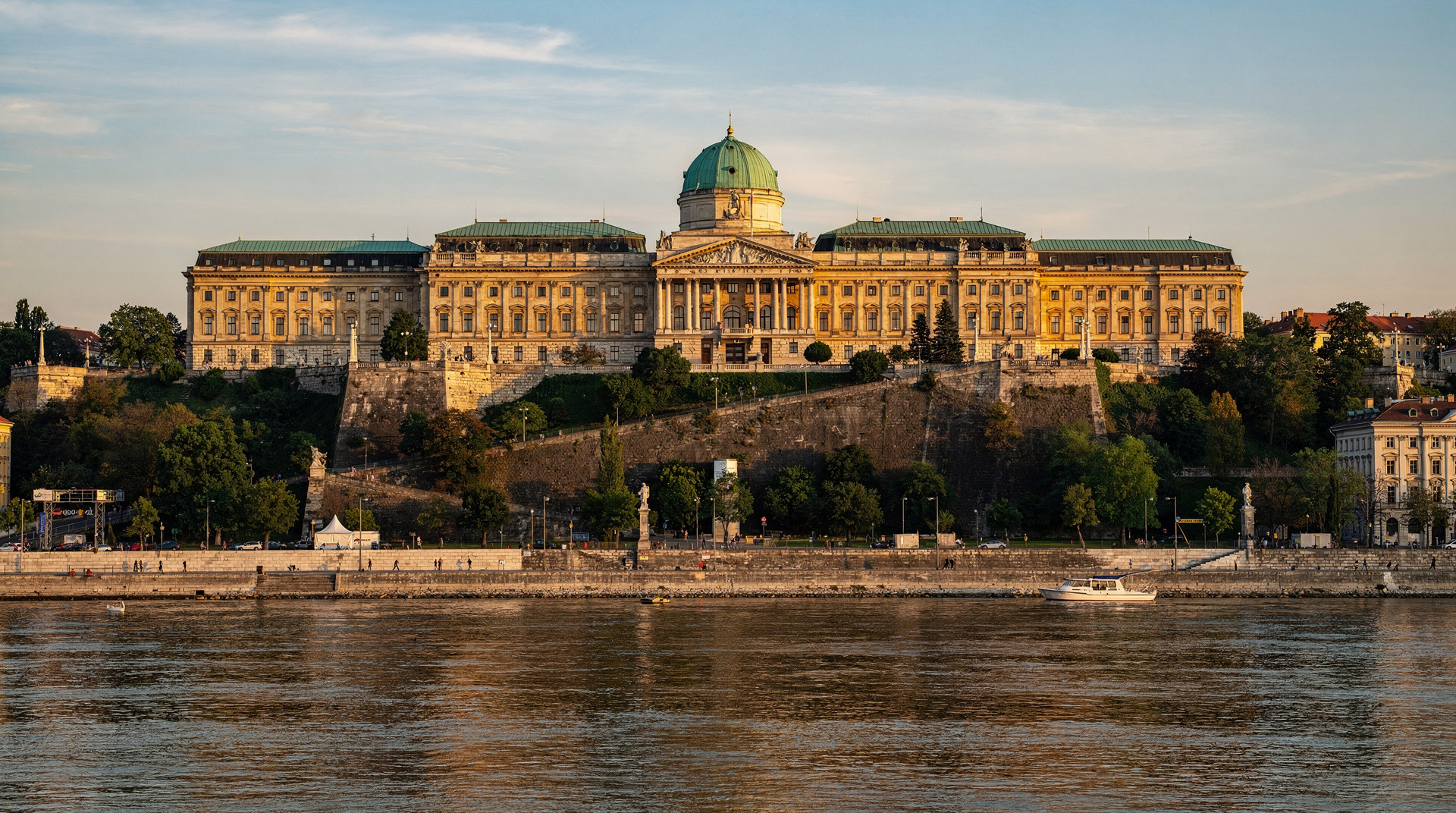
Looking up to the Buda bank: Castle Hill and the silhouette of the Royal Palace, with the funicular station at the base.
Looking down at the water: The Danube at the Chain Bridge is typically a dark olive-grey — not particularly blue, despite what the river’s romantic name suggests. The colour varies significantly with rainfall and upstream conditions. The width at this point is approximately 310 metres.
The lion statues
At each end of the bridge, on both sides of the towers, stand four stone lions by sculptor János Marschalkó (1852). They are large, dignified and satisfyingly leonine. The famous urban legend — that they have no tongues, and that the sculptor threw himself into the Danube in shame when this was pointed out — is false. The tongues exist but are carved in a position that makes them invisible from street level.
The lions make good photo subjects and are proportioned for standing-next-to photographs if you are so inclined. They are slightly above street level on stone pedestals; the angle from Clark Ádám tér frames the tower and lion together well.
Clark Ádám tér: the Buda approach
The Buda end of Chain Bridge opens onto Clark Ádám tér, named for the Scottish engineer who supervised the bridge’s construction. The square contains:
The zero kilometre stone (nulla kilométerkő): A small sphere in the centre of the square marks the point from which all Hungarian road distances are officially measured. A minor but historically significant object.
The Castle Hill Funicular (Budavári Sikló): The historic cable car up to Castle Hill departs from Clark Ádám tér. Tickets: 1 400 HUF upward; queue can be 20–40 minutes in peak season.
The Adam Clark tunnel: The road disappearing into the hillside at the square runs through the Castle Hill in a 350-metre tunnel built by — yes — Adam Clark. It emerges on the western side of Buda.
The Pest end: Széchenyi István tér
The Pest end of Chain Bridge opens onto Széchenyi István tér, a recently relandscaped square fronting the Danube embankment. The Gresham Palace (now the Four Seasons Hotel) on the north side of the square is one of the finest Art Nouveau buildings in Europe — its ornate ironwork, peacock glass and Zsolnay ceramic decorations are extraordinary even from the exterior. The lobby is accessible and worth a look.
The square connects to the Danube embankment walkway (Duna-korzó) in both directions — north toward the Parliament (15 minutes on foot) and south toward the Great Market Hall (15 minutes).
How to pace your visit
Most visitors treat Chain Bridge as a box to tick on the way between two other sights, and that undersells it. The bridge rewards a slower approach. Decide in advance whether you are crossing it as transport, as a photo stop or as a short walk in its own right, because each of those calls for a different rhythm. If it is transport, you will be across in a few minutes and can carry on to your next stop. If it is a photo stop, plan to pause at the midpoint of the central span and again near each tower, where the angles on the lions and the stonework change.
A good habit is to cross once in one direction with a specific goal, then return later in the day by the same route and notice how different it feels. In the morning the bridge is mostly commuters and early walkers; by late afternoon it fills with groups; after dark it quietens again and the lighting turns the whole structure into a silhouette against the hill. The same 200-odd metres of span can feel like three different places.
Footwear matters more than you might expect. The walkways are smooth and the pavements on both approaches are paved, but you will probably combine the bridge with a climb up Castle Hill or a long riverside stroll, so comfortable shoes make the day easier. Our what to pack guide covers the basics for a city that involves a lot of walking.
Reading the bridge as a piece of history
Chain Bridge is easier to appreciate if you know what it replaced. Before it existed, moving goods and people between the two banks was slow, seasonal and unreliable, and that shaped how each side developed. Buda was the seat of royal and administrative power on its hill; Pest was the commercial, growing side on the flat. The bridge stitched them together, and in doing so made the idea of a single capital practical rather than theoretical.
If you want the wider political and cultural background behind that story, the Hungarian history primer places the bridge in context, and the Buda vs Pest comparison explains how the two banks still differ in character today. Standing on the bridge with that picture in mind, you can see the hill, the palace and the flat embankment as the two halves the bridge was built to join.
The bridge is also a useful reminder of how much of the city was rebuilt after the war. The structure you cross today is both original in design and reconstructed in fact, which makes it a good companion to other sites where the same layering of loss and restoration is visible, such as the Hungarian Parliament and the riverside memorials nearby.
Budapest’s Danube bridges compared
Chain Bridge is the most famous of Budapest’s crossings, but four other bridges each have a distinct character worth knowing about if you plan to explore beyond the postcard shot.
| Bridge | Character | Best for |
|---|---|---|
| Chain Bridge (Lánchíd) | Historic, ornate, most photographed | First-time views, sunset/night photos |
| Margaret Bridge (Margit híd) | Angled, connects to Margaret Island | A quieter walk, access to the island’s parks |
| Liberty Bridge (Szabadság híd) | Green ironwork, locals sit on the railings | A local, less touristy crossing near the market |
| Elizabeth Bridge (Erzsébet híd) | Modern, minimalist white cable-stay design | Views of Gellért Hill and Buda Castle together |
Margaret Bridge sits within easy reach of Margaret Island, Budapest’s car-free park island, making it a natural pairing for a quieter half-day away from the crowds around Chain Bridge itself.
Chain Bridge closures and events
The bridge occasionally closes to traffic (though rarely to pedestrians) for public events — New Year’s Eve fireworks viewing, the Budapest Marathon route, and occasional maintenance work on the towers or cabling. These closures are announced in advance but not always prominently for visitors; if you have a specific photo plan tied to a particular evening, it is worth checking recent local news or your accommodation’s front desk on the day. Maintenance scaffolding, when present, is usually confined to one tower at a time and does not block pedestrian access.
Best times to cross
Dawn: Early morning (6–8 am) gives an almost empty bridge and the best light for photography — soft and directional, with Parliament illuminated by early sun.
Sunset: The hour before sunset, when the Buda hills cast long shadows and the river catches amber light. Chain Bridge itself glows warm. Crowds are present but manageable.
Night: After 9 pm, both banks of the Danube are illuminated. Chain Bridge is lit from below; Parliament is floodlit amber; Castle Hill glows. This is Budapest at its most theatrical. The bridge itself is not crowded; the Danube promenades on both banks have late-evening walkers.
Avoid: Saturday midday in summer, when tourist groups and day-trippers make the crossing uncomfortably dense.
Combining with nearby sights
Chain Bridge is the natural connector between Buda and Pest sightseeing. A typical day combines:
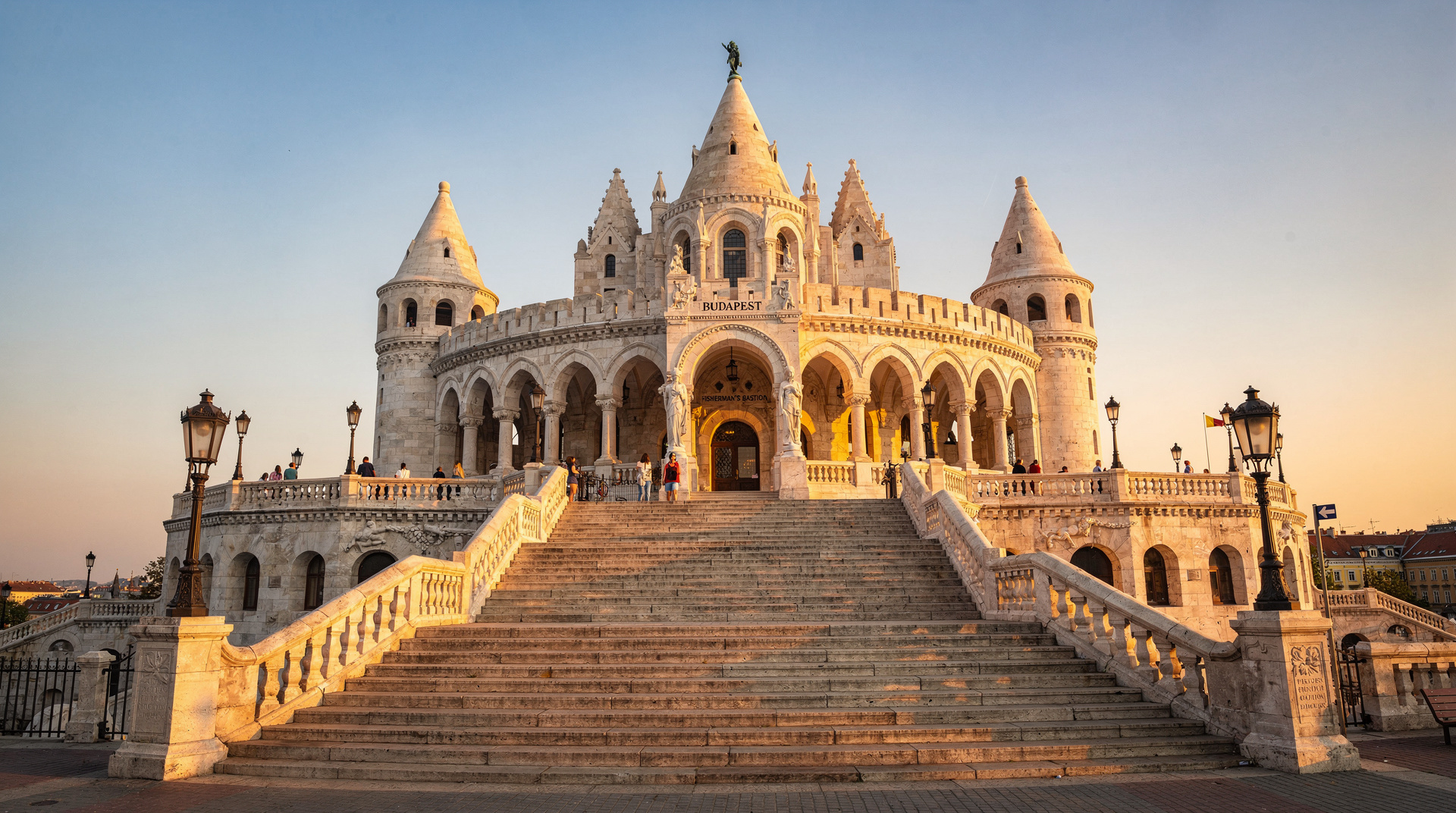
Morning: Buda — Castle Hill via funicular from Clark Ádám tér; Matthias Church, Fisherman’s Bastion, National Gallery. Afternoon: Walk back across Chain Bridge → Parliament interior → Shoes on the Danube memorial (on the way to Parliament) → Basilica.
A guided walking tour of central Budapest typically crosses Chain Bridge as part of a Buda-to-Pest or Pest-to-Buda arc.
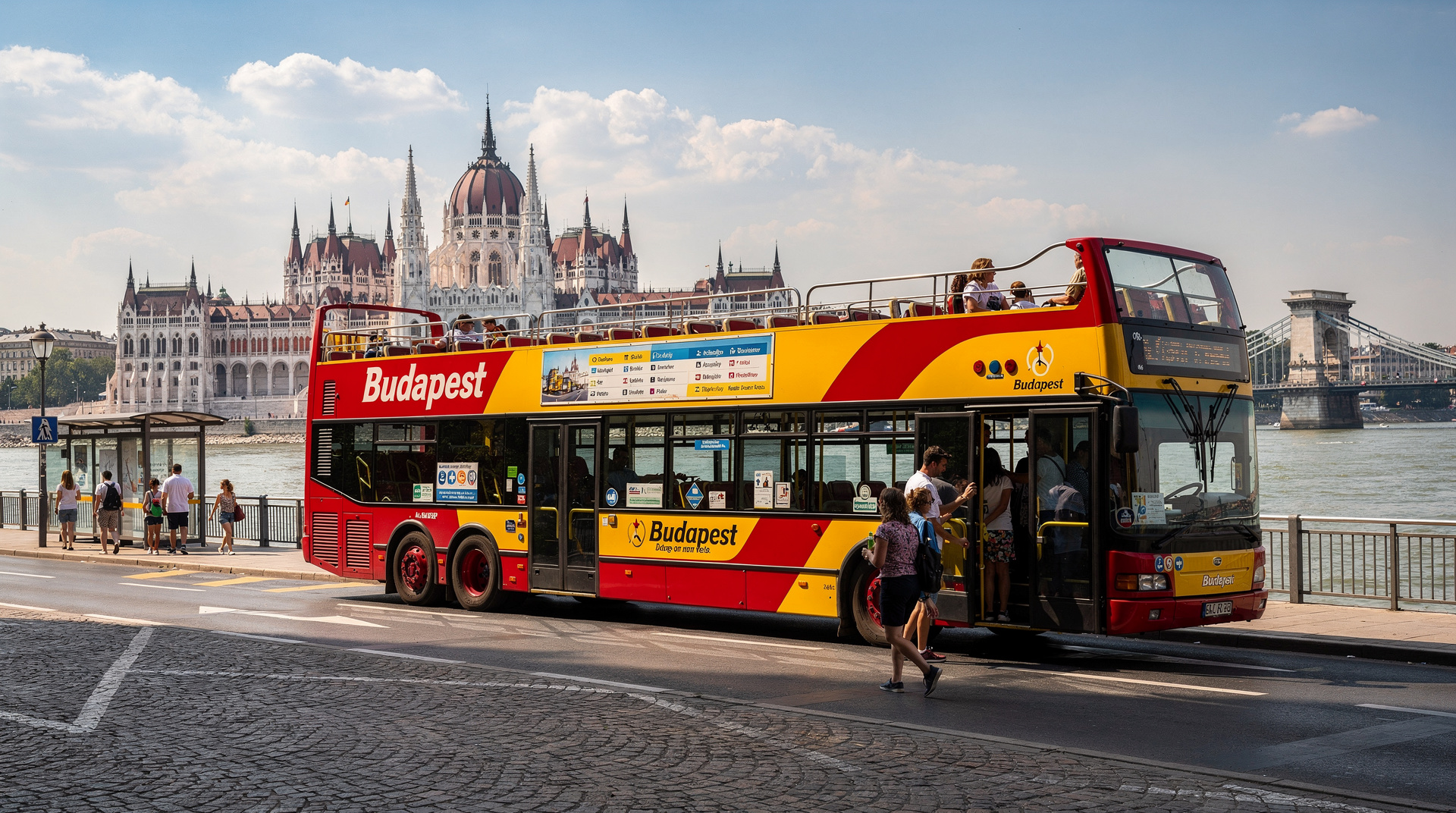
If your priority is the Buda side, a classic walking tour of the castle district pairs naturally with a bridge crossing, since the route starts from the bridge end of the hill and a guide can fill in the history you have just read about. Prefer to ride between the sights? a hop-on hop-off bus ticket lets you cover both banks with the bridge as one of the stops along the way. For more ways to explore on foot, see the best walking tours in Budapest and the free things to do in Budapest, where the bridge itself is a natural entry.
Planning a bridge-centred half day
A simple half day built around Chain Bridge works well for first-time visitors. Start on the Pest side at Széchenyi István tér, take a look at the Gresham Palace facade, and cross on foot to Clark Ádám tér. From there you can head up to the castle district, which our Buda Castle guide covers in detail, or turn along the embankment toward Gellért Hill. Return across the bridge at the end of the day for the lit-up view.
If you only have a short stay, the one-day Budapest itinerary and the first-timer highlights itinerary both build the bridge into a wider route, so you do not have to work out the sequencing yourself. For a more relaxed pace with more time on each bank, the three-day itinerary gives the bridge a natural place at the start or end of a day. The Castle District destination page is the place to look if you want to continue straight up the hill once you have crossed.
For a Danube-centric experience, a river cruise passes under Chain Bridge and gives you the water-level perspective on the entire riverfront panorama — a genuinely different way to appreciate the bridge’s scale.
The Gellért Hill guide covers the walk up to the Citadella from the Buda embankment, which starts 10 minutes south of Chain Bridge. The top attractions guide places Chain Bridge within the full multi-day sightseeing framework. For the broader question of which bank to base yourself on, see Buda vs Pest, and for the Buda-side sights just across the bridge, Matthias Church and Fisherman’s Bastion are both a short uphill walk away.
Frequently asked questions about Chain Bridge Budapest
What is the history of Chain Bridge?
Chain Bridge was the first permanent bridge linking Buda and Pest, completed in 1849 to designs by English engineer William Tierney Clark and supervised by Adam Clark. Before it, the two cities were connected only by pontoon bridges in summer and on foot over the ice in winter. The bridge was blown up by retreating German forces in January 1945 and rebuilt between 1947 and 1949.What are the lion statues on Chain Bridge?
The four stone lions at the bridge's two towers were sculpted by János Marschalkó. An urban legend claims the lions have no tongues — this is false, but the angle of carving makes the tongues hard to see from street level. The lions guard the bridge approach and are popular photo subjects.Is Chain Bridge the best bridge to walk in Budapest?
For views and symbolic significance, yes. For a more local, less crowded walk, Margit híd (Margaret Bridge) in the north is excellent, with views of Margaret Island. The Szabadság híd (Liberty Bridge) at the south end of the tourist area is greener and quieter, and is the bridge Hungarians favour for picnicking on the railings. All four central Budapest bridges are worth walking at some point.What is at each end of Chain Bridge?
At the Pest end: Clark Ádám tér, the zero milestone of Hungary (all Hungarian road distances are measured from here), and the entrance to the tunnel through Castle Hill. At the Buda end: the funicular (Budavári Sikló) up to Castle Hill, the Adam Clark monument, and access to the Buda embankment and Gellért Hill direction.
Top experiences
Bookable activities with verified prices and instant confirmation on GetYourGuide.