Matthias Church guide: visiting Budapest's Castle Hill church

How do you visit Matthias Church and what does it cost?
Entry to Matthias Church costs approximately 2 200–3 500 HUF for adults. The church is open daily but has limited visiting hours during services (check the schedule at the door). The interior has remarkable 19th-century murals in a Byzantine-Romanesque style, Gothic architectural details and a good museum upstairs. Allow 45–60 minutes.
Budapest’s most distinctive church
Matthias Church (Mátyás-templom) on Castle Hill’s Holy Trinity Square stands as the most architecturally layered religious building in Budapest — a 13th-century Gothic original, rebuilt after Ottoman occupation, reconstructed by 15th-century Hungarian kings, then restored in the 19th century into the building visitors see today.
| Where | Holy Trinity Square, Castle District (Buda) |
| Cost | Around 2,200–3,500 HUF adults |
| Time needed | 45–60 minutes |
| Getting there | Bus 16 or Várbusz to Castle Hill, or funicular from Clark Ádám tér |
| Best time | Weekday mornings, before tour groups arrive |
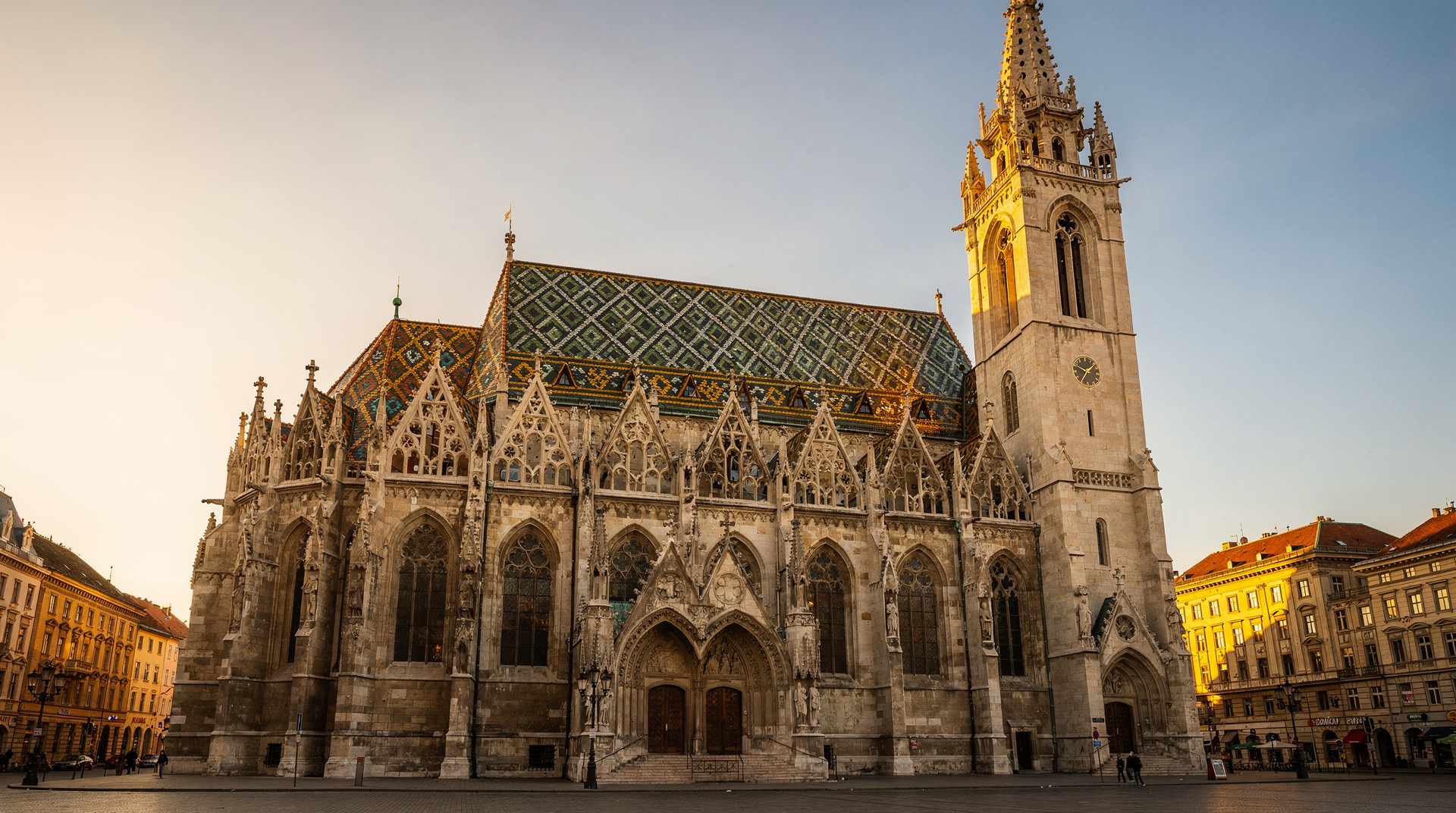
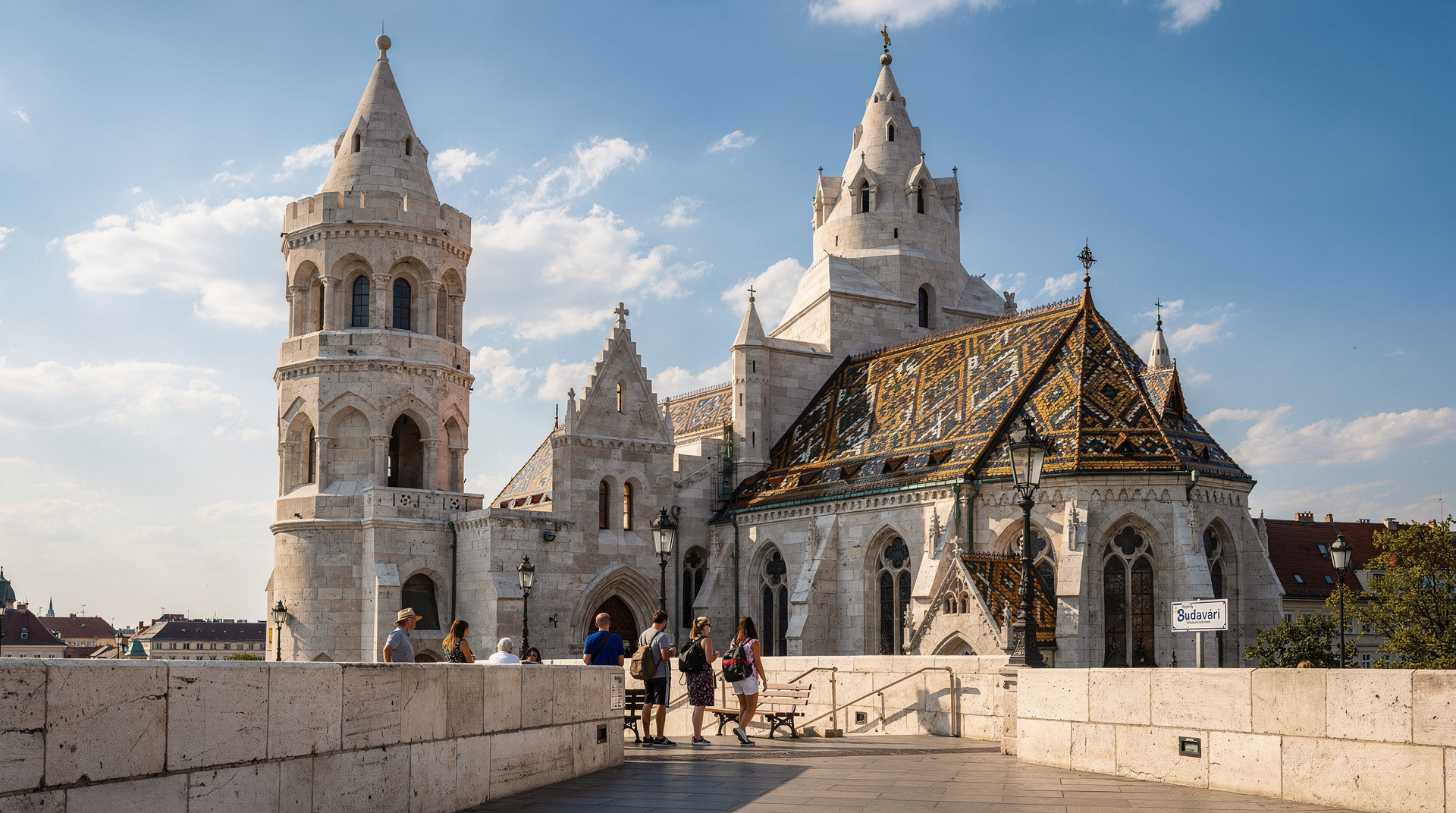
The result is a palimpsest of Hungarian history: Romanesque foundations, Gothic towers, Ottoman-era renovation, baroque additions and a Victorian-era makeover that imposed Byzantine-Romanesque murals on medieval walls. It should be incoherent; instead it is fascinating, and the multicoloured ceramic tiled roof — a Zsolnay porcelain masterwork — has become one of Budapest’s most recognised architectural images.
Entry tickets to Matthias Church can be bought at the door or through GYG, which skips any queuing at the ticket desk during peak season.
Reading the building from the square
Before you step inside, give the exterior a few unhurried minutes. Holy Trinity Square is the best place to understand why this church feels so different from the Gothic cathedrals of Western Europe. The tiled roof, the slender spire of the south tower and the pale stonework were all shaped by the same 19th-century vision, and standing back lets you see how deliberately they were composed. Notice how the bright geometric pattern of the roof contrasts with the restrained stone below it: the roof is the showpiece, while the walls hold the older, quieter story.
It also helps to understand where you are. This is the heart of the Castle District, a hilltop quarter that has been rebuilt many times, and the church has always been its spiritual and ceremonial centre. If you arrive on foot from the funicular or the bus stop, the approach through the narrow medieval streets builds a sense of anticipation that the open square then rewards. For a wider orientation on how the hill fits into the city, the Budapest destination page and the Buda vs Pest comparison are useful reading before you commit to a full day on the Buda side.
History in layers
The church’s origins date to around 1015, when King Stephen I founded the first church on this site. The current building’s earliest surviving elements date to the 13th century, when Béla IV commissioned a new Gothic church after the Mongol invasion of 1241–1242.
The church was the coronation church of the medieval Hungarian kingdom — nine kings were crowned here, most significantly Louis I (1342) and, much later, Franz Joseph I and Elisabeth (Sisi) in 1867. It was in this church that Beethoven’s Coronation Mass (composed for another event but adopted here) first resonated through Central European history in its most politically loaded performance.
Under Ottoman occupation (1541–1686), the church was converted to a mosque. The Christian imagery was whitewashed over, the high altar removed and carpets laid over the stone floor. Remarkably, when the Ottomans converted the church back as the Habsburgs reconquered Buda, the medieval murals beneath the whitewash had survived.
The Victorian restoration (1874–1896) by Frigyes Schulek is what dominates today’s appearance: the Zsolnay ceramic tile roof, the reconstructed rose window, the new south tower with its distinctive diamond pattern. Schulek’s interpretation of medieval Gothic was influenced by the French restoration architect Viollet-le-Duc and reflects 19th-century romanticism as much as genuine archaeology.
What to see inside
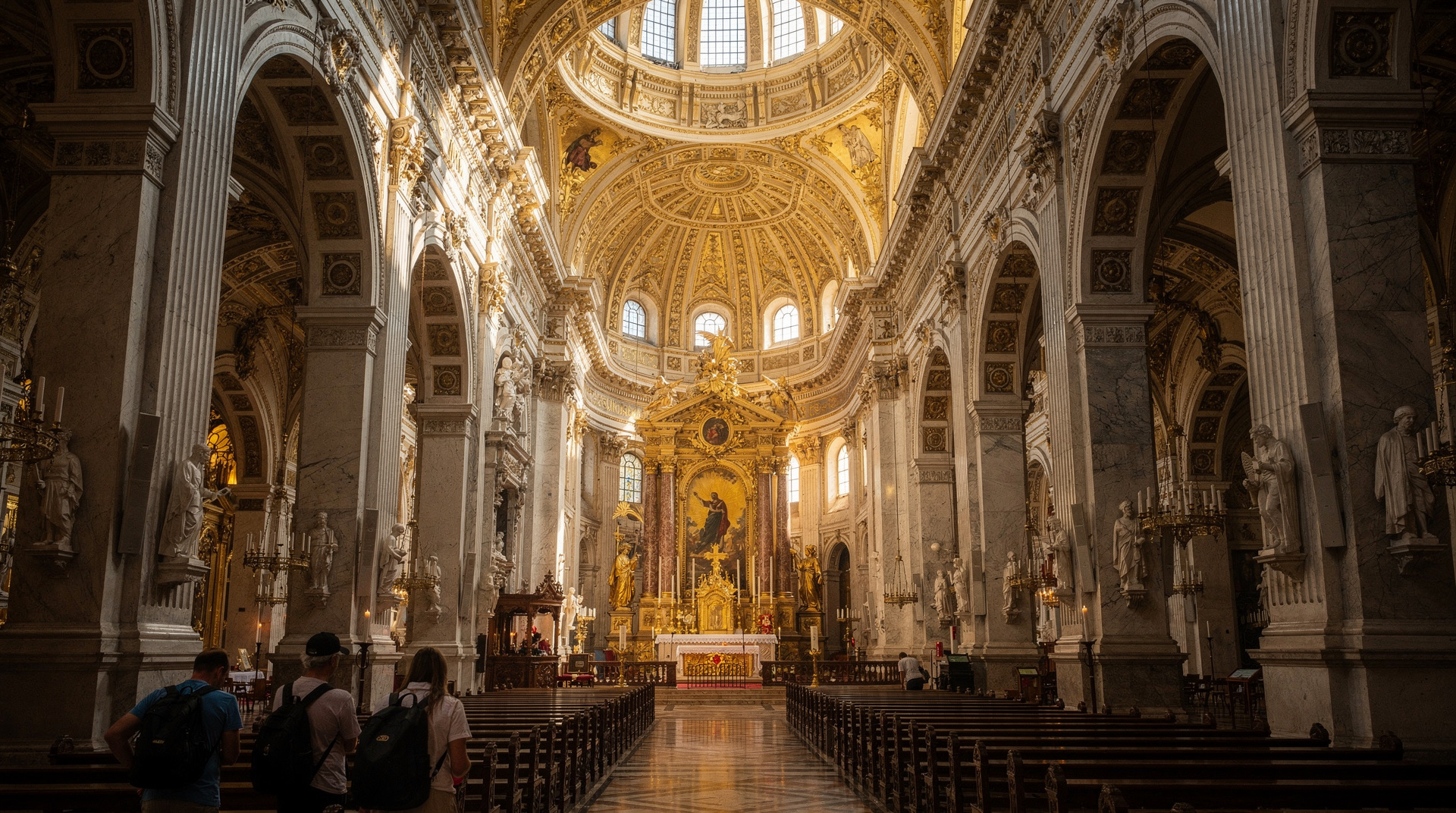
The murals: The most striking feature. Bertalan Székely and Mór Than painted the entire interior in a Byzantine-Romanesque style between 1874 and 1896. The scenes — Old Testament cycles, lives of saints, Hungarian sacred history — are in rich earth tones (ochre, umber, deep red) with Byzantine gold detailing. The effect is densely decorative and unlike the whitewashed interiors of most Central European Gothic churches.
The Loretto Chapel: In the northwest corner, a Gothic chapel with a Romanesque Madonna statue (12th century) and the tomb of a medieval knight. The vaulted ceiling retains original 14th-century red-and-white tracery.
The Trinity Chapel and royal oratory: The gallery above the nave’s west end gives an elevated view of the entire interior. The adjacent rooms contain the church museum.
The church museum (upstairs): Ecclesiastical objects, historic vestments, stone carvings from the medieval church, royal insignia replicas and exhibits on the building’s history. Entry included with the main ticket.
The Gothic stonework: Particularly the south tower doorway (original 14th-century Mary portal, severely damaged but partially surviving) and the tracery on the windows. The new construction by Schulek replicated the original style but is distinguishable up close by its freshness.
How to approach the interior
The interior rewards slow looking. Most visitors walk in, tilt their heads back at the painted vaults, take a few photographs and move on, but the murals are organised in bands and cycles that make more sense if you follow them deliberately. Start at the nave and let your eyes travel upward from the pillars to the ribs of the vault, then work around the side aisles, where the patterns shift from broad decorative fields to narrative scenes. The dim light is part of the experience: gold detailing glints and fades as you move, and the colours settle into a warm glow after your eyes adjust.
A few habits make the visit smoother:
- Pause near the entrance for a minute so your eyes adjust before you start photographing.
- Walk the perimeter first, then return to the centre of the nave for the full view.
- Take the stairs to the gallery and museum rather than saving them for the end, when energy is lower.
- Keep your voice down; this is a working church, and services take priority over sightseeing.
If you enjoy the stories behind what you are seeing, the Hungarian history primer gives a clear outline of the kings, invasions and occupations that shaped this building. Reading it the evening before turns the interior from a pretty space into a readable record.
Who will enjoy it most
Matthias Church suits a wide range of travellers, but for different reasons. Architecture and history enthusiasts will spend the longest here, because the building rewards close study of how medieval fabric and 19th-century restoration were blended. Photographers come for the roof and the murals. Couples often fold it into a slow Buda afternoon, and the romantic Budapest guide suggests how to pair the hill with a relaxed dinner afterwards. Families with younger children may find the interior a short stop rather than a long one, so it works best as one piece of a wider outing; the Budapest with kids guide has ideas for balancing quieter sights with more active ones.
If you only have a short stay, the church is an efficient way to experience something distinctly Hungarian without a long commitment. The one-day Budapest itinerary and the three-day first-timer plan both treat Castle Hill as a core stop, and the church is the natural anchor of that morning.
Practical visitor information
Opening hours: approximately 9 am–5 pm daily, with reduced hours on Sunday mornings (the 10 am Sunday Mass means visitor access is restricted until approximately noon). Services are held regularly — check the notice board at the entrance for the day’s schedule.
Entry fee: approximately 2 200–3 500 HUF for adults; reduced for students and children. The museum upstairs is included. An English-language audio guide is available for a small supplement.
Photography: permitted without flash in most areas. The interior is quite dark — use a high ISO setting or a steady hand. Do not use flash near the murals.
Combining with Fisherman’s Bastion
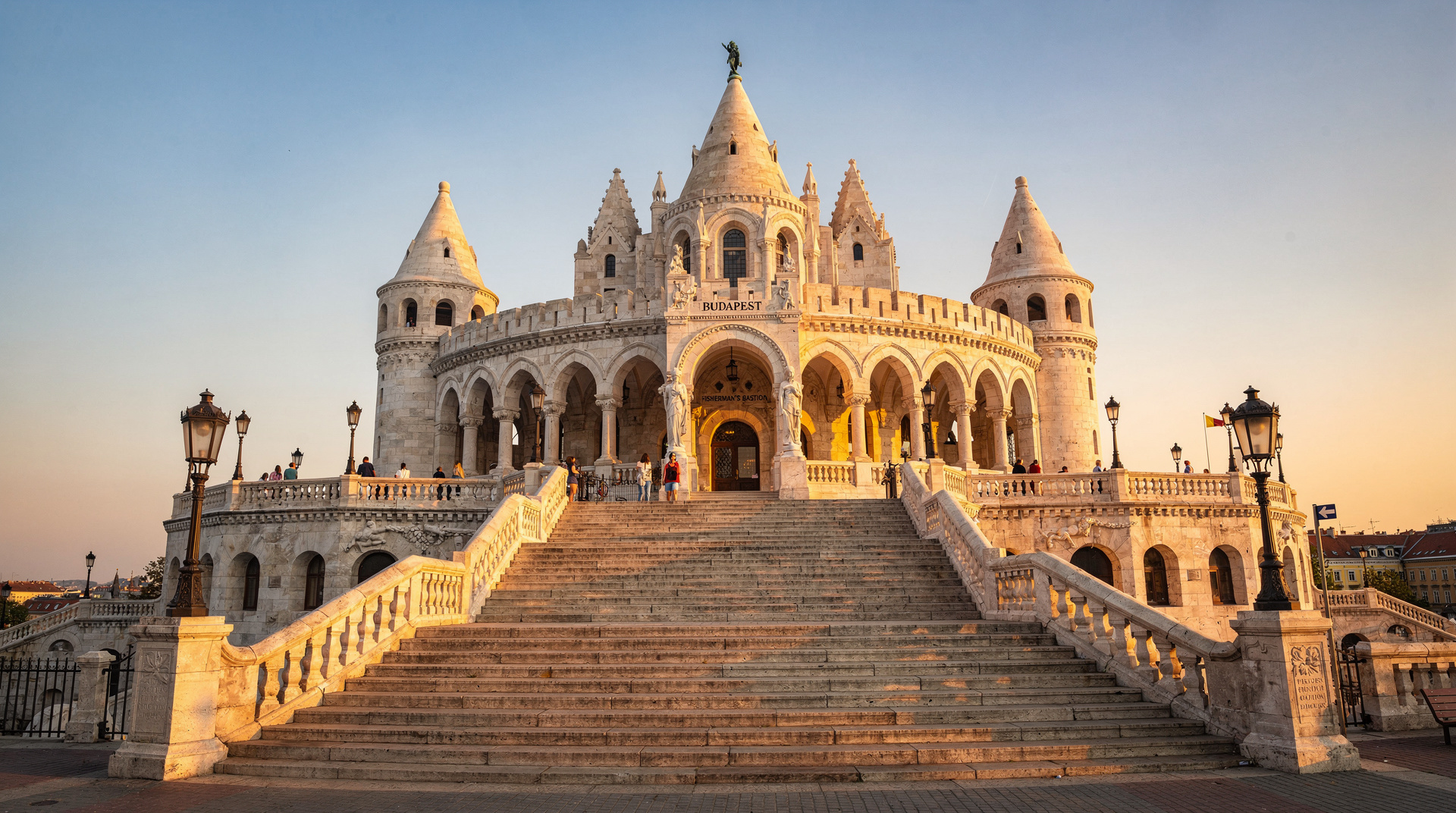
Matthias Church and Fisherman’s Bastion are directly adjacent — the west face of the church looks onto the Bastion’s upper terrace. A combined visit (1.5–2 hours total) is the standard approach. Arrive via Castle Hill in the morning, visit the church interior first (most tours and visitor groups arrive later), then move to the Bastion terrace for views.
The private tour of Buda Castle District and Matthias Church covers both sites in depth with a local historian who can explain the layered architecture in context. This is the most informative option for visitors who want to go beyond the visual.
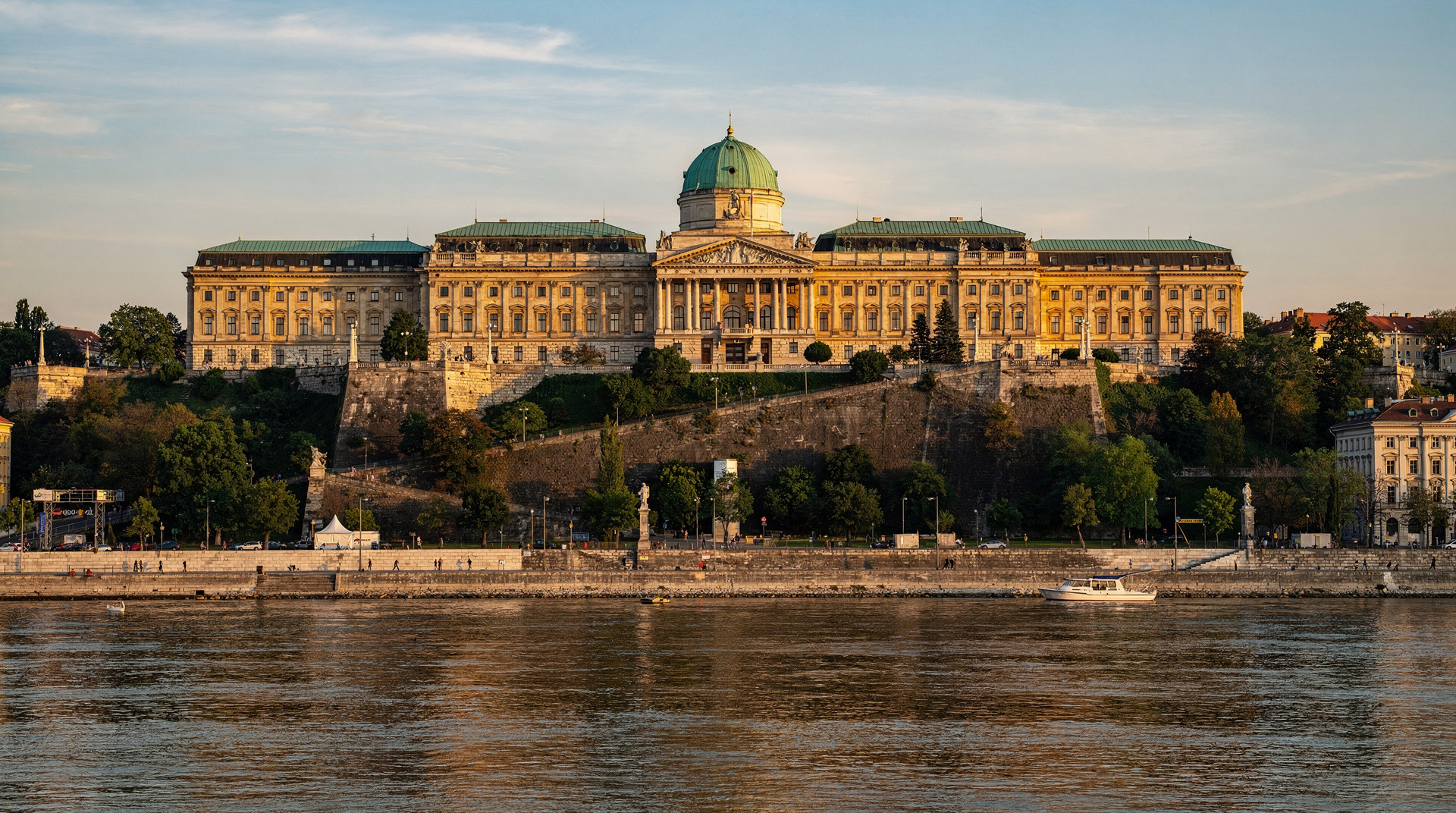
For the broader Castle Hill experience, the Buda Castle guide covers the Royal Palace, the cave system and transport options. The Fisherman’s Bastion guide covers entry, views and photography tips. The Castle District neighbourhood guide maps the medieval street network around both buildings.
For the full Budapest sightseeing framework, the top attractions guide places Matthias Church within a multi-day planning structure. Matthias Church by evening, with the Bastion illuminated behind it, is one of the most atmospheric sights in Budapest — the castle hill evening tour takes advantage of this.
Guided options on Castle Hill
Independent visiting works well, but a guided walk adds real value on Castle Hill because so much of what matters is invisible on a first look. A classic walking tour of the Buda Castle area places the church within the wider story of the hill, the palace and the old streets, which is useful if you want context rather than just a checklist of sights. Walking tours also tend to move at a comfortable pace and spare you from piecing together the route yourself; the best walking tours in Budapest guide compares the main styles if you are still deciding.
If you would rather see the hill when the day-trippers have gone, an evening visit to Castle Hill shows the church and its surroundings in a very different mood. The stone glows under lighting, the lanes are quieter, and the whole district feels closer to how it might have felt centuries ago. Note that interior access depends on the church’s own hours, so an evening outing is mostly about the exterior and atmosphere, and it pairs naturally with the views described in the Fisherman’s Bastion guide.
Making a half day of Castle Hill
Because the church sits so close to the other main sights, it is easy to stretch a visit into a satisfying half day. A sensible order is the church first, the Bastion terrace next, and then a slow wander towards the palace grounds. Leave time for a break at one of the cafés in the district; the coffee houses guide explains the Budapest café tradition if you want to make the pause part of the experience rather than an afterthought.
When you head down from the hill, you can continue towards the river and the Chain Bridge for a very natural transition from Buda to Pest. That walk gives you a different angle on the same skyline, and the roof you admired up close becomes a small bright detail on the hillside behind you. If you plan to combine several big sights in one trip, the Budapest Card guide is worth a look to see whether a pass suits your itinerary.
Respect, dress and atmosphere
Matthias Church is an active place of worship as well as a landmark, and the mood inside changes with the hour. During services the space is hushed and devotional; outside them it is a busy but still reverent sightseeing stop. Dress modestly, remove hats and keep conversations low. If you are visiting alongside a group, agree beforehand on a meeting point outside so that you are not gathering in the nave. These small courtesies make the visit better for you as well, since the quiet lets the architecture and the painted surfaces do their work.
If the church is full or a service is under way, do not treat it as a lost visit. Use the time for the square, the Bastion terrace and a slow circuit of the surrounding lanes, then return later. The first time in Budapest guide offers more general advice on pacing a trip so that a closed door or a crowded hour never derails the day.
Best time to visit and avoiding crowds
Matthias Church shares Castle Hill’s general crowd pattern: tour buses and cruise-ship groups tend to arrive from mid-morning through early afternoon, peaking around 11:00–14:00. Arriving at opening time or after 16:00 gives a noticeably calmer interior, with better light for photographing the murals as the day progresses. Weekends are busier than weekdays year-round, and July–August adds the heaviest crowds. If your schedule allows only a weekend visit, aim for the first hour after opening.
For visitors touring the wider Castle District, Matthias Church works well as the first stop of the morning before the crowds build, saving the Royal Palace and Buda Castle grounds for later.
Frequently asked questions about Matthias Church guide
Why is it called Matthias Church?
The church is formally named the Church of the Assumption of the Buda Castle (Nagyboldogasszony-templom). It is popularly called Matthias Church after King Matthias Corvinus (ruled 1458–1490), who added the south tower, decorated the interior and held two of his weddings here. The diamond-patterned tiled roof was added in the 19th-century restoration.What is Matthias Church famous for architecturally?
Three things: the diamond-pattern Zsolnay ceramic tile roof (yellow, green and dark blue), visible from all over Budapest; the Gothic tracery and stonework on the original 13th–15th century sections; and the 19th-century Byzantine-Romanesque interior murals by Bertalan Székely and Mór Than, which are unlike anything else in Central Europe.Are concerts held at Matthias Church?
Yes. Organ and classical concerts are held regularly, especially in summer. The acoustic under the Gothic vaults is excellent. Tickets are sold at the church and through online booking; prices vary from 4 000–8 000 HUF. Check the church's notice boards or website for current schedules.Can you visit Matthias Church independently or do you need a guide?
You can visit independently — buy a ticket at the door, collect the free audio guide or pamphlet, and explore at your own pace. A guide adds historical context that is hard to absorb from the information boards alone, particularly for the medieval history and the relationship between the church and Hungary's royal dynasty.How long should I spend at Matthias Church?
Budget 45–60 minutes for the church interior and museum, or up to 90 minutes if you also attend an organ concert. Combined with Fisherman's Bastion next door, a relaxed visit to both takes 1.5–2 hours in total.
Top experiences
Bookable activities with verified prices and instant confirmation on GetYourGuide.