City Park and Városliget — Széchenyi baths, Heroes' Square and Vajdahunyad Castle
Discover Budapest's City Park: Széchenyi thermal baths, Heroes' Square panorama, Vajdahunyad Castle and the Városliget renewal in half a day.

Quick facts
- Getting there
- Metro M1 (the yellow line, the oldest in continental Europe) to Széchenyi fürdő or Hősök tere — 15 minutes from the city centre.
- Széchenyi Baths entry
- From ~7 500 HUF (~€19) for a day pass; online booking recommended to skip the queue and avoid resellers.
- Heroes' Square
- Free to visit at all times; the surrounding Millenary Monument can be walked around in 20 minutes.
- Vajdahunyad Castle
- The exterior and grounds are free. The Agricultural Museum inside costs ~2 000 HUF (~€5). Ice rink in winter.
- Városliget renovation
- Major renovation project underway since the mid-2010s; some areas (new museums, the Ethnographic Museum) opened 2022–24 with others still under construction.
Budapest’s green lung — and its most visited baths
Városliget (City Park) is Budapest’s oldest and largest public park, a 100-hectare green space at the end of the grand Andrássy út that has served as the city’s outdoor living room since the late 18th century. What makes it different from similar parks in Paris or Vienna is the extraordinary density of things happening within its boundaries: thermal baths that drew visitors in Roman times, a reconstructed medieval castle, the country’s most important commemorative square, a zoo that dates from 1866, a circus, a circus museum, and now a cluster of brand-new cultural institutions added by the ongoing Városliget regeneration project.
Half a day gives you the essentials: Heroes’ Square, Vajdahunyad Castle and several hours at the Széchenyi Baths. A full day lets you add the zoo, one of the new museums and a walk around the less-visited northern section of the park.
| Where | District XIV, end of Andrássy út; metro M1 to Széchenyi fürdő |
| Cost | Heroes’ Square free; Széchenyi day pass from ~7 500 HUF |
| Time needed | Half a day for the essentials; a full day with the zoo or a museum |
| Getting there | Metro M1, ~15 minutes from the city centre |
| Best time | Year-round for the baths; mornings for Heroes’ Square |
Heroes’ Square — Hungary’s national monument
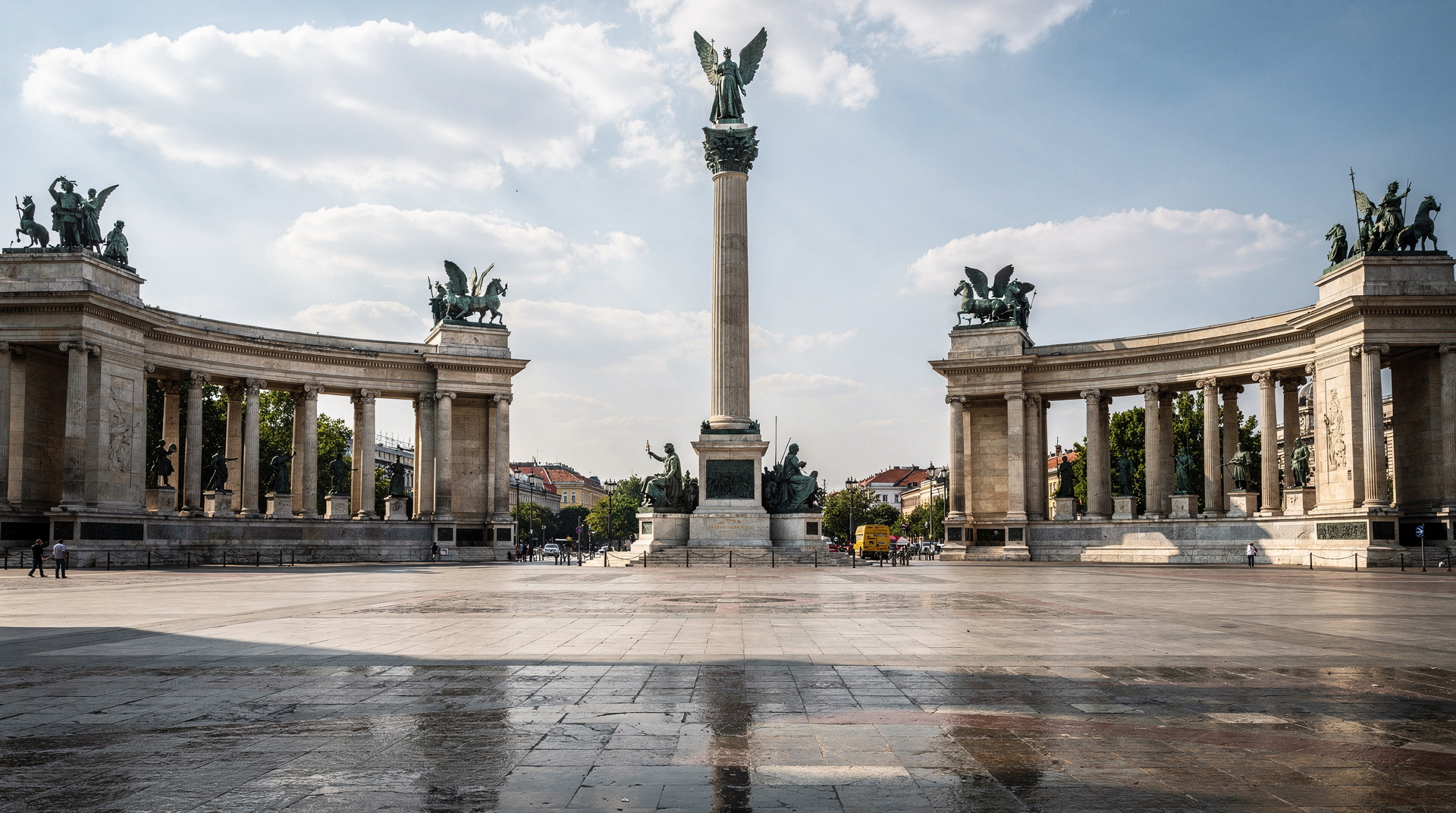
Hősök tere marks the formal end of Andrássy út and the entrance to City Park. The square was designed for the 1896 Millennial Exhibition celebrating 1 000 years of the Hungarian state, and the Millenary Monument at its centre remains one of the most important public sculptures in the country.
The 36-metre central column is topped by a gilded Archangel Gabriel, who Hungarian legend holds appeared in a dream to Pope Sylvester II to recommend that he crown Stephen as Hungary’s first Christian king. At the base of the column are equestrian statues of the seven Magyar tribal chieftains — Árpád and his companions — who led the Carpathian conquest in 895. Behind the column, two semicircular colonnades carry bronze statues of Hungarian rulers from Stephen I to Lajos Kossuth, with relief panels depicting key moments in Hungarian history.
The Heroes’ Square, City Park and baths highlights tour connects the square with the Széchenyi Baths and the City Park in a single guided morning — a good option if you want the historical context delivered efficiently.
Standing in the square, the Hungarian Museum of Fine Arts faces the Palace of Art (Műcsarnok) across a broad ceremonial space that still functions as intended: as a backdrop for state ceremonies, protests, concerts and casual weekend afternoon crowds. The Museum of Fine Arts holds a substantial collection of European art from the 13th to 20th centuries, with particularly strong Old Masters and Spanish Golden Age rooms.
Széchenyi Baths — the outdoor pool that defined Budapest’s image
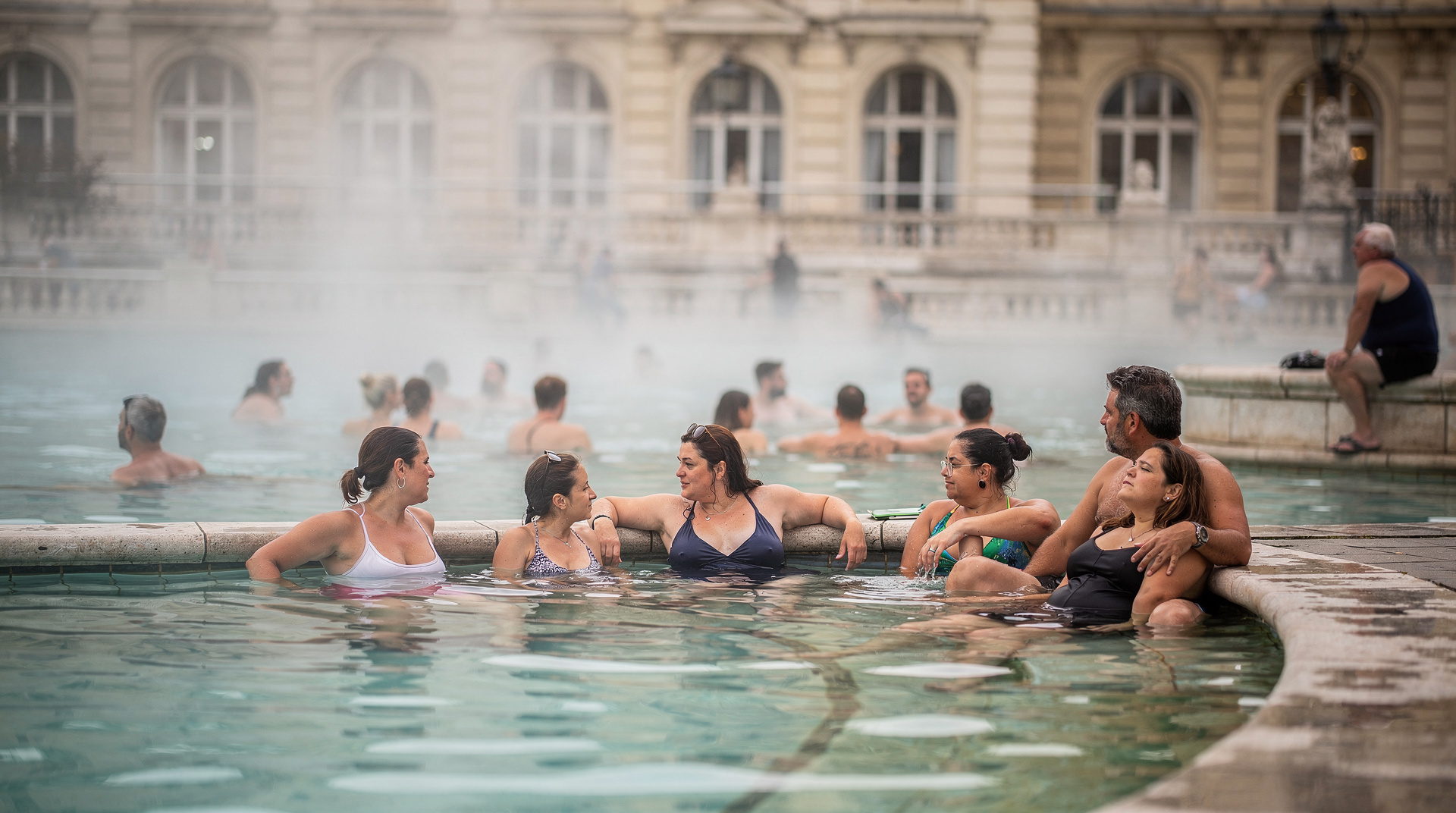
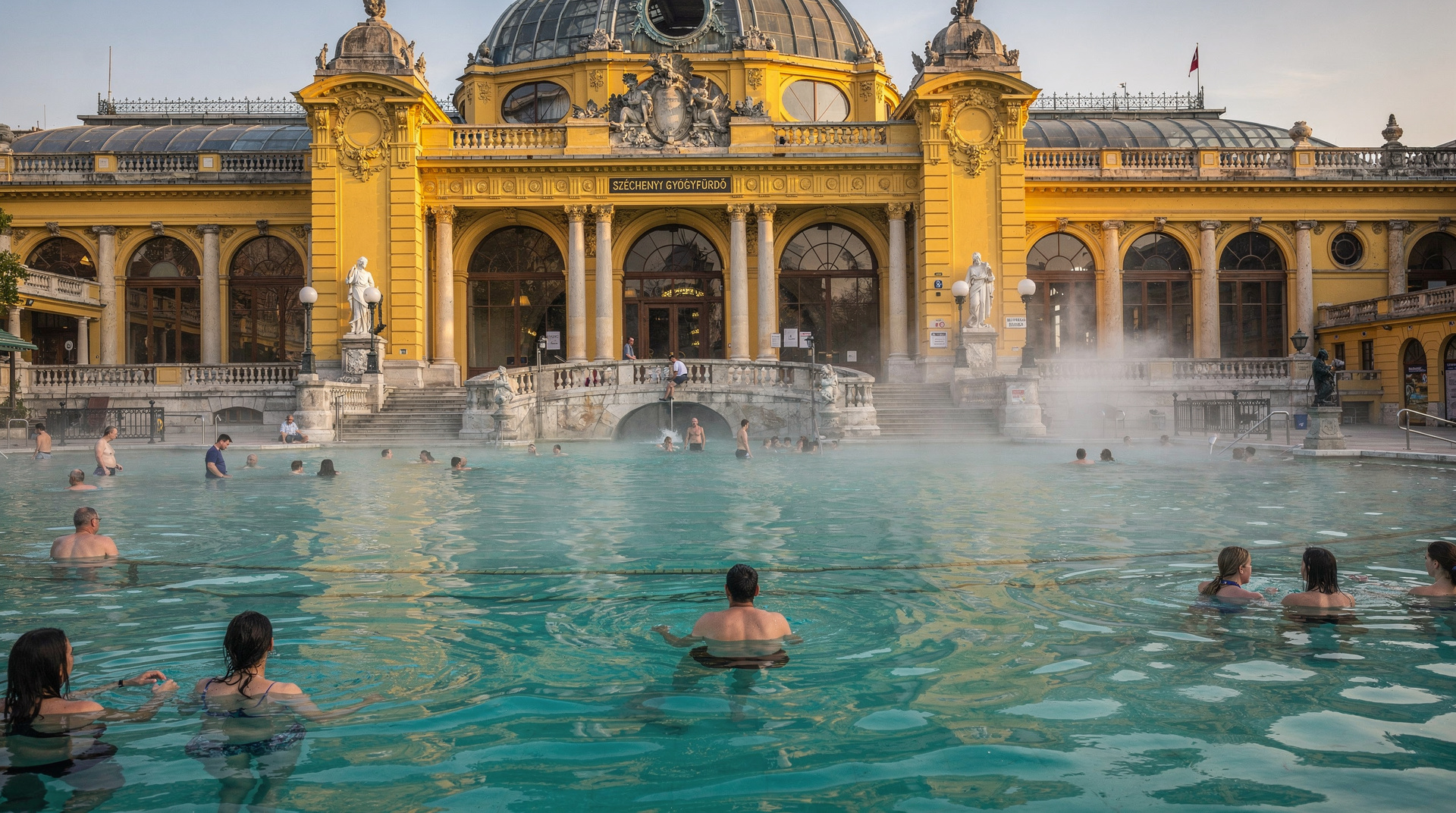
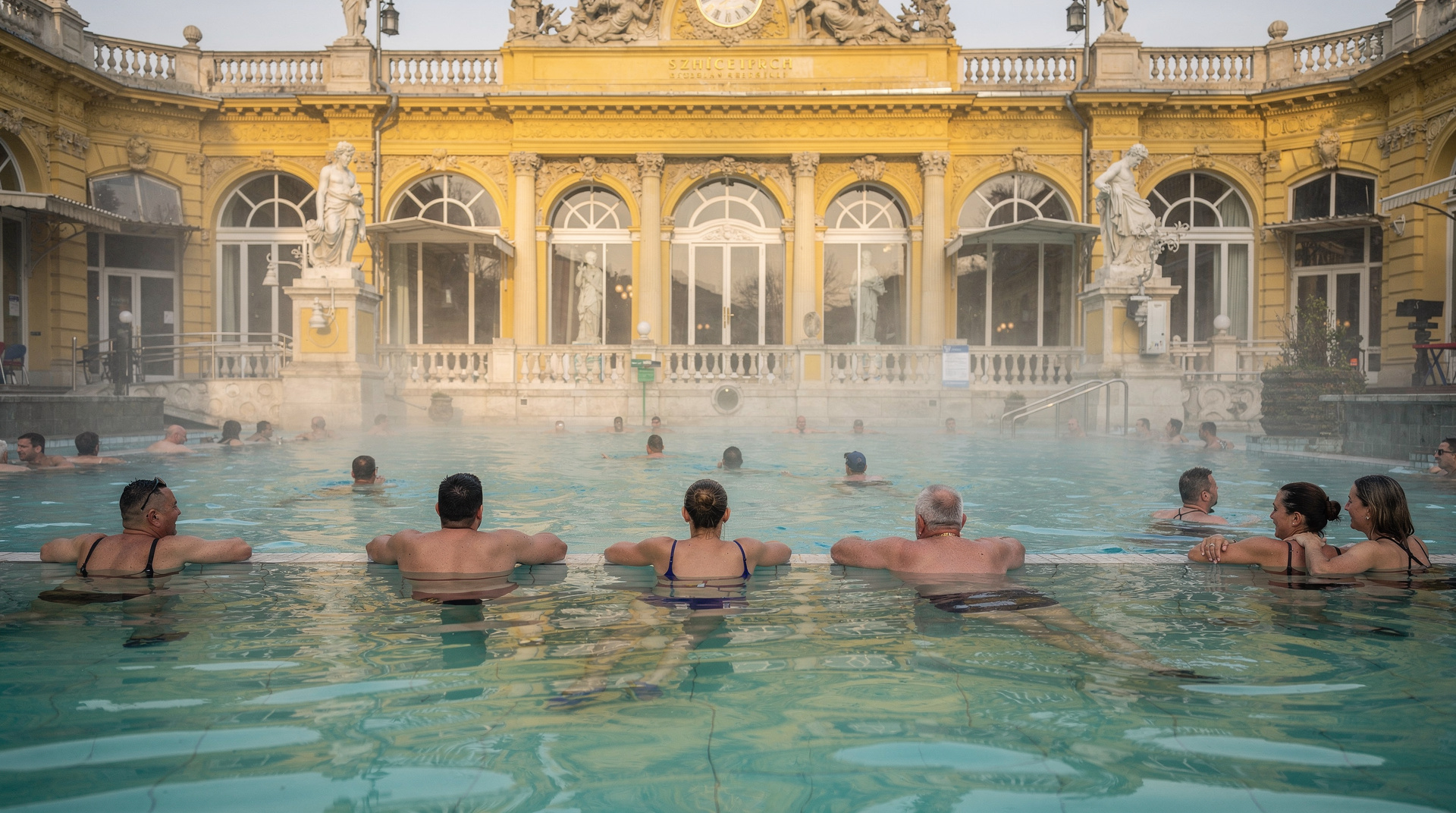
The photograph that appears in every feature on Budapest — a sea of bathers in steaming outdoor pools, neo-baroque dome rising above them — is taken at Széchenyi. The baths opened in 1913 in a yellow Baroque-revival palace that was expanded several times through the 20th century. Today the complex has 18 pools: three large outdoor pools (including the famous chess-players’ pool), and 15 indoor pools, saunas and steam rooms.
The outdoor pools stay open year-round. Winter visits — when the water temperature holds at 36–38°C against an air temperature that can drop below freezing — deliver the definitive Budapest bath experience. The mist rising from the pools, the contrast between the hot water and the cold air, the improbability of sitting outdoors in January while comfortably warm: this is what makes Budapest’s thermal bath culture genuinely distinct from the spa culture of any other European city.
Book Széchenyi Baths entry online to secure a locker and avoid the queue at the desk — particularly important on weekends and in peak summer. Resellers at the entrance charge a premium for tickets that may not include locker access; the official online booking avoids this. The thermal baths tour with folk music performance adds a cultural evening dimension to the bath visit.
Prices start from around 7 500 HUF (~€19) for a day pass on weekdays. The day pass allows unlimited access to all facilities including the outdoor pools. Bring a padlock for the locker (or rent one), and flip-flops for the indoor areas. A swimsuit is required throughout.
For a comprehensive comparison with Gellért, Rudas and Lukács, see the best thermal baths in Budapest guide.
Vajdahunyad Castle — a Gothic-Baroque-Romanesque history lesson
At the back of City Park, separated from the park by a small lake (which becomes an ice rink in winter), stands Vajdahunyad Castle — a structure that looks medieval but was built for the 1896 Millennial Exhibition as a reproduction of (an amalgamation of) Hungarian historic architectural styles. The name comes from the Vajdahunyad Castle in Transylvania (now Hunedoara in Romania), which was the seat of the Hunyadi family and the birthplace of the great 15th-century king Matthias Corvinus.
The complex is a deliberate architectural anthology: Romanesque chapel, Gothic tower, Renaissance loggia and Baroque main wing, all connected into a single building. What was intended as a temporary exhibition pavilion in cardboard and wood proved popular enough to be rebuilt in permanent materials between 1904 and 1908.
The castle’s interior houses the Hungarian Agricultural Museum — the largest of its kind in Europe, covering Hungarian hunting, fishing, viticulture, livestock breeding and cereal farming from prehistoric times to the present. It is more interesting than it sounds, particularly the sections on the Hungarian horse breeds (Lipizzan, Nonius) and the reconstruction of a traditional farmstead interior.
In winter, the moat around the castle becomes one of Budapest’s most popular ice rinks — skating under neo-Gothic towers while snow occasionally falls is an experience that explains itself.
The chocolate museum and family attractions
Near the Széchenyi Baths end of the park, the Budapest Chocolate Museum is one of the city’s better family-oriented attractions — interactive exhibits, a smell-and-taste experience, and a workshop element that children find genuinely engaging. More importantly for parents, it is indoors, year-round and requires only a couple of hours.
The Budapest Zoo and Botanical Garden (Állatkert körút 6–12) has been continuously open since 1866, making it one of the oldest zoos in the world. The Art Nouveau entrance gates and elephant house (both listed buildings) are as interesting as the animals in some respects. Entry costs around 4 000–5 000 HUF (~€10–12) for adults; a popular half-day with children.
The Budapest Circus (Állatkert körút 7) next door is a traditional big-top with regular performances — check the schedule at the box office.
Andrássy út — the boulevard connecting downtown to the park
Walking from the city centre to City Park along Andrássy út is the recommended approach if you have time. The 2.5-kilometre boulevard is a UNESCO World Heritage site along with the other Buda and Pest elements of the historic centre. Its western stretch (near the Opera House) is lined with aristocratic town palaces from the Austro-Hungarian period; the middle section holds embassies and consulates; the eastern stretch opens into the Millennial Underground — metro M1, built in 1896 as the second underground railway in the world and the first on the European continent.
Along the route: the Hungarian State Opera House (guided tours available; worth the exterior inspection even if you do not attend a performance) and the House of Terror museum at number 60 — the former headquarters of both the Nazi Arrow Cross and the Soviet ÁVH secret police, now a museum of 20th-century totalitarianism.
How to shape your day in the park
The park rewards a loose plan. Because the main sights sit close together and most of the grounds are free to enter, you can adjust the order to the weather, your energy and the crowds rather than following a rigid timetable. The one fixed point is the baths, which are the part of the visit most affected by timing, so decide first when you want to be in the water and arrange everything else around it.
A sensible rhythm for first-timers is to start with the open-air sights while you are fresh, then move to the baths when the walking has made warm water most welcome. Heroes’ Square and the castle grounds are pleasant on foot and cost nothing, which makes them easy to fit around a bath booking. If you would rather have the baths first and the sightseeing afterwards, that works too: the park is comfortable to stroll when you are relaxed, and the lake and castle make a calm ending to the day. Our dedicated Heroes’ Square and City Park guide walks through the monuments in more detail, and the Széchenyi baths guide covers the bathing side step by step.
If you are weighing this half-day against the rest of your trip, the Budapest 3-day overview shows where City Park fits alongside the Castle District, the Danube and the evening neighbourhoods. Visitors with a little more time can see it as part of the first-timer highlights itinerary, which pairs well-known sights with slower moments like a long soak.
What to expect inside the baths
Many visitors arrive at Széchenyi expecting a modern spa and find something closer to a grand public institution, with all the character that implies. The corridors can be a little labyrinthine, the changing arrangements take a moment to understand, and the atmosphere is lively rather than hushed. Take your time on arrival, ask staff when you are unsure, and treat the first few minutes as orientation rather than rushing to the pools.
Once you are settled, the pleasure lies in moving between the different temperatures and settings. Start in a warm pool to loosen up, try the saunas or steam rooms if you enjoy them, and finish in the outdoor water to enjoy the view of the dome. Pace yourself: hot water is more tiring than it feels, and a slow session is better than a long one that leaves you drained. Drinking water between pools and sitting down to rest are both sensible habits. If the etiquette is new to you, the thermal bath etiquette guide explains what is expected so you can relax rather than worry about doing something wrong, and the list of bath ticket mistakes is worth a read before you pay for anything.
For the folk-music option, think of it as an addition to a bath visit rather than a replacement for it. It suits travellers who want the baths to feel like part of an evening out, and it gives the experience a more memorable shape than a plain entry ticket does.
Combining the park with other parts of the city
City Park is the natural bookend to a walk down Andrássy út, so it pairs easily with the neighbourhoods at the other end of the boulevard. Read the downtown Pest guide if you want to build a day that starts in the centre and ends among the park’s trees, or look at the Margaret Island guide for another green escape on the Danube, with a different mood and a very different setting.
Travellers who enjoy museums can use the park as a base for a gentler cultural day. The best museums in Budapest guide helps you decide which of the city’s collections deserve your limited time, while families will find more ideas in the family-friendly attractions guide and the Budapest Zoo and Aquarium guide. On a grey day, the rainy-day Budapest with kids guide lists indoor fallbacks so the plan does not collapse when the weather turns.
Practical tips
Arrive at Széchenyi before 10am on weekdays to secure a locker and find the outdoor pools manageable. Saturday and Sunday afternoons are the busiest times — arrive by 9am or after 3pm. The spa area (indoor pools, saunas, massage) is quieter than the outdoor pools throughout the day.
For a family visit, the logical sequence is: Heroes’ Square (30 minutes), Vajdahunyad Castle exterior and ice rink/lake walk (45 minutes), Chocolate Museum (1.5–2 hours), then either the zoo or the baths for the afternoon. Pack swimsuits and a change of clothes even for a “sightseeing only” plan — the baths tend to pull families in once the Heroes’ Square and castle portions are done, and arriving unprepared means either skipping them or renting gear at extra cost.
City Park connects naturally to Downtown Pest via Andrássy út and to the Jewish Quarter via a 10-minute walk south. For context on the full Budapest visit, see the Budapest travel guide and the Budapest with kids guide.
Városliget versus the other baths, briefly
Choosing which Budapest bath to prioritise is a common first-timer question. The short version, expanded fully in the thermal baths guide:
| Széchenyi (City Park) | Gellért | Rudas | |
|---|---|---|---|
| Style | Neo-baroque, grand, outdoor pools | Art Nouveau, glass-roofed | 16th-century Ottoman, domed |
| Crowds | Busiest, most tourist-facing | Moderate | Local-heavy, less touristy |
| Best for | First-timers, winter outdoor soaking | Architecture lovers | Authenticity, weekday mornings |
Top experiences
Bookable activities with verified prices and instant confirmation on GetYourGuide.