Lukács baths guide: Budapest's best kept local secret
What is Lukács baths like?
Lukács is the quietest and most local of Budapest's main baths — no stag groups, no selfie sticks, just a pleasant garden, outdoor thermal pool, and neighbourhood regulars. Great value and a genuine escape from tourist-heavy Széchenyi.
Lukács baths: where locals actually go
If you ask a Budapest resident where they go to soak, most will say Lukács. Not Széchenyi — that is for Instagram. Not Gellért — that is for hotel guests and tour groups. Lukács, tucked behind the tram line in Buda’s District II, is where people in the neighbourhood have been coming since 1884 for a genuine thermal bath experience without the theatre.
| Where | Frankel Leó út 25–29, District II (Buda) |
| Cost | Around 4,900–6,500 HUF full day |
| Time needed | 1.5–3 hours |
| Getting there | Tram 17, or tram 4/6 + short walk from Margaret Bridge |
| Best for | Quiet soak, locals’ atmosphere, value |
The Lukács complex is not spectacular. It does not have an Ottoman dome or a yellow neo-baroque palace. What it has is an outdoor heated pool in a garden surrounded by trees, a network of indoor thermal pools at various temperatures, a medical spa with genuinely therapeutic credentials, and an atmosphere closer to a neighbourhood swimming centre than a tourist attraction. On weekday mornings, the clientele is mostly local: older residents doing laps, physiotherapy patients, young professionals from the nearby Buda residential streets.
The Lukács full-day ticket is also the best value of any of the major Budapest baths — significantly cheaper than Széchenyi or Gellért, with access to a broader thermal section than the price might suggest.
What to expect at Lukács
The outdoor thermal pool
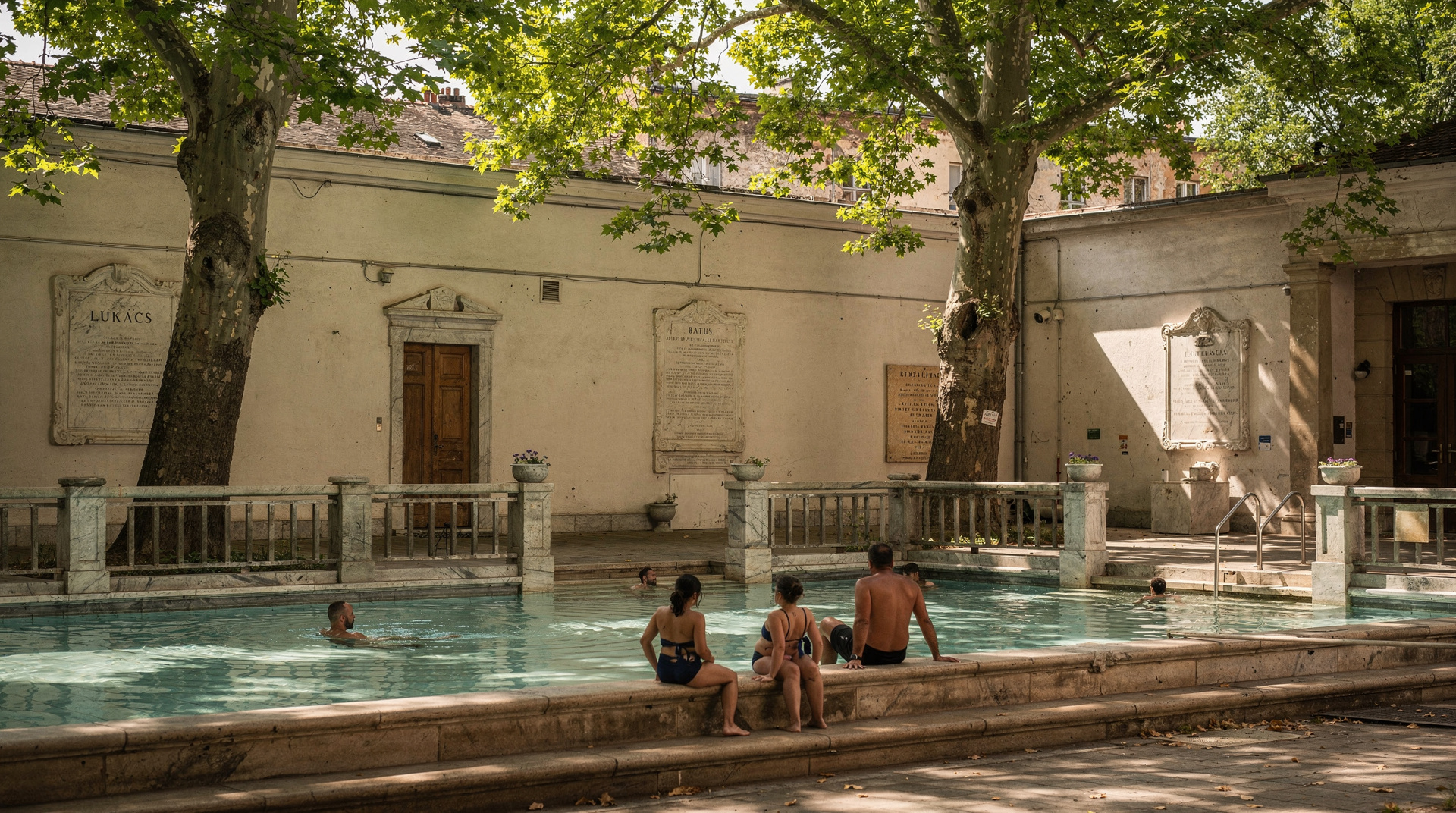
The centrepiece of Lukács — more than any individual indoor pool — is the outdoor garden pool. Set in a courtyard surrounded by plane trees, it holds at 36°C and is large enough to swim lengths without congestion. The garden has benches and sun loungers, and the combination of thermal water and fresh air makes this one of the pleasanter places to spend a slow afternoon in Budapest.
The outdoor pool feels particularly good in late September and October, when the surrounding trees turn and the sky is clear. Not many visitors discover this specific pleasure of a Lukács autumn afternoon.
Indoor thermal pools
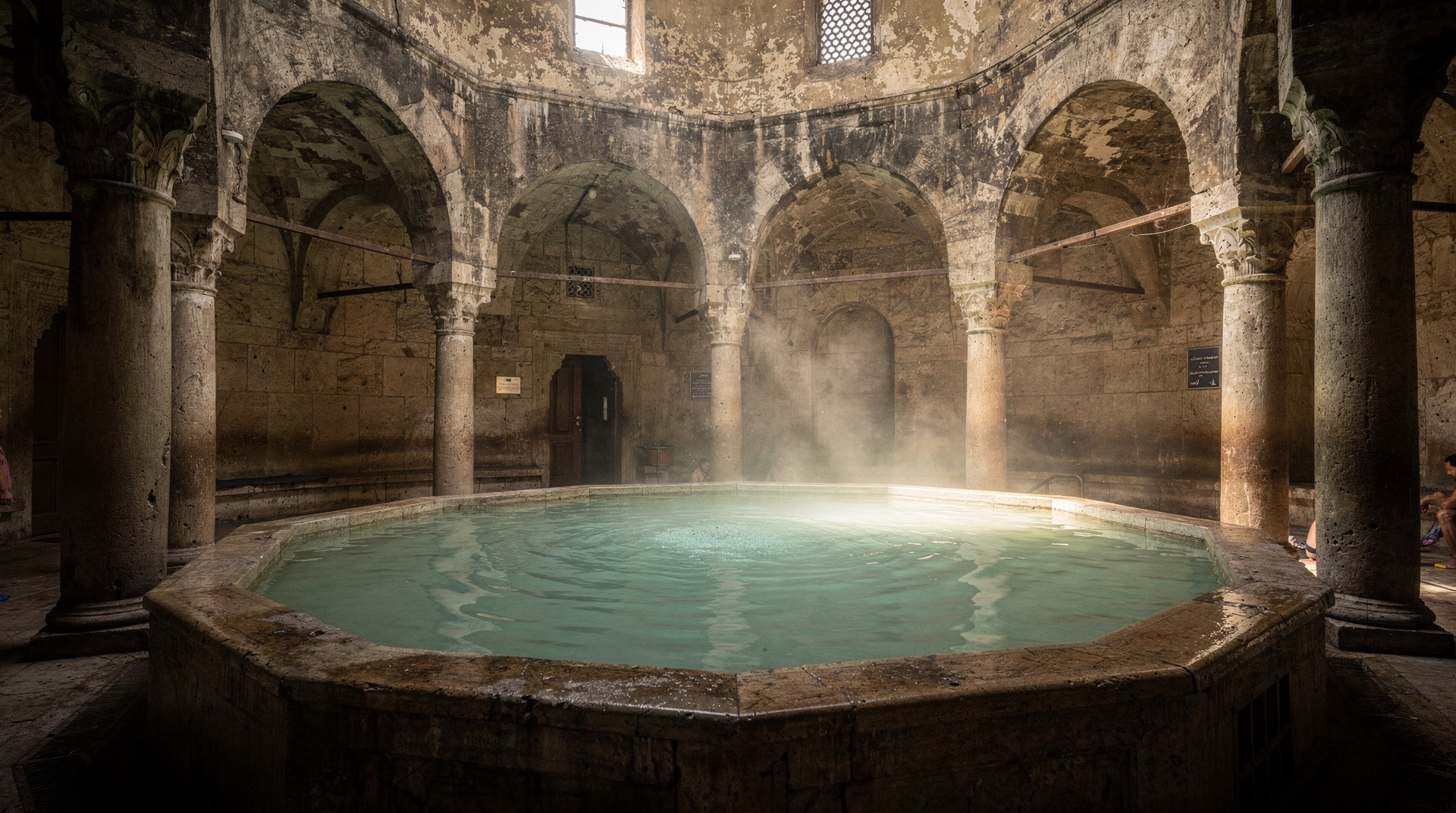
The indoor section has a main pool and several smaller thermal pools ranging from 22°C to 40°C. There is a plunge pool. The interior is functional rather than ornate — a clean, well-maintained complex that was last significantly renovated in the 1990s. It is not architecturally dramatic, but it is comfortable.
Saunas and steam rooms
Dry sauna and steam room are included in the day ticket. Less impressive than Széchenyi’s sauna zone in size, but quieter. You will rarely need to queue.
Medical bathing and physiotherapy
Lukács retains a genuine medical bathing operation. Physiotherapy, hydro-massage, underwater traction, and mud treatments are available to book separately, usually at the reception desk on the day. The thermal water at Lukács is classified as medicinal and is used for conditions including arthritis, joint problems, and post-surgical rehabilitation. Prices for treatments range from 8,000 to 18,000 HUF (€20–45) depending on type and duration.
Getting there
Bus: Bus 86 runs along Buda’s riverbank from the southern districts to District II, stopping near Lukács. From central Pest, take tram 4 or 6 to the Margit híd (Margaret Bridge) stop and cross to Buda — the bath is a short walk north along Frankel Leó út.
Tram: Tram 17 runs along Buda’s riverside and stops near Lukács. Also reachable by tram 4/6 via the Margaret Bridge.
Time from city centre: About 15–20 minutes by public transport from Deák Ferenc tér.
Address: Frankel Leó út 25–29, District II (Buda).
Pricing and tickets
Full-day entry with locker: approximately 4,900–6,500 HUF (€12–16). This is substantially cheaper than Széchenyi or Gellért for equivalent access. The full comparison across all baths is in /guides/budapest-baths-prices-tickets/.
Weekly regulars at Lukács include older Budapestians who buy monthly passes. Day passes include the outdoor pool, all indoor thermal pools, and the sauna zone. Physiotherapy is booked and charged separately.
Lukács vs the alternatives
| Bath | Character | Price (full day) | Best for |
|---|---|---|---|
| Lukács | Local, quiet, medical | 4,900–6,500 HUF | Value, avoiding crowds |
| Széchenyi | Iconic, busy, ornate | 8,000–12,000 HUF+ | First-time visitors, photos |
| Rudas | Ottoman, rooftop view | 7,000–10,000 HUF | History, skyline views |
| Gellért | Art Nouveau architecture | 9,000–13,000 HUF | Architecture lovers |
| Dandár | Ultra-local, District IX | 3,500–5,000 HUF | Maximum authenticity |
vs Széchenyi: Széchenyi has the outdoor drama and the iconic setting; Lukács has the quiet and local atmosphere. If you have already done Széchenyi (or want to avoid the crowds), Lukács is the obvious choice.
vs Rudas: Rudas has the Ottoman history and the rooftop view. Lukács has the garden and the calm. Both are Buda-side; they appeal to different preferences.
vs Gellért: Gellért has the Art Nouveau architecture. Lukács has the neighbourhood character. If Gellért’s current status is uncertain (check before you visit), Lukács is the natural Buda-side alternative.
vs Dandar: Dandar in District IX is even more local and even less visited by tourists. Both are good choices for those actively avoiding the tourist circuit. Dandar is slightly easier to reach from Pest; Lukács has slightly better facilities.
The full comparison is in /guides/szechenyi-vs-gellert-vs-rudas/ and /guides/best-thermal-baths-in-budapest/.
When to visit
Ideal: Weekday mornings or weekday afternoons in shoulder season (April–May, September–October). These times give you the outdoor pool at its most pleasant, with the fewest visitors.
Good: Any winter morning. The outdoor pool’s steam and the surrounding trees make Lukács a particularly pleasant winter experience. Less dramatic than Széchenyi in winter, but genuinely serene.
Avoid: Saturday afternoons in summer — the outdoor pool is at its busiest and the neighbourhood residents are joined by those who have overflowed from a full Széchenyi.
Tips for the visit
Shower before entering: Standard practice at all Budapest baths. Showers are available at the changing room exits.
Bring a book: Lukács is one of the few Budapest baths where reading in the garden feels natural and undisturbed.
Physiotherapy booking: If you want a treatment, ask at the reception desk on arrival or call ahead. Popular treatments (particularly the underwater massage) are sometimes booked out on popular days.
Food nearby: The surrounding Frankel Leó út neighbourhood has good local cafés and bakeries. Not tourist-facing — prices are local Hungarian, which means significantly cheaper than the tourist zone.
Combine with Buda districts: Lukács sits in one of Budapest’s more interesting residential neighbourhoods. A walk north along the Buda Danube bank after your soak takes you through quieter residential streets, past the Óbuda archaeology zone. The /destinations/obuda-aquincum/ destination page covers this area.
For general bathing etiquette applicable to Lukács and all Budapest baths, read /guides/thermal-bath-etiquette/ before your visit.
The honest case for Lukács
Budapest’s thermal bath scene is marketed primarily through Széchenyi. That makes commercial sense — it is the most photogenic and the most accessible for first-time visitors. But it means that Lukács, which offers a more authentic version of what daily Budapest bathing culture actually looks like, is consistently overlooked.
If you are returning to Budapest, or if you are the kind of traveller who finds the least-visited option more interesting than the most-visited one, Lukács is the answer. The thermal water is as medicinal as anywhere in the city, the prices are the best value, and the experience of sharing a garden pool with neighbourhood Budapestians on a sunny October afternoon is one of those quietly memorable travel moments.
For planning purposes, Lukács works well as part of a Buda day alongside the /destinations/castle-district/ or a walk along the Danube bank from the Margaret Bridge. See the /itineraries/budapest-thermal-baths-itinerary/ for a two-day wellness itinerary that includes both Rudas and Lukács.
Pool temperatures at a glance
Lukács has more distinct temperature zones than most visitors expect, which is part of why regulars stay for hours rather than one quick soak:
- Outdoor garden pool: 36°C, the main draw, open year-round
- Indoor thermal pools: range 22°C to 40°C across several basins
- Plunge pool: cold-water contrast pool, part of the traditional bathing circuit
- Swimming pool: cooler lengths pool for those who want exercise rather than soaking
Moving between temperatures — hot soak, cold plunge, back to hot — is the traditional Hungarian bathing rhythm, and Lukács is one of the easier baths to do this properly because the pools are close together and rarely crowded enough to queue between them.
How to spend a first visit
A first visit to Lukács rewards a slow pace. Arrive without a plan, change, shower, and start in the outdoor garden pool while you are still fresh. Then work inward: a warmer indoor basin, a short stint in the sauna or steam room, a quick cold plunge, and back to the garden. Regulars treat the day as a loop rather than a checklist, and nobody here is counting how many pools you have ticked off.
If it is your first thermal bath anywhere in Hungary, it helps to read thermal bath etiquette beforehand. The rules are simple, but knowing them removes the small anxieties — what to wear, where to shower, how the lockers work — that make newcomers tense. The same goes for the ticket mistakes that catch visitors out at other baths, which are worth a glance before you queue anywhere.
Lukács suits solo visitors particularly well. Nobody expects conversation, a book is perfectly normal, and the garden gives you somewhere to sit when you have had enough of the water. If you are travelling alone, the solo travel guide has more ideas for quiet, unhurried days like this one.
Lukács as part of a wider plan
Because Lukács is the calm option, it pairs well with busier days. Many visitors do the big sights in the morning and come here in the afternoon to recover. It also fits naturally into a longer stay: the 3-day Budapest overview leaves room for exactly this kind of recovery soak, and the thermal baths itinerary shows how to sequence several baths without exhausting yourself.
For couples, Lukács is less romantic in the postcard sense than some alternatives, but the garden and the quiet make it a pleasant shared afternoon. Compare it with the options in best baths for couples before deciding. Families will find the relaxed atmosphere helpful, and baths with kids explains what to consider when you bring children.
If you are comparing Lukács with the famous names, three guides cover them in depth: Széchenyi for the big outdoor spectacle, Rudas for the Ottoman hall and the skyline, and Gellért for the Art Nouveau interior. If you would rather see them side by side, Széchenyi vs Gellért vs Rudas puts the main differences in one place. Anyone who wants the other tourist-light option nearby can add Dandár to the shortlist, and a visit to a neighbourhood bath in District IX makes an instructive contrast with Lukács.
Seasons and weather at the garden pool
The outdoor pool changes character through the year. In spring it is bright and uncrowded; in summer the garden is at its busiest and the shade of the trees matters; in autumn the colours make it the most photogenic moment of the year; in winter the steam rising off the water is the main attraction. If cold weather is the reason you are curious, outdoor baths in winter explains what the experience is like and how to prepare for the walk between pools.
To time the rest of your trip around the weather, the best time to visit Budapest is a good starting point, and Budapest in autumn fits the season in which Lukács is at its most appealing. A personal account of the first cold-weather soak is in the blog post my first winter bath, which gives a sense of what first-timers feel in the water.
Costs, passes and planning around the bath
Lukács is the cheapest of the main baths, which makes it easy to fit into a tight budget. For a wider look at where the money goes, see Budapest baths prices and tickets and Budapest on a budget. If you are weighing a city pass against paying bath by bath, Budapest Card worth it lays out the reasoning.
Getting around is straightforward, and Budapest public transport tickets covers the ticket side of the tram and bus journey. For a different style of day in the same bank of the river, Margaret Island is close enough to combine with a soak, and the Buda Castle guide covers another half-day that sits comfortably on the same side of the Danube.
Whichever combination you choose, leave the evening free. After a few hours in warm water most people feel heavy and slow, and a long dinner or an early night is the natural ending. If you want a bigger comparison of every bath worth your time, best thermal baths in Budapest is the overview, and Széchenyi is the one to add if you want a lively contrast to Lukács.
Frequently asked questions about Lukács baths guide
How much do Lukács baths cost?
A full-day ticket at Lukács costs around 4,900–6,500 HUF (€12–16) — the best value of the four main Budapest baths. The price includes access to all thermal pools, the outdoor pool, saunas, and the garden. Physiotherapy treatments are available at extra cost.Where is Lukács baths?
Lukács Baths is located in Buda's District II, at Frankel Leó út 25–29, a short walk from the Margaret Bridge and the Danube bank. Bus and tram connections make it easy to reach from central Pest in about 15 minutes.Is Lukács baths suitable for families?
Yes. Lukács is one of the better baths for families — calmer than Széchenyi, with no age restrictions on most pools. The outdoor area has sun loungers and a garden, and the general atmosphere is more relaxed. Read /guides/best-baths-with-kids/ for more.Does Lukács have physiotherapy?
Yes. Lukács has a medical bathing tradition and offers physiotherapy, hydro-massage, underwater jet massage, and other treatments bookable separately on site. It remains genuinely used for therapeutic purposes by Hungarian residents.Can I use Lukács baths year-round?
Yes. The indoor pools are open year-round. The outdoor pool is heated and usable in colder months, though more pleasant in spring and autumn. The garden is a lovely setting on sunny autumn days.
Top experiences
Bookable activities with verified prices and instant confirmation on GetYourGuide.