Segway tours in Budapest: what to expect and which to book

Are segway tours worth doing in Budapest?
Yes, if you want a novel sightseeing experience that covers significant ground quickly. A 2-hour segway tour covers 10–15 km and most major sights. Expect 15–20 minutes of training before departure. Prices run 10 000–18 000 HUF per person. Not suitable for those with balance issues or knee/ankle injuries.
Self-balancing sightseeing
Segways polarise opinions. Some visitors find them ridiculous; others find them liberating. The practical reality is that they offer a mode of sightseeing that sits between cycling (more effort, more flexibility) and bus tours (no effort, no flexibility): you move at a pleasant pace, cover meaningful ground, and engage physically with the journey without significant exertion.
Budapest suits segways well. The Pest riverside is wide and flat. The main boulevards have pavements spacious enough for supervised group riding. The Castle District approach — typically done along the Buda riverside rather than up the steep hill itself — gives interesting perspectives on the castle from below.
| Where | Pest riverside, main boulevards, Buda riverside approach |
| Cost | around 10,000–18,000 HUF per person |
| Time needed | 1–2.5 hours depending on route |
| Getting there | most meeting points are central and metro-accessible |
| Best time | early evening tours for the illuminated landmarks |
The tour options
Standard city tour (2 hours)
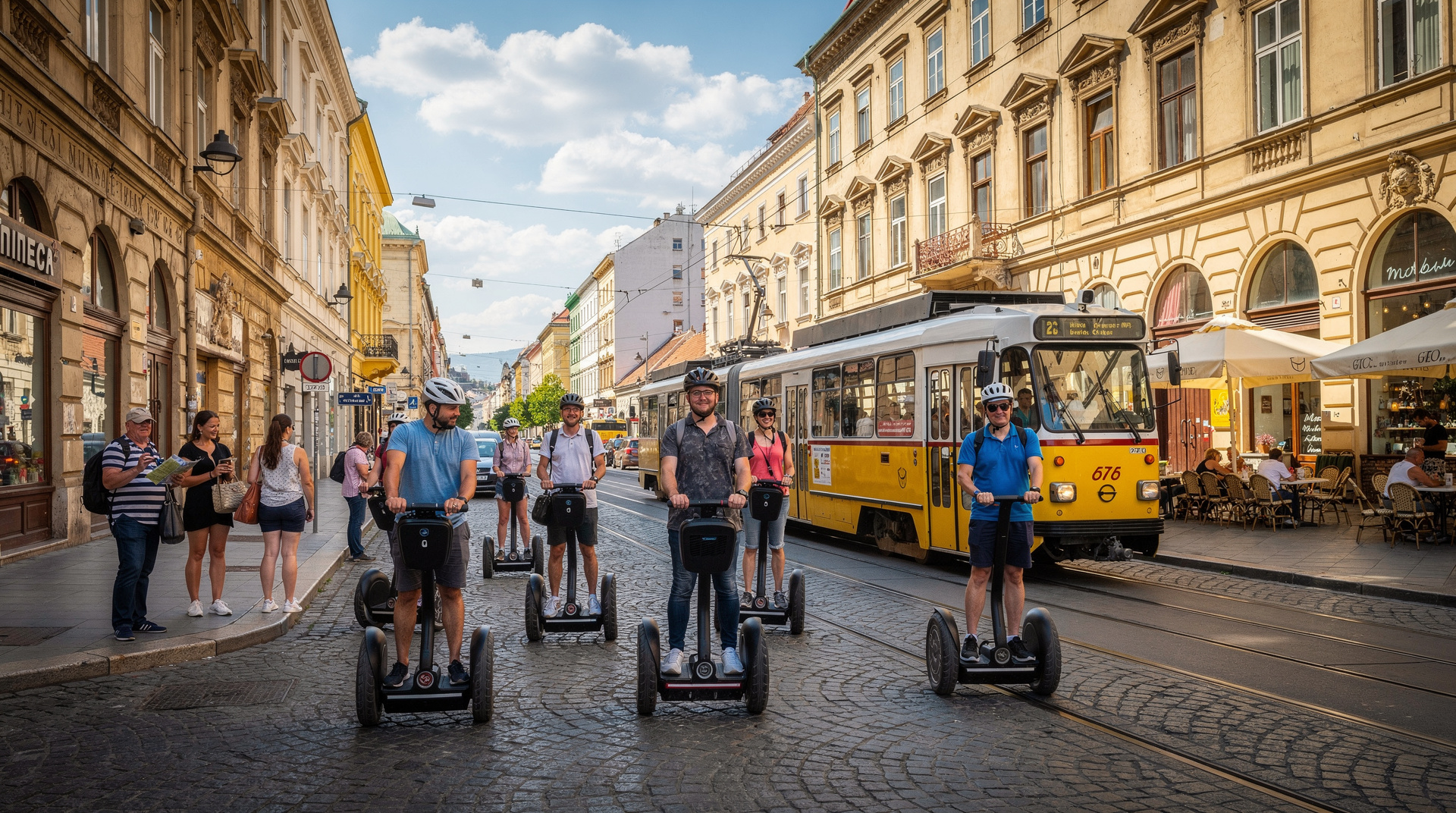
The Superior segway city tour is a 2-hour group tour covering the central Budapest sights: Parliament riverfront, Chain Bridge approach, the Jewish Quarter, and key Pest boulevards. Groups typically run 4–12 participants. The guide leads, stops for commentary at significant points, and adjusts pace to the slowest/most cautious participant.
This is the right option for visitors who want to experience segway touring without committing to a longer, more expensive private tour. Budget 10 000–14 000 HUF per person.
Buda is hills and Pest is flat, and crossing between them means a bridge and a climb that a walking tour usually decides against: a segway tour covering both Buda and Pest takes in the two halves that most itineraries treat as separate days.
Private segway tour
The Budapest private segway tour allows the route and stops to be customised. For couples or small groups (2–4 people), the per-person price is often comparable to group tours once divided, with the significant advantage of moving at your preferred pace and stopping where you choose. Private tours can also be requested at specific times — useful for combining with other day plans.
Grand city tour (extended)
The Budapest 2.5-hour private grand city segway tour is the most comprehensive version: a longer route covering both the Pest centre and the Buda side, including the panoramic views from Castle Hill (reached by funicular, not segway — you park at the base). At 2.5 hours, this works well as a half-day activity rather than an add-on.
Express 1-hour option
For visitors tight on time, the 1-hour express tour covers the riverfront highlights only — Parliament exterior, Chain Bridge, the main Pest waterfront vista. Limited in depth but provides the segway experience and the best river views in a single package.
How to choose between them
The decision mostly comes down to three questions: how much time you have, who is coming with you, and whether you want a guide who talks to a group or one who adapts to you. If this is your first day and you simply want your bearings, the standard group tour does the job. If you are travelling as a couple or with friends and care about the pace, the private version is worth the extra thought. If you only have a gap between a morning museum and an afternoon booking, the express format fits without upsetting the rest of the day. Whichever you pick, the sensible habit is to read the meeting-point details on the booking page carefully, because central starting points differ from one operator to the next.
What the ride actually feels like
The first few minutes are the strangest. A segway responds to the slightest shift of your weight, so the instinct to stiffen up works against you. Relax your knees, look ahead rather than down, and let the machine do the balancing. Within a short time most riders stop thinking about the mechanics and start looking at the city, which is the whole point.
On the move, the group rides in single file or in a loose line, with the guide at the front setting the pace. Because you are standing upright and moving at a gentle speed, your view is better than from a bus and your hands are free of pedals and traffic lights to worry about. The trade-off is that you stay in formation: you follow the guide’s route, you stop where the guide stops, and you cannot peel off to look at something that catches your eye. That is the same limitation noted in the comparison with bikes below, and it is worth accepting before you book rather than discovering it halfway along the river.
Pavements and promenades are shared with pedestrians, so a good guide spends as much energy managing the group as talking. Expect some brief pauses where the group waits for a crowd to clear, and expect to dismount at certain points for commentary. These pauses are part of the rhythm, not a flaw in the tour.
Before your first ride
A little preparation makes the experience smoother:
- Wear comfortable trousers or shorts that allow your knees to bend freely, and closed shoes with a flat sole.
- Bring a layer you can add or remove; standing still on a riverside promenade feels cooler than walking, especially in the evening.
- Keep your bag small and secure. Phones and cameras belong in a zipped pocket, not in your hand.
- Arrive a little early so the training session does not start without you, and so you have time to ask the guide any questions about the route.
- Mention any injuries or concerns during the briefing. Guides would much rather adjust the plan than deal with a problem on the road.
If you are unsure about your balance, the accessible Budapest guide is a good place to look at other ways of seeing the city, and a seated option such as a hop-on-hop-off bus may suit you better.
Combining a segway tour with the rest of your trip
A segway tour works best as a single anchor in a day rather than the whole day. Use it early in a stay to get oriented, then return on foot to the places that caught your attention. A few ways to build it in:
- On day one: ride in the morning or late afternoon, then spend the rest of the day revisiting a favourite stop at your own speed. The first time in Budapest guide and the Budapest in one day itinerary show how to fit this around the essentials.
- As part of a short break: the Budapest weekend break itinerary leaves space for one active, slightly different experience, and a segway ride is an easy fit.
- For a longer stay: the three-day itinerary has room for a half-day activity, which suits the longer private and grand formats.
- On a romantic trip: an evening ride pairs naturally with dinner, and the romantic Budapest guide has ideas for what to do before or after.
Since segways stay on level ground, they also pair well with places that are best seen from the river or the boulevards, such as the Hungarian Parliament and the Chain Bridge. Riding past them gives you a feel for their scale, and you can then decide whether you want to go inside or climb up for a closer look.
Getting to the meeting point
Most operators start from central locations, so you rarely need more than a short walk or a ride on the metro. The Budapest metro guide and the getting around Budapest guide explain how to reach the centre without stress, and the BKK travel passes guide helps you pick a ticket if you plan several rides that day. Give yourself a comfortable margin: a late arrival can mean missing the training session, and without it you cannot join the tour.
Training and safety
Every operator provides a mandatory training session of 15–20 minutes before departure. You practise starting, stopping and turning in a controlled area. Only participants who demonstrate basic control join the tour; operators can and do exclude people who cannot manage the basics safely (rare, but it happens).
Helmets are provided and required. Some operators also provide wrist guards. Closed shoes are mandatory on most tours; sandals and flip-flops are not permitted.
Weather: tours operate in light rain. They are cancelled in heavy rain or storms. Check the operator’s cancellation policy; most offer a reschedule rather than a refund.
Comparing segway to bike and e-scooter
| Mode | Control | Ground covered | Effort | Cost/person | Age |
|---|---|---|---|---|---|
| Segway | Medium (guided) | 10–15 km | Very low | 10 000–18 000 HUF | 12+ |
| Bike tour | High (follow guide) | 15–25 km | Low–moderate | 9 000–14 000 HUF | 6+ |
| E-scooter tour | High (guided) | 10–20 km | Low | 9 000–15 000 HUF | 16+ |
| Walking tour | High (guided) | 3–5 km | Low | 4 000–12 000 HUF | Any |
The segway sits in an interesting middle position: more active than a bus tour, less tiring than cycling, but with less flexibility than either a bike or walking. For visitors who want the physical sensation of moving through the city without cycling effort, it is the right choice.
Evening segway tours
Several operators offer evening or night segway tours, typically starting around 19:00–20:00. These follow routes that prioritise the illuminated landmarks — the lit Parliament, the Chain Bridge at night, the Castle District from the Pest bank. The Danube promenade at night is atmospheric in a way that daylight hours do not replicate.
Evening tours are particularly popular with couples. The night tours Budapest guide covers the full range of evening tour options including segway, cruise and minibus alternatives.
Who a segway tour suits — and who it doesn’t
A segway tour works best for a first full day in Budapest when you want an efficient overview before deciding where to return on foot, or for visitors with limited mobility for walking but no balance or joint issues that rule out standing. It suits couples and small groups who want a shared novelty activity more than deep historical context — commentary happens at stops, not continuously. It’s a poor fit if you want to wander spontaneously, stop for long photo sessions, or dip into shops and cafés along the way; for that kind of pace, a walking tour or the Budapest travel guide for planning your own route on foot serves better. Families with children under the minimum age (typically 12–14) should look at family-friendly attractions or a hop-on-hop-off bus instead.
1-hour express segway tour — riverfront highlightsChoosing the time of day and season
Time of day changes the character of the tour more than most visitors expect. Daytime rides are brighter and better for seeing architectural detail, and the riverside is busier with walkers and cyclists. Late-afternoon and evening rides trade detail for atmosphere: the light softens, the bridges and the Parliament glow, and the whole outing feels more like a treat than an activity. If you can only do one, pick based on whether you want information or mood.
Seasons matter too. In the warm months, a ride is a pleasant way to be outdoors without much effort, though the busiest weeks bring more people on the promenades and fuller groups. In the cooler months, the same route feels quieter and the air is crisp, but you will want warm gloves and a hat, because standing on a moving platform makes cold hands more noticeable. The best time to visit Budapest guide helps you decide when the city suits the kind of trip you have in mind, and the Budapest in summer and Budapest in winter pages describe what each season feels like on the ground.
Other ways to cover the same ground
A segway is only one of several guided ways to see central Budapest, and it is worth knowing what else is on offer before you commit:
- A guided bike ride gives you more range and more control. The bike tours guide covers the options, and a guided bike ride is a natural alternative if you would rather pedal than stand.
- A river cruise lets you see the same landmarks from the water, with commentary and a seat. Compare the formats in the cruise versus walking tour guide.
- A walking tour is the slowest option but gives the most access to courtyards, side streets and cafés that no vehicle can reach.
None of these is strictly better. A segway suits people who like the idea of gliding through the city and do not mind following a set route; the others suit different priorities.
Booking tips
Book at least a day ahead in summer (June–August) — popular time slots fill. Cancellation policies vary by operator; check before booking whether same-day cancellation is possible. Most GetYourGuide listings offer 24-hour free cancellation on segway tours.
The photography tours Budapest guide notes that segway tours are not ideal for photography — you need both hands on the handlebars for balance. If photography is your primary goal, a walking tour or dedicated photography walk gives you full camera access.
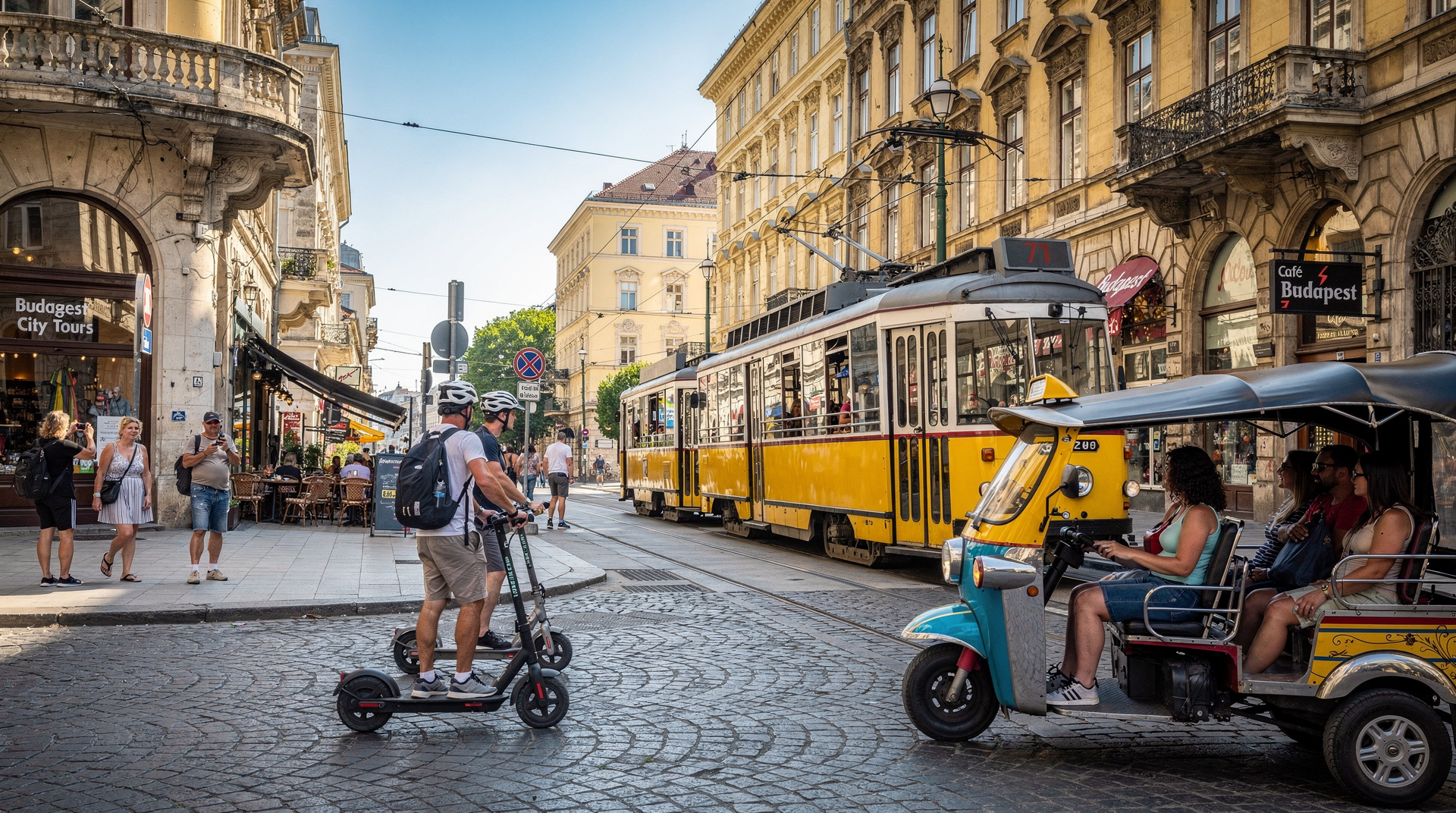
For further active tour options, the tuktuk and e-scooter tours guide covers alternatives that provide a sitting position for easier photography and phone use while moving.
Frequently asked questions about Segway tours in Budapest
Is it hard to ride a segway?
Most people are comfortable on a segway within 10–15 minutes of training. The learning curve is steep at first (leaning forward to accelerate feels counterintuitive) but the body adjusts quickly. Guides provide training before the tour departs and adjust pace to the group's comfort level. Very few participants cannot manage the basics.What is the minimum age for segway tours in Budapest?
Most operators set a minimum age of 12–14 and a minimum weight of 40–45 kg. Maximum weight is typically 100–120 kg. Check with the specific operator before booking.Are segway tours good for seeing Budapest?
For a first-time visitor who wants to cover broad ground efficiently, yes. A typical 2-hour tour sees Parliament, the Danube promenade, the Castle District approach, and the main Pest boulevards. The limitation is that you cannot stop spontaneously or diverge from the group route. For more flexible sightseeing, bikes or walking tours give more control.How much do segway tours cost in Budapest?
Standard group segway tours cost 10 000–15 000 HUF per person for a 2-hour tour. Private segway tours run 15 000–25 000 HUF per person or per couple depending on route length. Premium grand city tours covering both banks are at the upper end of these ranges.Can segway tours cross into the Castle District itself?
Most routes stay on the flat riverside and boulevards rather than climbing Castle Hill's steep cobbled streets, which are unsuitable for segways. Grand tours typically approach the Castle District from the Buda riverside for the view, then park at the base for anyone who wants to walk or take the funicular up separately.What happens if it rains during a booked segway tour?
Light rain doesn't usually stop a tour, but operators cancel or reschedule in heavy rain or storms for safety. Check the specific operator's weather policy when booking — most offer a reschedule rather than a cash refund, so build some flexibility into your itinerary if you're segwaying on a day with a mixed forecast.
Top experiences
Bookable activities with verified prices and instant confirmation on GetYourGuide.